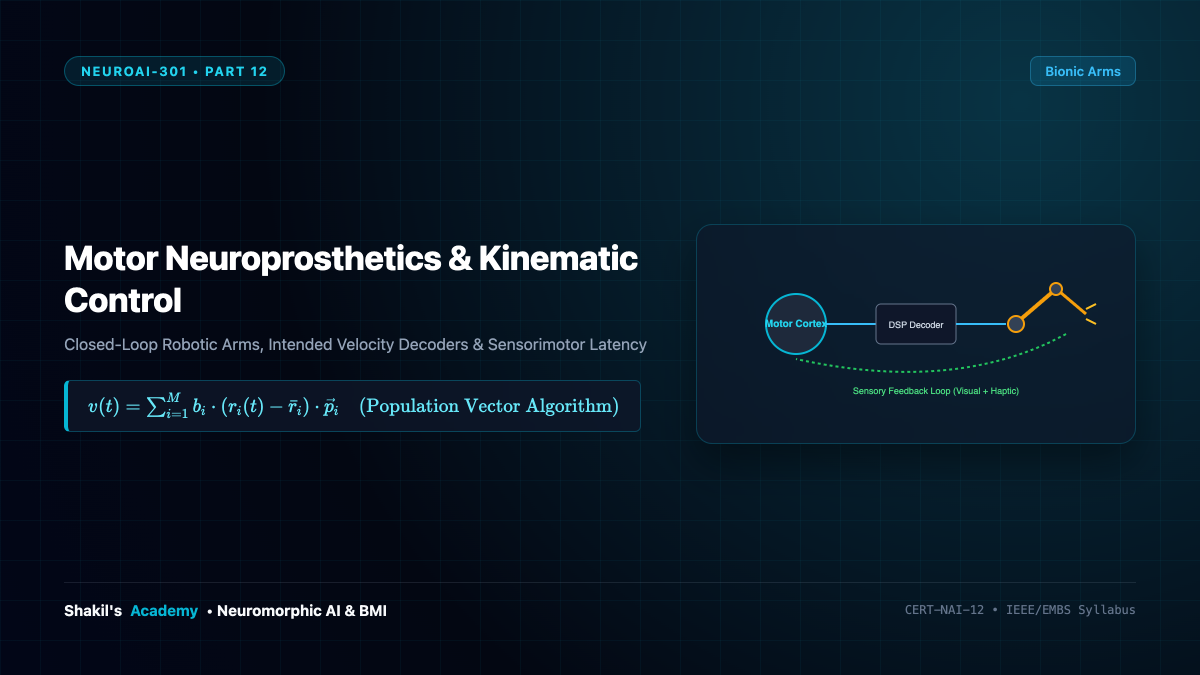
For millions of individuals living with complete tetraplegia, amyotrophic lateral sclerosis (ALS), or spinal cord injury, cognitive intellect remains fully intact while the motor communication pathways are severed. Motor Neuroprosthetics restore physical agency by routing voluntary movement intentions decoded from the primary motor cortex (( ext{M1})) directly to external prosthetic effectors: multi-articulated bionic limbs, functional electrical stimulation (FES) suits, and assistive computer interfaces. This part examines directional cosine tuning, multi-degree-of-freedom robotic control, and closed-loop sensorimotor latency constraints.
1. Georgopoulos Directional Cosine Tuning
In 1982, Apostolos Georgopoulos made the foundational discovery governing motor cortical decoding: single neurons in the primary motor cortex do not encode individual muscle contractions, but rather the overall intended direction of hand movement in 3D Cartesian space.
The firing rate (r_i) of neuron (i) varies as a sinusoidal function of movement angle ( heta):
[
r_i( heta) = b_i + k_i cos( heta – heta_i) = b_i + mathbf{w}_i cdot ec{v}
]
where (b_i) is the baseline firing rate, (k_i) is the modulation depth, ( heta_i) is the neuron’s Preferred Direction (the angle that evokes maximum firing), and (ec{v}) is the normalized velocity vector.
2. The Population Vector Algorithm (PVA)
Because any single neuron’s tuning curve is broad and ambiguous, the motor system represents velocity through the collective consensus of a neuronal ensemble. Georgopoulos introduced the Population Vector Algorithm (PVA):
[
ec{P}(t) = sum_{i=1}^{M} w_i(t) cdot ec{C}_i = sum_{i=1}^{M} left( rac{r_i(t) – b_i}{k_i}
ight) ec{C}_i
]
where (ec{C}_i) is the unit vector pointing in neuron (i)’s preferred direction. By summing the weighted contribution of all (M) neurons, the resultant vector (ec{P}(t)) points with remarkable accuracy in the exact direction of intended instantaneous hand velocity.
3. Multi-Degree-of-Freedom (7-DoF) Bionic Arm Control
In groundbreaking clinical milestones (BrainGate, Hochberg et al., 2012; Collinger et al., 2013 at the University of Pittsburgh), paralyzed tetraplegic patients with chronically implanted 96-channel Utah arrays achieved simultaneous control of high-dimensional robotic limbs:
- Kinematic State Vector (7 Degrees of Freedom):
[
mathbf{x} = left[ x, y, z, ext{roll}, ext{pitch}, ext{yaw}, ext{grasp aperture}
ight]^T
] - Patients successfully commanded the Modular Prosthetic Limb (MPL) to reach into 3D space, orient an anthropomorphic wrist, grasp a beverage container, bring it to their lips to sip through a straw, and return it to the table with a (91.6%) success rate.
- Neural Plasticity and Co-Adaptation: Over weeks of interaction, the patient’s biological motor cortex undergoes functional remapping (tuning curve modulation) to optimize control through the decoder, while machine learning decoders continuously re-estimate parameters ((mathbf{A}, mathbf{C})) in a mutual closed-loop co-adaptive handshake.
4. Sensorimotor Latency and the Stability Horizon
A closed-loop human-in-the-loop control system is subject to the Nyquist stability criterion. In a neuroprosthetic loop, latency accumulates across multiple physical stages:
| Pipeline Stage | Latency Duration | Physical Origin |
|---|---|---|
| Neural Integration & Binning | (20 ext{ to } 50 ext{ ms}) | Spiketrain accumulator window |
| Decoding & State Estimation | (5 ext{ to } 10 ext{ ms}) | Matrix multiplication & Kalman recursion |
| Robotic Bus & CAN Actuation | (10 ext{ to } 25 ext{ ms}) | Motor servo controllers & mechanical inertia |
| Visual Feedback Propagation | (150 ext{ to } 200 ext{ ms}) | Retino-geniculo-cortical visual processing latency |
| Total Closed-Loop Latency | (mathbf{185 ext{ to } 285 ext{ ms}}) | Total delay in sensory correction |
If the decoding delay exceeds (100 ext{ ms}), users experience severe overshoot oscillations (hunting behavior) when attempting to stop or fine-tune grasp grip force. Maintaining decoder loop latency under (50 ext{ ms}) is essential to achieve fluid, natural motor neuroprosthetic control.