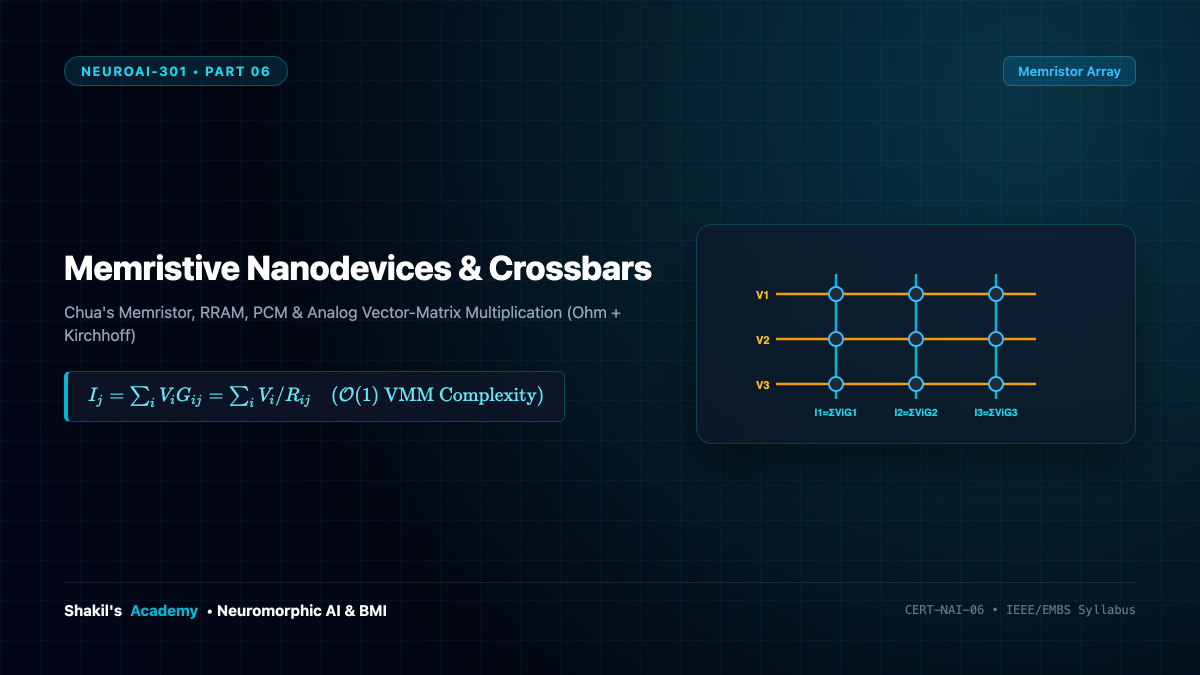
In 1971, UC Berkeley circuit theorist Leon Chua predicted on fundamental symmetry grounds that alongside the resistor, capacitor, and inductor, a missing fourth fundamental passive two-terminal circuit element must exist: the Memristor ((M = darphi / dq)). In 2008, HP Labs realized nanoscale titanium dioxide memristive switches. Today, Memristive Nanodevice Crossbar Arrays—implemented via Resistive RAM (RRAM) and Phase Change Memory (PCM)—provide the ultimate holy grail for neuromorphic AI: performing massive (mathcal{O}(1)) analog Vector-Matrix Multiplication (VMM) directly inside physical memory.
1. Leon Chua’s Theoretical Formulation
The four fundamental circuit variables—electric current (i), voltage (v), charge (q = int i dt), and magnetic flux linkage (arphi = int v dt)—define five pairwise mathematical relationships:
- (dq = i dt) and (darphi = v dt) (Integrals)
- (dv = R di) (Resistor)
- (dq = C dv) (Capacitor)
- (darphi = L di) (Inductor)
By mathematical completeness, there must exist a functional relation between magnetic flux (arphi) and electric charge (q): (f(arphi, q) = 0). Differentiating yields:
[
darphi = M(q) , dq implies v(t) = M(q) , i(t)
]
where (M(q)) is the Memristance (in Ohms). Chua generalized this to state-dependent non-linear dynamical systems:
[
v(t) = R(w, i) , i(t), qquad rac{dw}{dt} = f(w, i)
]
where (w) represents internal physical state variables (such as conductive filament length or amorphous-crystalline phase fraction).
2. Physical Implementations: RRAM and PCM
Two primary nanoscale non-volatile memory technologies power modern neuromorphic crossbars:
- Resistive RAM (Oxide-based RRAM): Consists of an insulating transition metal oxide thin film (( ext{HfO}_2, ext{TiO}_2, ext{TaO}_x), (sim 5 ext{ nm})) sandwiched between metal electrodes. Applying an electric field drives the migration of positively charged oxygen vacancies ((V_O^{bulletbullet})), forming a nanoscale metallic conductive filament that switches the device from a High Resistance State (HRS) to a Low Resistance State (LRS). Modulating current compliance produces multi-level analog conductance states ((G = 1/R)).
- Phase-Change Memory (PCM): Utilizes chalcogenide alloys (such as ( ext{Ge}_2 ext{Sb}_2 ext{Te}_5), GST). Electrical current pulses induce localized Joule heating:
- A short, high-voltage reset pulse melts the material, which rapidly quenches into an amorphous, high-resistance glass phase.
- A prolonged, intermediate set pulse heats the cell above crystallization temperature ((sim 160^circ ext{C})), restoring the highly conductive polycrystalline state.
3. Analog Vector-Matrix Multiplication via Ohm’s and Kirchhoff’s Laws
In standard GPU computing, computing the product of a matrix (W in mathbb{R}^{M imes N}) and vector (x in mathbb{R}^M) requires (mathcal{O}(M imes N)) discrete digital arithmetic instructions. In a memristor crossbar array, this entire operation is computed in a single physical step ((mathcal{O}(1)) time complexity) using fundamental laws of electrodynamics:
- Input vector values (V_i) are applied as analog voltage pulses across the horizontal wordlines.
- At each intersection ((i, j)), the memristor possesses conductance (G_{ij} = w_{ij}). By Ohm’s Law, the current passing through the device is:
[
I_{ij} = V_i cdot G_{ij}
] - The vertical bitlines tie all crosspoint currents together. By Kirchhoff’s Current Law (KCL), the total output current accumulating at column (j) is the exact dot product:
[
I_j = sum_{i=1}^{M} I_{ij} = sum_{i=1}^{M} V_i G_{ij}
]
The matrix multiplication is completed instantly at the speed of electromagnetic propagation across the wire, consuming near-zero dynamic energy compared to digital arithmetic registers.
4. Non-Idealities: Parasitic Wire Resistance and Device Variability
Translating memristor crossbars into commercial hardware requires overcoming significant physical non-idealities:
- Sneak Path Currents: Unselected cells in passive arrays draw leakage current. This is mitigated by integrating a non-linear selector device (1T1R or 1S1R architectures).
- Conductance Drift: In PCM, amorphous GST undergoes structural relaxation, causing resistance to increase over time following a power law: (G(t) = G_0 (t/t_0)^{-
u}). - Cycle-to-Cycle and Device-to-Device Variability: Stochastic oxygen vacancy migration produces statistical conductance spread ((sigma_G / mu_G sim 5% ext{ to } 20%)), necessitating hardware-aware noise-tolerant training algorithms.