In 1952, Alan Hodgkin and Andrew Huxley published a landmark series of papers on the giant axon of the Atlantic squid (Loligo pealeii), establishing the biophysical and mathematical foundation of cellular neurophysiology. By applying voltage-clamp techniques, they discovered that action potentials are generated by voltage-gated ion channels undergoing non-linear conductance shifts. Their Nobel Prize-winning Hodgkin-Huxley (HH) Model remains the gold standard for all conductance-based computational models of excitable membranes.
1. The Equivalent Electrical Circuit of the Cell Membrane
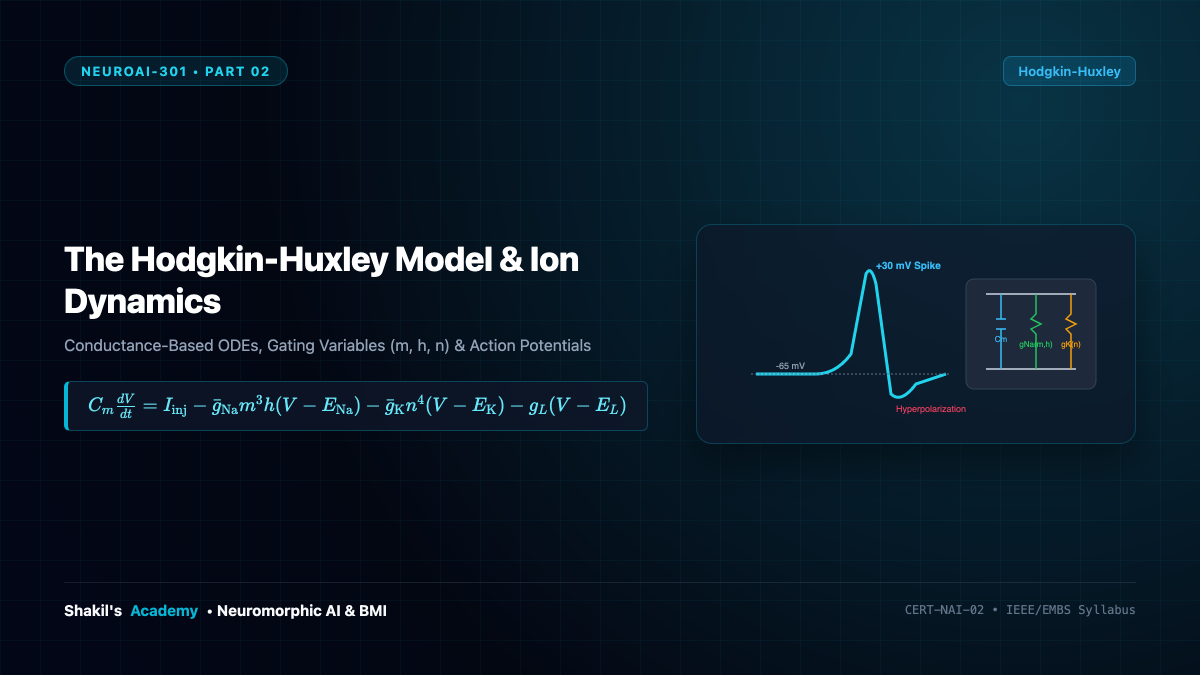
A biological cell membrane consists of an insulating phospholipid bilayer approximately (3 ext{ to } 5 ext{ nm}) thick, studded with embedded macromolecular ion channel proteins. Electrically, this is equivalent to a parallel circuit composed of:
- A membrane capacitance (C_m approx 1 mu ext{F/cm}^2), representing the dielectric charge separation between the intracellular and extracellular electrolytes.
- Voltage-dependent non-linear conductances for Sodium (( ext{Na}^+)) and Potassium (( ext{K}^+)) ions.
- A voltage-independent passive Leak conductance ((g_L)) primarily mediated by Chloride (( ext{Cl}^-)) ions.
- Direct-current Nernst equilibrium batteries ((E_{ ext{Na}}, E_{ ext{K}}, E_L)) maintained by ATP-driven ion pumps (( ext{Na}^+/ ext{K}^+)-ATPase).
Applying Kirchhoff’s Current Law, the total transmembrane current per unit area (I_m) is the sum of the capacitive displacement current and the ionic currents:
[
C_m rac{dV}{dt} = I_{ ext{inj}} – I_{ ext{Na}} – I_{ ext{K}} – I_L
]
where the ionic currents are given by Ohm’s law governed by their reversal potentials:
[
I_{ ext{Na}} = g_{ ext{Na}}(V, t) (V – E_{ ext{Na}}), quad I_{ ext{K}} = g_{ ext{K}}(V, t) (V – E_{ ext{K}}), quad I_L = g_L (V – E_L)
]
2. Non-Linear Gating Variables: (m, h, n)
Hodgkin and Huxley deduced that the macroscopic conductances are proportional to the open probabilities of microscopic molecular sub-gates:
- Potassium Conductance ((g_{ ext{K}})): Controlled by four identical, independent activation particles (n):
[
g_{ ext{K}}(V, t) = bar{g}_{ ext{K}} , n^4
] - Sodium Conductance ((g_{ ext{Na}})): Controlled by three activation particles (m) and one independent inactivation particle (h):
[
g_{ ext{Na}}(V, t) = bar{g}_{ ext{Na}} , m^3 h
]
Each gating variable (x in {m, h, n}) represents the probability ((0 le x le 1)) of finding the gate in its open state, governed by a first-order kinetic differential equation:
[
rac{dx}{dt} = alpha_x(V)(1 – x) – beta_x(V) x = rac{x_infty(V) – x}{ au_x(V)}
]
where the steady-state activation (x_infty(V)) and voltage-dependent time constant ( au_x(V)) are:
[
x_infty(V) = rac{alpha_x(V)}{alpha_x(V) + beta_x(V)}, qquad au_x(V) = rac{1}{alpha_x(V) + beta_x(V)}
]
3. Empirical Voltage-Dependent Rate Constants
Through exhaustive empirical curve-fitting at (6.3^circ ext{C}), Hodgkin and Huxley established the rate equations (with membrane potential (V) in millivolts):
[
alpha_m(V) = rac{0.1(V + 40)}{1 – xp(-(V + 40)/10)}, quad beta_m(V) = 4 xp(-(V + 65)/18)
]
[
alpha_h(V) = 0.07 xp(-(V + 65)/20), quad beta_h(V) = rac{1}{1 + xp(-(V + 35)/10)}
]
[
alpha_n(V) = rac{0.01(V + 55)}{1 – xp(-(V + 55)/10)}, quad beta_n(V) = 0.125 xp(-(V + 65)/80)
]
Typical standard parameters for squid axon are: (C_m = 1.0 mu ext{F/cm}^2), (bar{g}_{ ext{Na}} = 120 ext{mS/cm}^2), (bar{g}_{ ext{K}} = 36 ext{mS/cm}^2), (g_L = 0.3 ext{mS/cm}^2), (E_{ ext{Na}} = +50 ext{mV}), (E_{ ext{K}} = -77 ext{mV}), and (E_L = -54.4 ext{mV}).
4. The Four Phases of the Action Potential
The non-linear coupled system of four ordinary differential equations ((V, m, h, n)) produces the stereotypical all-or-none spike:
- Resting State: Near (-65 ext{ mV}), (m) is tiny ((approx 0.05)), (h) is high ((approx 0.6)), and (n) is low ((approx 0.32)). Potassium leak maintains negative polarization.
- Explosive Depolarization: A stimulus pushes (V) past threshold ((approx -55 ext{ mV})). The activation variable (m) responds almost instantaneously (( au_m < 0.2 ext{ ms})), opening ( ext{Na}^+) channels. The rapid inward ( ext{Na}^+) flux depolarizes the membrane further, creating a runaway positive feedback loop (Hodgkin cycle) driving (V) toward (+30 ext{ mV}).
- Repolarization: Delayed by higher time constants (( au_h, au_n sim 1 ext{ to } 5 ext{ ms})), the inactivation particle (h) shuts the ( ext{Na}^+) channels, while activation variable (n) opens the delayed rectifier ( ext{K}^+) channels. Massive outward ( ext{K}^+) current rapidly restores membrane negativity.
- Hyperpolarization & Refractory Period: ( ext{K}^+) channels remain open briefly, pulling (V) toward (E_{ ext{K}} = -77 ext{ mV}). Until (h) de-inactivates, the neuron is in an Absolute Refractory Period, enforcing unidirectional propagation and placing an upper limit on firing rates ((sim 500 ext{ Hz})).