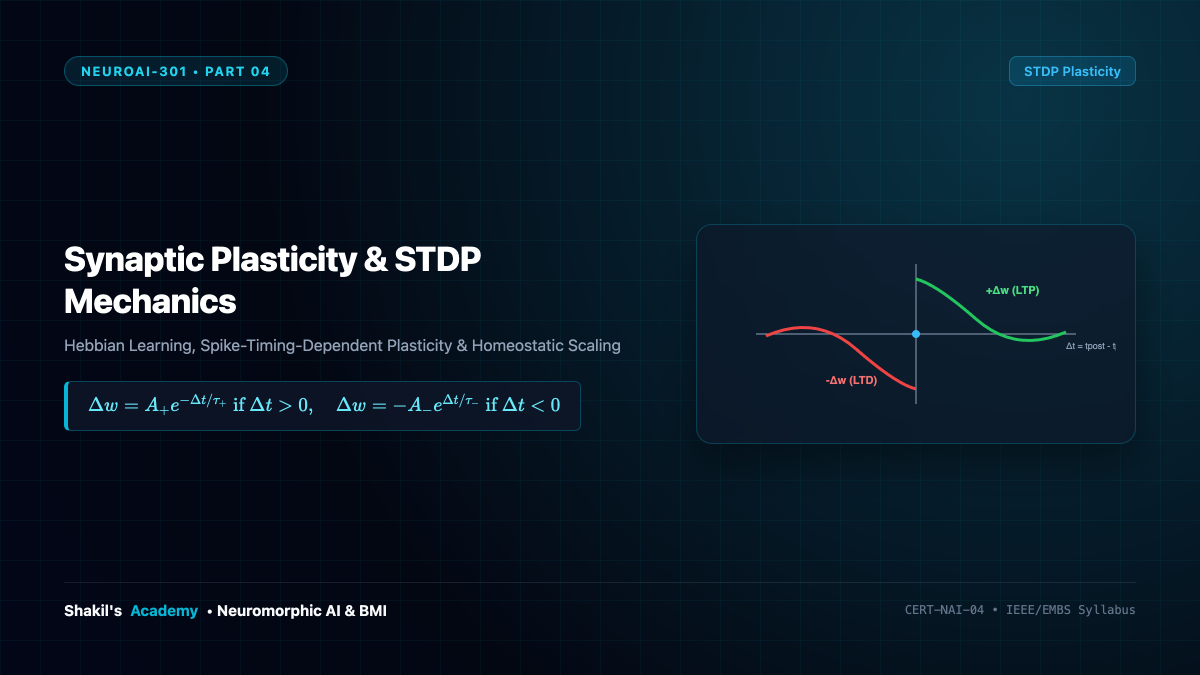
In 1949, Canadian psychologist Donald Hebb formulated the fundamental postulate of neural learning: “Neurons that fire together, wire together.” In the late 1990s, Henry Markram, Bi, and Poo demonstrated that biological synaptic modification depends exquisitely on the precise relative millisecond timing of pre-synaptic and post-synaptic action potentials. This phenomenon, known as Spike-Timing-Dependent Plasticity (STDP), provides the primary unsupervised, local learning rule implemented in neuromorphic hardware.
1. The Classic Bi-Phasic STDP Learning Rule
Let (t_{ ext{pre}}) denote the arrival time of a spike from the presynaptic neuron, and (t_{ ext{post}}) denote the time at which the postsynaptic neuron fires. The timing difference is defined as:
[
Delta t = t_{ ext{post}} – t_{ ext{pre}}
]
The change in synaptic conductance weight (Delta w) follows a striking bi-phasic exponential curve:
[
Delta w = begin{cases}
A_+ xpleft(-rac{Delta t}{ au_+}
ight) & ext{if } Delta t > 0 quad ( ext{Long-Term Potentiation, LTP})
-A_- xpleft(rac{Delta t}{ au_-}
ight) & ext{if } Delta t < 0 quad ( ext{Long-Term Depression, LTD})
nd{cases}
]
In mammalian cortical synapses, typical empirical parameters are: (A_+ approx 0.01), (A_- approx 0.0105) (slightly depression-dominant for stability), and time constants ( au_+ approx au_- approx 20 ext{ ms}).
2. Biophysical Basis: The NMDA Receptor Coincidence Detector
The molecular mechanics underlying STDP depend fundamentally on the biophysics of the post-synaptic N-methyl-D-aspartate (NMDA) receptor:
- Causal Pairing ((Delta t > 0), LTP): The presynaptic spike releases glutamate into the synaptic cleft, binding to NMDA receptors. Immediately afterward, the postsynaptic action potential depolarizes the dendritic membrane, expelling the magnesium ion (( ext{Mg}^{2+})) blocking the NMDA pore. This allows a massive influx of Calcium (( ext{Ca}^{2+})) ions, activating CaMKII kinase cascades that insert additional AMPA receptors into the postsynaptic density, permanently strengthening the synapse.
- Anti-Causal Pairing ((Delta t < 0), LTD): The postsynaptic spike arrives first, depolarizing the membrane and expelling ( ext{Mg}^{2+}). However, by the time presynaptic glutamate arrives, the membrane has already repolarized and ( ext{Mg}^{2+}) has returned. Only a minor, slow ( ext{Ca}^{2+}) influx occurs, activating calcineurin and protein phosphatase 1 (PP1), resulting in AMPA receptor internalization and synaptic weakening.
3. Triplet and Multi-Spike STDP Formulations
Pairwise STDP fails to account for high-frequency burst firing where spike interactions are non-linear. Pfister and Gerstner (2006) introduced the Triplet STDP Model, incorporating two presynaptic and two postsynaptic traces:
[
rac{dw}{dt} = -o_1(t) left[ A_2^- + A_3^- r_2(t – psilon)
ight] sum_f delta(t – t^{(f)}_{ ext{pre}}) + r_1(t) left[ A_2^+ + A_3^+ o_2(t – psilon)
ight] sum_n delta(t – t^{(n)}_{ ext{post}})
]
This formulation successfully accounts for firing rate dependence (transitioning from LTD to LTP at high frequencies), enabling stable self-organizing feature extraction in spiking neural networks.
4. Homeostatic Synaptic Scaling and Stability
Pure Hebbian plasticity is inherently unstable: synapses that cause firing get strengthened, increasing future firing probability in an uncontrolled positive feedback runaway until all weights saturate at (w_{ ext{max}}). The brain prevents this catastrophe through Homeostatic Synaptic Scaling (Turrigiano, 1998):
[
rac{dw_i}{dt} = ext{STDP}(w_i) – gamma , w_i , (
u_{ ext{post}} –
u_{ ext{target}})
]
where (
u_{ ext{post}}) is the running average firing rate and (
u_{ ext{target}}) is the biological setpoint. If a neuron becomes hyper-active, all incoming synaptic weights are scaled down multiplicatively, preserving relative weight distributions while maintaining network stability.