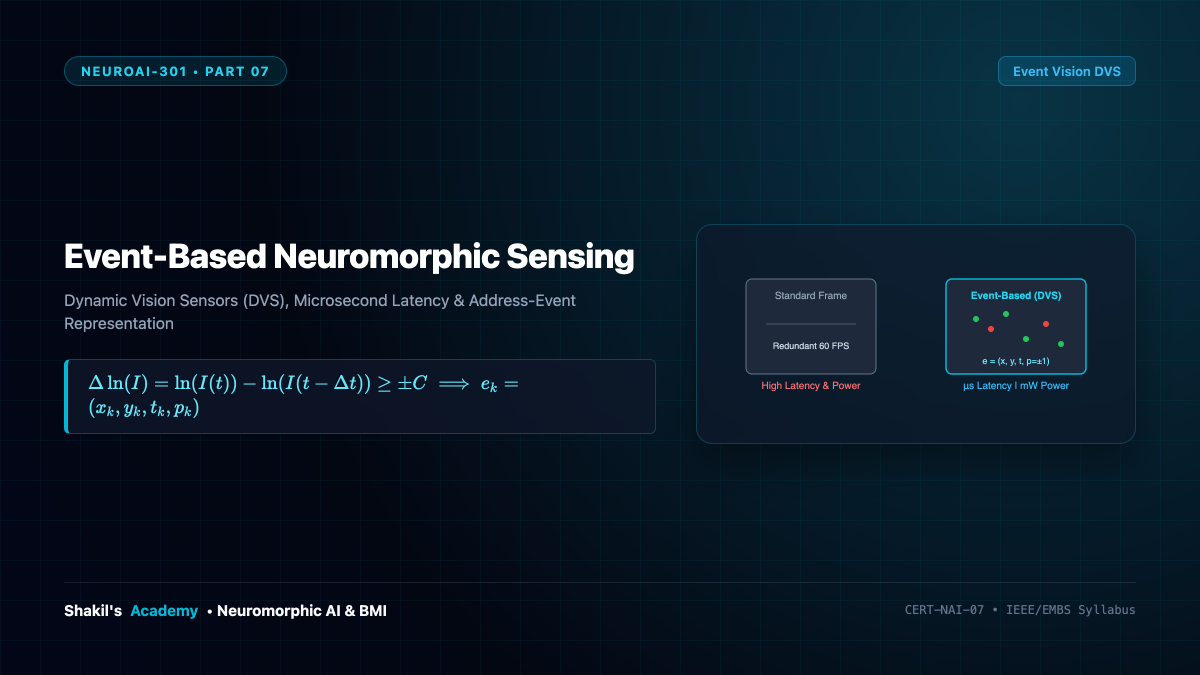
Standard digital cameras operate on an archaic 19th-century cinematic illusion: capturing arbitrary static snapshot frames at fixed periodic intervals (e.g., 30 or 60 frames per second). This frame-based paradigm produces massive spatial and temporal data redundancy, consumes excessive power, suffers from motion blur, and lacks dynamic range. In contrast, biological retinas transmit no frames whatsoever; each individual photoreceptor responds asynchronously to continuous changes in local scene reflectance. This biological principle powers Event-Based Neuromorphic Sensors: the Dynamic Vision Sensor (DVS) and the silicon cochlea.
1. Pixel Architecture of the Dynamic Vision Sensor (DVS)
Invented by Patrick Lichtsteiner, Christoph Posch, and Tobi Delbruck (2008), every independent pixel in a DVS circuit comprises three continuous analog stages:
- Logarithmic Photoreceptor: A photodiode produces a photocurrent (I_{ ext{ph}}) proportional to incident illuminance (I). Subthreshold MOSFETs compress this current logarithmically:
[
V_{ ext{pr}} = V_0 + U_T ln(I_{ ext{ph}})
]
Taking the logarithm guarantees that scene contrast changes (Delta ln(I) = Delta I / I) are independent of absolute ambient illumination levels (from starlight to direct sunlight). - Differencing Amplifier & Temporal High-Pass Filter: A switched-capacitor circuit amplifies changes in (V_{ ext{pr}}) while rejecting constant DC background levels with an adaptive time constant.
- Dual Threshold Comparators: Two continuous-time comparators monitor the voltage change (Delta V). If the change exceeds an ON threshold ((+ heta_{ ext{ON}})) or an OFF threshold ((- heta_{ ext{OFF}})), the pixel fires an event:
[
Delta ln(I(t)) = ln(I(t)) – ln(I(t_{ ext{last}})) ge pm C
]
2. The Spatio-Temporal Event Stream
When a threshold is exceeded, the pixel requests access to an asynchronous arbiter, transmits its coordinate payload, and immediately resets its baseline voltage. The output is not a 2D matrix of pixel brightnesses, but a continuous asynchronous stream of discrete Events:
[
e_k = (x_k, y_k, t_k, p_k)
]
where ((x_k, y_k)) are spatial pixel coordinates, (t_k) is the microsecond-accurate timestamp ((1 mu ext{s}) temporal resolution), and (p_k in {+1, -1}) is the polarity bit (increase or decrease in brightness).
| Metric / Feature | Standard Frame-Based CMOS Camera | Neuromorphic Dynamic Vision Sensor (DVS) |
|---|---|---|
| Temporal Resolution / Latency | (16.6 ext{ to } 33.3 ext{ ms}) (30-60 FPS) | (1 ext{ to } 10 mu ext{s}) (Equivalent to > 10,000 FPS) |
| Dynamic Range | (60 ext{ dB}) (Saturation in harsh sunlight) | (> 120 ext{ to } 140 ext{ dB}) (Starlight to direct sun) |
| Data Redundancy | High (Transmits static backgrounds repeatedly) | Near-Zero (Zero data generated if scene is static) |
| Power Consumption | (1 ext{ to } 5 ext{ Watts}) | (5 ext{ to } 20 ext{ Milliwatts}) ((100 imes) lower) |
| Motion Blur | Severe in high-velocity dynamics | Virtually non-existent |
3. Neuromorphic Auditory Sensing: The Silicon Cochlea
The human inner ear (cochlea) is not a simple microphone recording pressure waveforms. Instead, the basilar membrane acts as a non-linear hydrodynamic frequency analyzer. High frequencies resonate near the base (oval window), while low frequencies propagate to the apex.
Pioneered by Carver Mead and Shih-Chii Liu, the Silicon Cochlea implements a cascade of continuous-time second-order bandpass filter sections (biquads) operating in weak inversion CMOS:
[
H_k(s) = rac{ au_k^2 s^2 + dots}{1 + rac{s}{Q omega_k} + rac{s^2}{omega_k^2}}
]
Each resonant filter tap drives an integrate-and-fire spike generator mimicking biological auditory nerve fibers. The sensor outputs an asynchronous AER spiketrain where each channel fires in phase with its resonant acoustic frequency component, achieving microsecond binaural sound localization with microwatts of power.
4. Event-Based Computer Vision Algorithms
Conventional convolutional neural networks (CNNs) cannot directly consume asynchronous event clouds without grouping them into artificial frame histograms. Native event-based algorithms process events sequentially:
- Time Surfaces (HAT, SAE): Maps an incoming event into a 2D exponential decay surface (Sigma(x, y) = xp(-(t – t_{ ext{last}}(x, y))/ au)), extracting local edge orientation and speed.
- Asynchronous Spiking Graph Networks: Treat events as spatio-temporal nodes in a dynamic directed graph, propagating activations only along active geometric trajectories.