For over one hundred and sixty million years—from the recovery of the Triassic to the cataclysmic impact at the end of the Cretaceous—the Mesozoic Era belonged to a singular, magnificent clade of diapsid reptiles: the Archosauria (“ruling reptiles”). While popular imagination celebrates dinosaurs for their towering stature, razor-sharp fangs, and armored crests, the true biological engine of their supremacy lay hidden deep within their thoracic cavities: an astonishing, unidirectional flow-through respiratory system of pulmonary air sacs. This respiratory super-engine enabled sauropods to engineer 70-tonne cantilever skeletons, drove theropod dinosaurs across continents, and ultimately transformed feathers from primitive thermal fuzz into the aerodynamic marvel of avian powered flight.
1. The Respiratory Super-Engine: Unidirectional Air-Sac Ventilation
In the aftermath of the Permian-Triassic extinction, the atmospheric concentration of molecular oxygen plummeted from a Carboniferous high of $30\%$ down to a suffocatingly low $12\text{–}15\%$—equivalent to standing at the summit of the Himalayas today. In this oxygen-starved world, our synapsid ancestors were crippled by their ancestral tidal respiratory system. In mammalian lungs, air travels in and out along the same dead-end alveolar passages, meaning newly inhaled air is constantly contaminated by stale, carbon-dioxide-rich residual air, capping oxygen extraction efficiency at barely $25\%$.
Archosaurs conquered this physiological crisis by inventing a continuous, unidirectional flow-through respiratory circuit powered by non-vascularized air sacs acting as bellows:
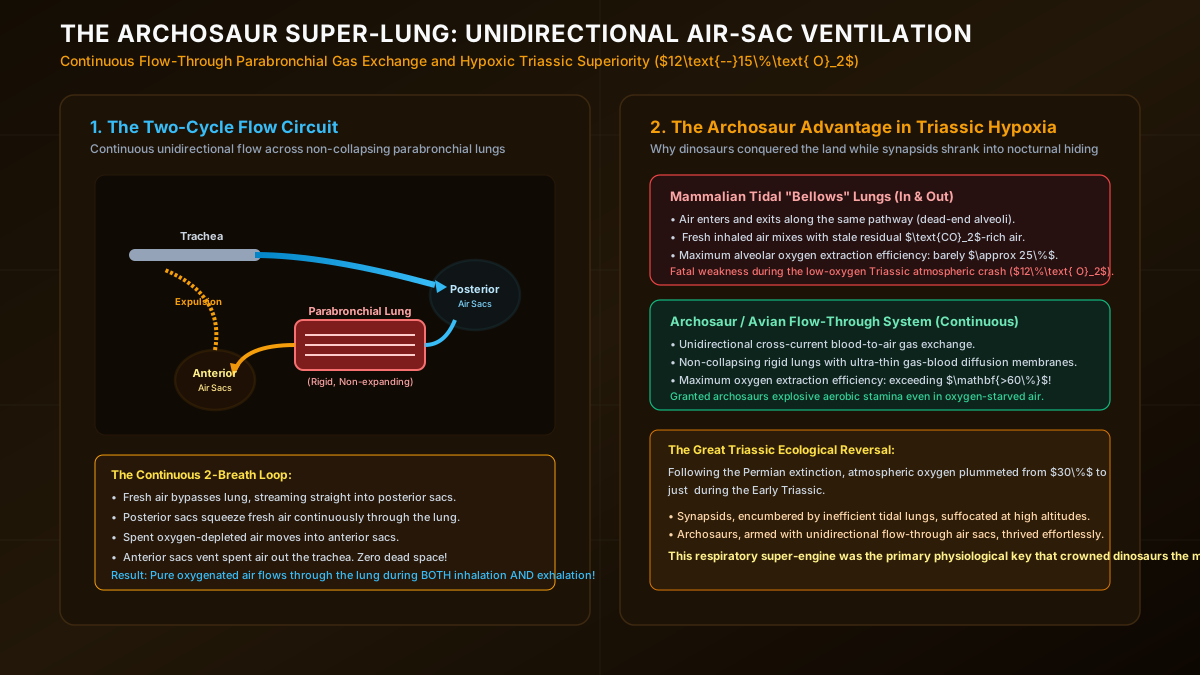
The system operates across a coordinated two-breath cycle:
- Breath 1 (Inhalation): Inhaled air bypasses the lung tissue entirely, streaming directly through the primary bronchus into the compliant posterior air sacs (abdominal and caudal thoracic sacs).
- Breath 1 (Exhalation): The posterior sacs contract, forcing a continuous stream of pure, oxygen-rich air forward through the rigid, non-expanding parabronchial lung. Here, blood capillaries cross the parabronchi in a counter-current or cross-current geometry, driving oxygen diffusion with maximum efficiency.
- Breath 2 (Inhalation): As the next volume of fresh air enters the posterior sacs, the spent, oxygen-depleted air in the lung is pulled forward into the anterior air sacs (clavicular and cranial thoracic sacs).
- Breath 2 (Exhalation): The anterior sacs contract, venting the spent air directly out through the trachea into the atmosphere.
Because fresh air flows unidirectionally through the parabronchi during both inhalation and exhalation, there is zero residual volume dead space. Oxygen extraction efficiency exceeds $60\%$. This single physiological breakthrough gave dinosaurs an explosive aerobic advantage over synapsids, driving stem-mammals into the nocturnal shadows while archosaurs exploded into terrestrial and aerial dominance.
2. Sauropod Gigantism: Postcranial Skeletal Pneumatization (PSP)
Armed with this respiratory system, the Saurischian branch of dinosaurs evolved the largest terrestrial animals ever to walk the Earth: the long-necked Sauropods (such as Argentinosaurus, Brachiosaurus, and Patagotitan), reaching lengths of over $35\text{ metres}$ and body masses exceeding $70\text{ metric tons}$.
Under the square-cube law of biomechanics, scaling up an animal isometrically creates a structural crisis: body mass scales with volume ($M \propto L^3$), whereas the weight-bearing cross-sectional area of bones scales only with area ($A \propto L^2$). If an elephant were scaled to the size of an Argentinosaurus, its solid bones would be so heavy its skeleton would crush under its own dead weight. How did sauropods build $12\text{-metre}$ cantilever necks without structural collapse?
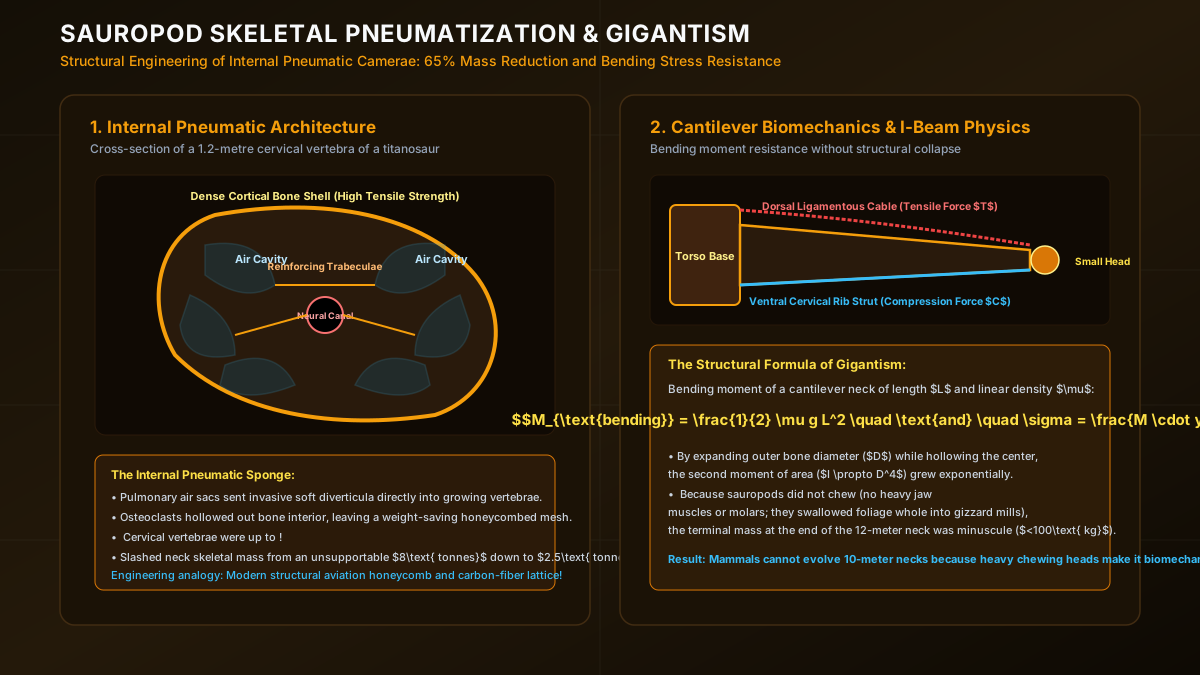
The secret lay in Postcranial Skeletal Pneumatization (PSP). Soft-tissue diverticula from the cervical and thoracic pulmonary air sacs actively infiltrated the growing vertebrae, excavating deep hollow cavities known as pneumatic camerae and camellae:
- CT scans reveal that the interior of sauropod vertebrae was up to $65\text{–}70\%$ air by volume, structured as a delicate, honeycombed lattice of paper-thin bony trabeculae.
- The exterior was reinforced by a dense, seamless cortical bone shell. In mechanical engineering, this mimics an optimized hollow tubular beam or an aviation honeycomb composite panel.
- By concentrating the solid bone mass at the outer perimeter (increasing the external diameter $D$), the second moment of area ($I \propto D^4$) expanded exponentially, conferring massive resistance against bending moments ($M = \sigma \cdot Z$) while slashing skeletal weight by more than half!
Furthermore, sauropods possessed another crucial exaptation: they did not chew. Because they lacked heavy molars and massive masseter jaw muscles, their skulls remained minuscule ($<100\text{ kg}$). A tiny head at the end of a lightweight, air-filled cantilever neck enabled sauropods to sweep a vast vertical and horizontal feeding envelope without taking a single step—a super-efficient grazing factory unmatched by any mammal.
3. Theropod Miniaturization & The Evolution of Feathers
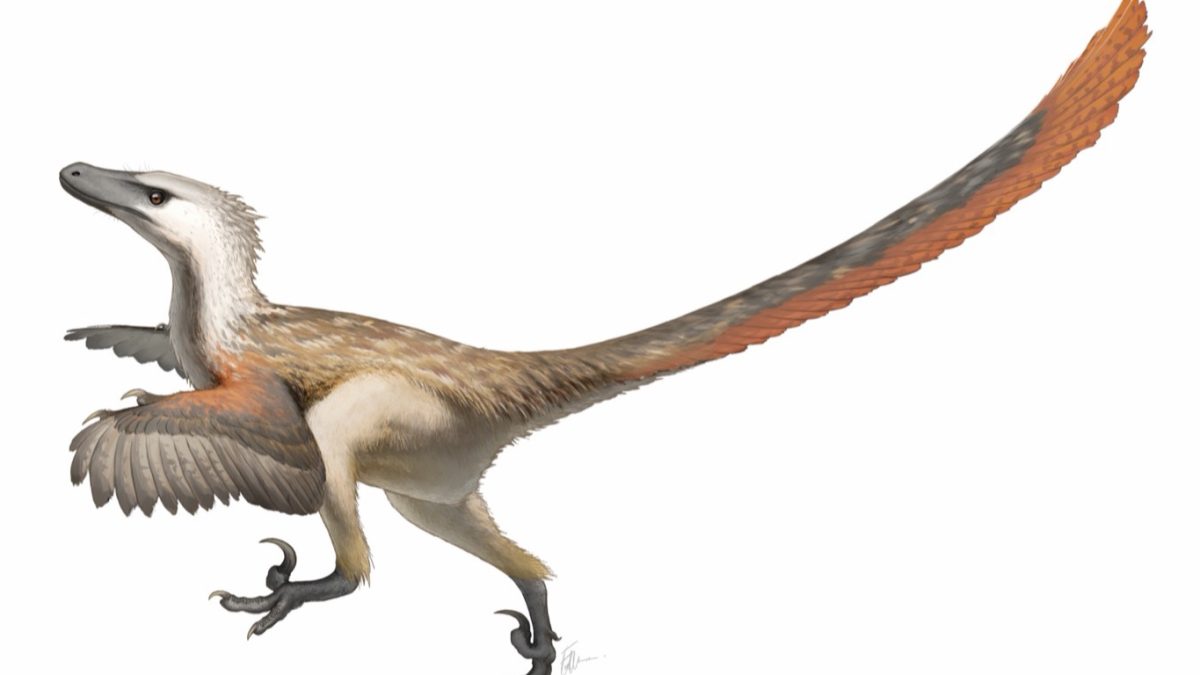
While sauropods pursued gigantism, the bipedal, carnivorous Theropod lineage took the opposite evolutionary path: progressive miniaturization. Beginning with basal coelurosaurs and progressing through maniraptorans, dromaeosaurs, and troodontids, theropod body sizes shrank over fifty million years, refining skeletal traits that would eventually take to the sky.
Central to this transition was the origin of feathers. In 2002, evolutionary ornithologist Richard Prum proposed the groundbreaking developmental and phylogenetic model of feather evolution, which was spectacularly corroborated by the feathered dinosaur fossils of Liaoning, China:
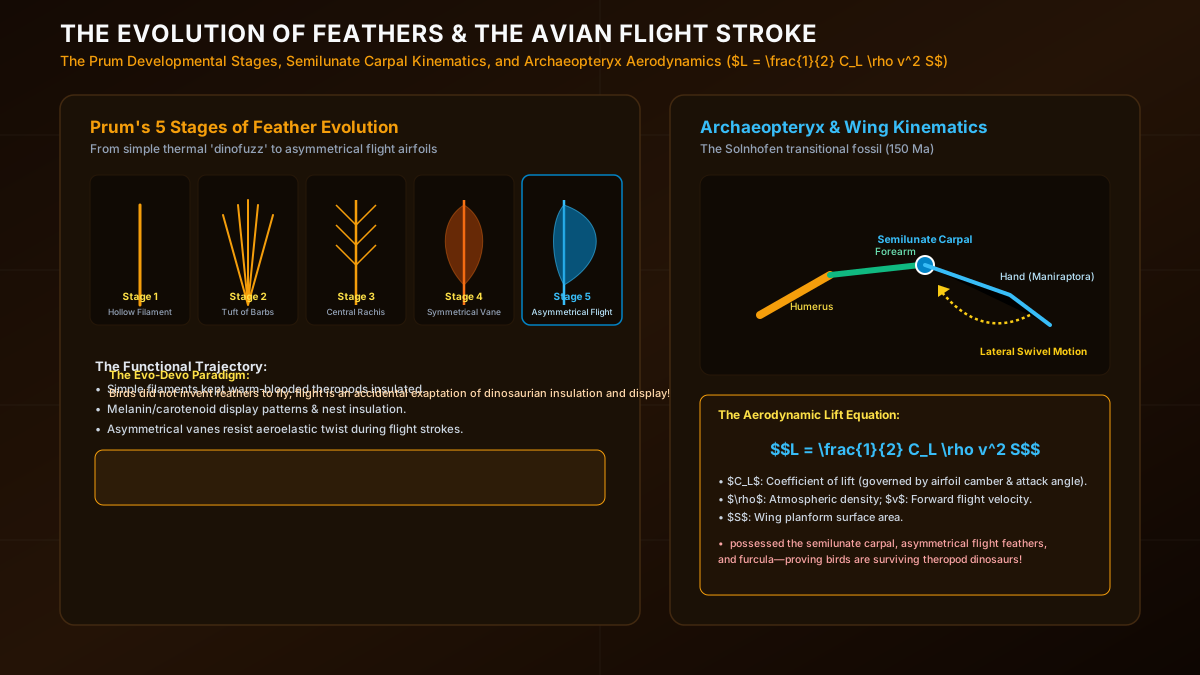
- Stage 1 (Hollow Filament): Unbranched cylindrical tubular follicles (“dinofuzz”) found in compsognathids like Sinosauropteryx. Its function was strictly thermal insulation for high-metabolic theropods.
- Stage 2 (Tuft of Barbs): Multiple unbranched barbs emerging from a single follicle collar base, forming down-like plumulaceous coats.
- Stage 3 (Helical Central Rachis): Fusion of barbs into a central shaft (rachis) with open lateral barbs (e.g., Beipiaosaurus).
- Stage 4 (Symmetrical Pennaceous Vane): Barbs evolved microscopic barbules equipped with hooklets (hamuli) that zipped adjacent barbs into a planar, wind-resistant vane. In dinosaurs like Caudipteryx and Oviraptor, these feathers bore colorful melanin bands used for sexual display, intimidation, and brooding eggs.
- Stage 5 (Asymmetrical Flight Airfoil): The central rachis shifted off-center, making the leading vane much narrower and stiffer than the trailing vane ($w_{\text{lead}} < w_{\text{trail}}$). Under aerodynamic load, this asymmetry prevents the feather from twisting upward, creating an effective lifting surface.
The Evolutionary Truth: Dinosaurs did not invent feathers to fly. Feathers evolved as thermal down jackets and vibrant display banners over one hundred million years before the first bird ever flapped into the Mesozoic sky!
4. Archaeopteryx & The Birth of Avian Flight
In 1861—barely two years after Charles Darwin published On the Origin of Species—quarrymen in the Late Jurassic Solnhofen limestone of Bavaria, Germany, split open a slab of lithographic stone to reveal the ultimate transitional fossil: Archaeopteryx lithographica ($150\text{ Ma}$).
Archaeopteryx was an anatomical marvel perfectly poised between non-avian theropod dinosaurs and crown birds:
- Dinosaurian Features: Sharp predatory teeth set in sockets, three free fingers with curved claws, a flat sternum lacking a deep keel, and a long, bony reptilian tail supported by 23 free caudal vertebrae.
- Avian Features: A fused wishbone (furcula) that functioned as an elastic spring during flapping, perching feet with a reversed hallux, and fully developed, asymmetrical Stage 5 flight feathers arranged on its wings in primary and secondary flight suites.
Crucially, Archaeopteryx and its dromaeosaurid cousins inherited a unique wrist bone from their predatory raptor ancestors: the semilunate carpal. Originally evolved in terrestrial hunters to execute a lightning-fast, two-handed grasping strike at prey, this half-moon-shaped bone permitted extreme lateral swiveling of the wrist. When feathered theropods extended this swiveling strike into the air, it became the mechanical basis for the aerodynamic downstroke and folding upstroke of avian flight!
According to the classical aerodynamic lift equation: $$L = \frac{1}{2} C_L \rho v^2 S$$ Where $C_L$ is the lift coefficient, $\rho$ is atmospheric density, $v$ is forward flight speed, and $S$ is wing planform area. With cambered asymmetrical feathers creating pressure differentials and the semilunate carpal driving the stroke, theropods crossed the boundary into true, powered aerodynamic flight.
The dinosaur empire had conquered the land and the sky. But sixty-six million years ago, a six-mile-wide mountain of rock and nickel-iron was hurtling toward the Yucatán Peninsula. The Mesozoic paradise was about to come to a sudden, apocalyptic end—and in the nuclear winter that followed, it was the small, shivering mammals living in the shadows that would inherit the Earth.