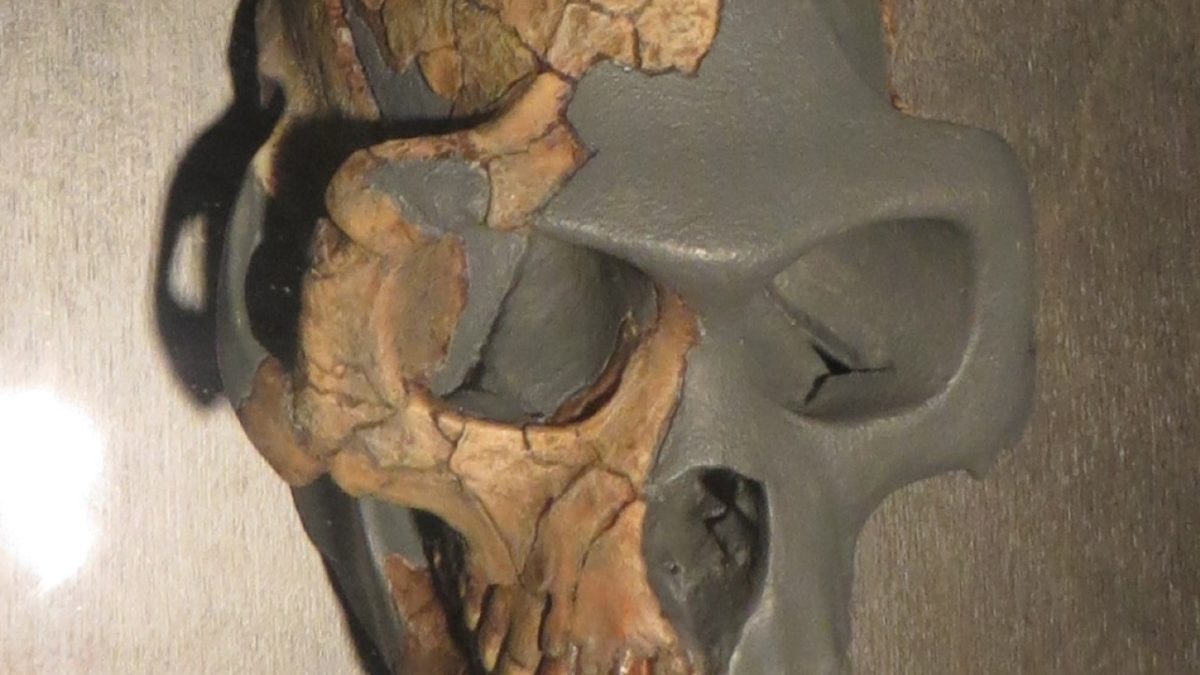
Between seven and eight million years ago, in the volatile tectonic cradle of equatorial Africa, our evolutionary journey crossed its ultimate Rubicon: the divergence of the human clade (tribe Hominini) from our closest living evolutionary cousins, the chimpanzees and bonobos (genus Pan). While our genomes remain $98.77\%$ identical at the single-nucleotide level, this speciation event initiated a morphological transformation unprecedented in mammalian history: the adoption of obligate habitual bipedalism. Abandoning knuckle-walking and four-limbed arboreal scurrying, our earliest ancestors stood upright upon two feet—a biomechanical revolution that reconstructed the pelvis, realigned the lower limb musculature, and permanently emancipated the forelimbs to manipulate the material world.
1. The Pan-Homo Divergence & The Molecular Clock
In 1871, Charles Darwin famously prophesied in The Descent of Man that because African gorillas and chimpanzees are anatomically closest to humans, Africa was the most probable cradle of human origins. A century later, molecular biology vindicated Darwin beyond his wildest dreams. By comparing homologous protein and DNA sequences, Allan Wilson and Vincent Sarich calibrated the Hominoid Molecular Clock, proving that humans and African apes did not diverge thirty million years ago (as paleoanthropologists had long assumed), but in the very late Miocene ($7\text{–}8\text{ Ma}$):
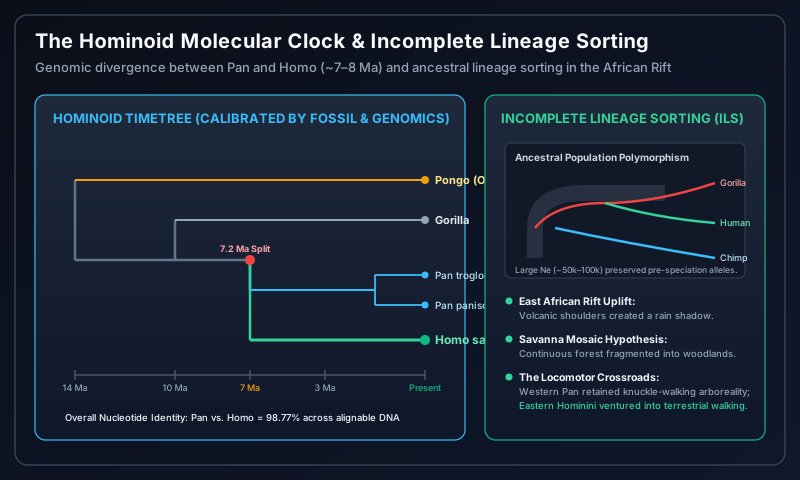
Incomplete Lineage Sorting (ILS)
Modern whole-genome sequencing has revealed a fascinating nuance of our ancestry: while the species tree clearly unites humans and chimpanzees as sister taxa, approximately $1.5\%$ of our individual gene trees cluster humans closer to gorillas than to chimpanzees! This phenomenon, known as Incomplete Lineage Sorting (ILS), occurs because the ancestral hominine population prior to the gorilla and chimpanzee splits was genetically vast ($N_e \approx 50,000\text{–}100,000\text{ individuals}$). Polymorphic ancestral alleles failed to coalesce prior to subsequent speciation nodes, preserving discordant gene phylogenies in our chromosomes today.
The Tectonic Engine: East African Aridification
What triggered this fateful split? Tectonic geophysicists point to the formation of the East African Rift System. Between 10 and 6 Ma, tectonic mantle plumes domed and fractured the African continental crust, elevating the western and eastern rift shoulders thousands of meters into the sky. These towering mountain chains created a devastating rain shadow: while moist Atlantic winds continued to nourish dense rainforests in the Congo Basin (where ancestral Pan evolved), eastern Africa grew progressively cooler, more seasonal, and arid.
The continuous rainforest fractured into a mosaic of closed gallery woodlands, seasonal scrub, and open savannas. In this fragmented landscape, ancestral hominins faced a life-or-death caloric challenge: finding sufficient food required traversing increasingly wide open terrestrial gaps between scattered groves of trees.
2. The Biomechanical Engine of Habitual Bipedalism
Walking upright on two hindlimbs is an exceptionally rare, mechanically perilous mode of locomotion. Birds achieve it horizontally with a stabilizing counterbalancing tail; only humans among living mammals balance an upright, vertical trunk directly over extended hindlimbs. Yet bipedalism proved to be a metabolic miracle:

The Inverted Pendulum Gait
Human bipedal walking operates on the physical principle of an Inverted Pendulum. During the stance phase of every step, the center of mass ($COM$) vaults over a rigid stance leg like an inverted pendulum. At the crest of the vault, forward kinetic energy ($E_k$) is converted into gravitational potential energy ($E_p$); as the body falls forward into the next step, potential energy is converted back into kinetic energy.
Biomechanical studies by Herman Pontzer and David Raichlen revealed that this mechanical exchange achieves $\sim 70\%$ energy recovery efficiency. In contrast, chimpanzee knuckle-walking requires continuous muscular effort with zero inverted-pendulum energy exchange, burning four times more calories per kilometer than a walking human! In an aridifying African landscape where food was dispersed, bipedalism provided our ancestors with a four-fold expansion of their foraging range on the same caloric intake.
The Pelvic Revolution and Gluteal Reorientation
Achieving this efficient gait required reconstructing the ancestral pelvis from the ground up:
- Coronal to Sagittal Curvature: In quadrupeds and chimpanzees, the iliac blades are tall, flat, and positioned in the coronal (frontal) plane along the back. In humans, the iliac blades shortened, broadened, and twisted forward into the sagittal plane, forming a bowl-shaped pelvic basin that cradles the abdominal viscera.
- The Lesser Gluteal Transformation: In chimpanzees, the gluteus medius and gluteus minimus muscles attach behind the hip joint, acting purely as hip extensors (propelling the leg backward). In humans, because the ilium curves around the hip, these muscles insert onto the greater trochanter of the femur laterally, transforming into powerful hip abductors.
- Preventing Trendelenburg Collapse: During bipedal walking, when one foot swings forward, gravity pulls the unsupported pelvis downward. In humans, the stance-leg gluteus medius contracts vigorously, pulling down on the ilium and locking the pelvis level. Without this adaptation (as seen in clinical Trendelenburg gait), a biped topples sideways at every step.
The Bicondylar (Valgus) Angle
In apes, the femur drops straight down from the hip joint at a $0^\circ$ angle. Consequently, when an ape stands on one foot, its foot is placed wide of its center of mass, requiring an awkward, energy-wasting side-to-side waddle. Humans evolved a distinct bicondylar (valgus) angle of $9\text{–}10^\circ$: the femoral shaft slants inward toward the knee, bringing the knees and feet directly beneath the body’s center of mass, eliminating lateral sway entirely.
3. The Fossil Pioneers: Sahelanthropus, Orrorin, and Ardipithecus
For decades, skeptics argued that bipedalism could not have originated prior to four million years ago. But between 2000 and 2009, paleontologists unearthed three monumental Late Miocene and Early Pliocene fossil hominins that pushed the origin of our lineage back past seven million years:
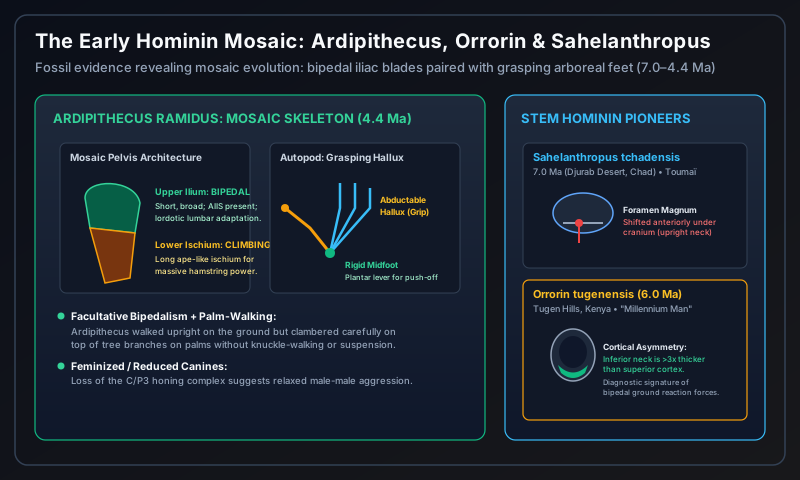
1. Sahelanthropus tchadensis (7.0 Ma, Chad)
Discovered in 2001 by Michel Brunet in the Toros-Menalla desert of Chad, the fossil cranium TM 266-01-060 (“Toumaï”) is the oldest known putative hominin. While possessing a chimp-sized brain ($360\text{–}370\text{ cm}^3$), Toumaï exhibits two astonishing derived hominin features:
- The foramen magnum (the great hole where the spinal cord exits the skull) is positioned forward toward the center of the cranial base and angled horizontally downward, proving the head was balanced atop a vertical, bipedal cervical spine rather than projecting horizontally as in quadrupedal apes.
- The canine teeth are significantly reduced and blunt, lacking the self-sharpening C/P3 honing complex of apes—indicating relaxed male-male sexual competition.
2. Orrorin tugenensis (6.0 Ma, Kenya)
Discovered in 2000 by Brigitte Senut and Martin Pickford in the Lukeino Formation of Kenya, “Millennium Man” is represented by fragmentary postcrania, including proximal femora (BAR 1002’00). High-resolution CT scans revealed that the femoral neck cortical bone distribution is distinctly human: the cortical bone along the inferior margin of the neck is over three times thicker than the superior margin. This asymmetric thickening is a direct biomechanical adaptation to resist the compressive bending stresses generated by habitual bipedal ground reaction forces.
3. Ardipithecus ramidus (4.4 Ma, Ethiopia) — The “Ardi” Revelation
In 2009, Tim White, Owen Lovejoy, Berhane Asfaw, and their team published the comprehensive analysis of ARA-VP-6/500 (“Ardi”), a female skeleton preserved in the volcanic ash of Aramis, Ethiopia. Ardi revealed the true ancestral morphotype of our lineage: Mosaic Evolution in its purest form:
- The Mosaic Pelvis: The upper ilium was broad and short with an anterior inferior iliac spine (AIIS), positioning the abductors for bipedal walking. Yet the lower ischium remained long and robust, preserving the deep attachment for massive arboreal climbing hamstrings.
- The Grasping Foot with a Bipedal Lever: Ardi possessed a fully divergent, abductable big toe (hallux) that stuck out at a right angle like a chimpanzee’s, allowing her to grasp branches securely. However, the four lateral metatarsals and tarsal bones (especially the os peroneum) were stiffened into a rigid plantar plate, enabling her to push off the ground bipedally without collapsing the midfoot.
4. The Death of the Savanna Hypothesis
For nearly a century, textbook anthropology taught that bipedalism was invented when our ancestors stepped out of the forests onto vast, grassy African plains (the classical “Savanna Hypothesis”). The discovery of Ardipithecus obliterated this myth.
Paleobotanical analysis of fossil seeds, phytoliths, and thousands of fossil mammals excavated alongside Ardi revealed that Aramis was not an open savanna at all—it was a closed, dense, subtropical woodland populated by colobine monkeys, tragelaphin bovids (kudus), and hackberry trees. Ardipithecus did not evolve bipedalism on the open savanna; she was a facultative biped who walked upright along broad tree limbs and foraged on the woodland floor.
Bipedalism did not begin as an adaptation for running across grasslands. It began in the trees and woodlands as a slow, deliberate foraging adaptation—freeing hands to carry fruit, offspring, and tools. When the climate dried even further in the Pliocene, this woodland bipedal toolkit would undergo its next great leap forward in the savanna mosaic with the emergence of the Australopithecines.