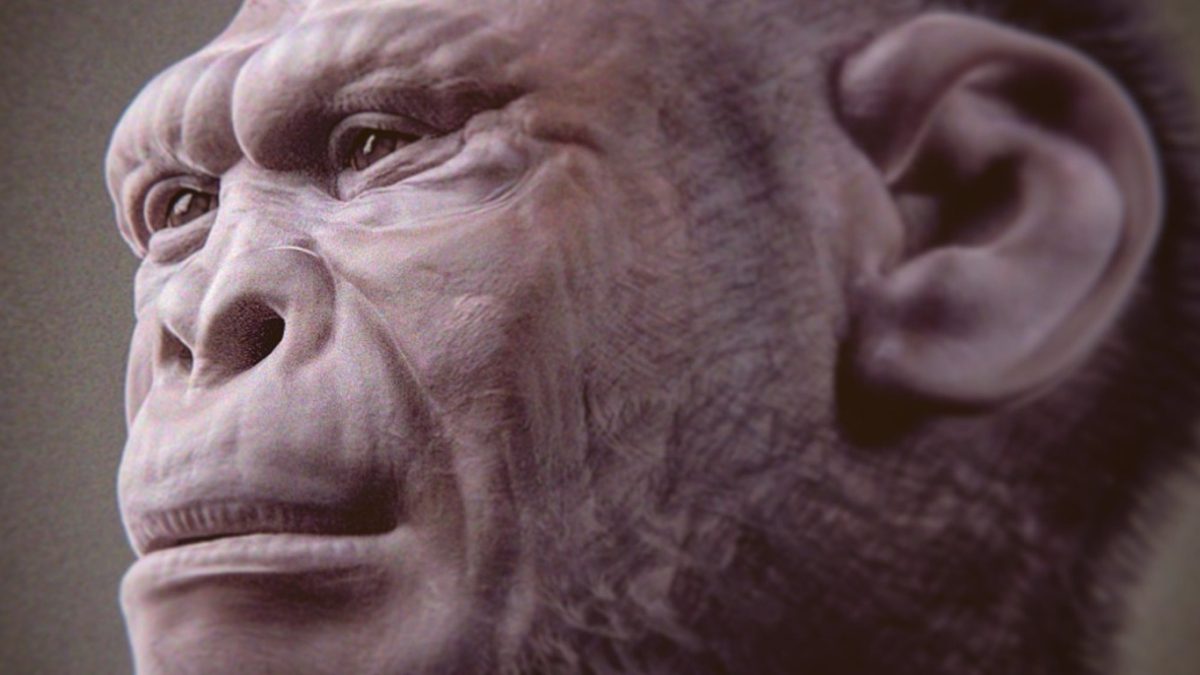
Two million eight hundred thousand years ago, during a period of intense global cooling and African aridification, our evolutionary lineage crossed the most momentous threshold in the history of life on Earth: the emergence of our own genus, Homo. Faced with the collapse of tropical forest resources, early members of Homo did not develop giant chewing teeth like their cousins Paranthropus. Instead, they invented an entirely new evolutionary strategy: Lithic Technology. By understanding the fracture physics of stone, they outsourced biological digestion outside their bodies. Armed with razor-sharp Oldowan stone flakes, they breached an uncontested ecological goldmine—the calorie-dense, fatty bone marrow sealed inside the limb bones of megafaunal carcasses. This nutritional bonanza unlocked the metabolic energy necessary to fuel the greatest neurological expansion in mammalian history.
1. The Earliest Homo and Craniodental Transformation
In 2013, Ethiopian researcher Chalachew Seyoum discovered a fossilized left mandibular fragment in the Ledi-Geraru badlands of Afar, Ethiopia. Cataloged as LD 350-1 and securely dated to $2.80\text{–}2.75\text{ million years ago}$, this jawbone pushed the origin of the genus Homo back by nearly half a million years. Combining primitive australopithecine-like anterior symphyseal contours with derived, slender Homo-like molars and a uniform mandibular corpus, LD 350-1 represents the morphological dawn of our genus.
By $2.0\text{–}1.8\text{ Ma}$, at Olduvai Gorge in Tanzania and Koobi Fora in Kenya, early Homo had diversified into two classic lineages:
- Homo habilis (“Handy Man”): First named by Louis Leakey, Phillip Tobias, and John Napier in 1964 from holotype OH 7 (a juvenile parietals and hand skeleton) and beautifully preserved cranium KNM-ER 1813. Brain size jumped from the australopithecine average of $\sim 430\text{ cm}^3$ to $510\text{–}650\text{ cm}^3$. Cheeks teeth shrank, and the dental arcade adopted a parabolic curve.
- Homo rudolfensis: Exemplified by the grand, flat-faced cranium KNM-ER 1470 ($1.9\text{ Ma}$), possessing an impressive brain capacity of $750\text{–}775\text{ cm}^3$.

The Neurological Hardware: Broca’s Cap and Precision Grip
Endocranial casts (endocasts) of Homo habilis (such as KNM-ER 1470 and OH 7) reveal an unprecedented structural innovation: an asymmetrical bulge in the left inferior frontal convolution corresponding to Broca’s Cap (Brodmann Areas 44 and 45). While modern human language was still hundreds of thousands of years away, Broca’s area is neuro-anatomically linked to hierarchical sequential motor planning—the precise mental syntax required to strike a stone core at the exact velocity, angle, and trajectory to detach a predictable flake.
Simultaneously, the hand evolved a true Precision Grip (Three-Jaw Chuck): the apical thumb tuft broadened, the thumb lengthened relative to the fingers, and the insertion of the flexor pollicis longus muscle deepened, allowing early Homo to hold a spherical hammerstone securely against heavy rebound shocks.
2. Oldowan Mode 1: The Physics of Conchoidal Fracture
Discovered at Gona, Ethiopia ($2.6\text{ Ma}$) and famously documented by Mary Leakey in Bed I of Olduvai Gorge, the Oldowan Industrial Complex (Mode 1) represents humanity’s inaugural technological horizon. While early scholars dismissed Oldowan tools as crude, modern lithic replication experiments by Nicholas Toth and Kathy Schick proved that knapping a successful Oldowan flake requires sophisticated mechanical comprehension:
The Mechanics of the Hertzian Cone
Oldowan hominins did not smash stones together haphazardly. They specifically selected hard, cryptocrystalline, isotropic rocks—such as volcanic basalt, chert, and quartzite—which lack natural cleavage planes:
- Striking Platform Geometry: The knapper selects a cobble core with an acute exterior platform angle of less than $80^\circ$. Striking a platform at $>90^\circ$ merely crushes the stone without initiating fracture.
- Hertzian Cone Initiation: When the dense spherical hammerstone strikes the platform millimeters from the edge at high velocity, it creates localized Hertzian compressive stress. A high-energy elastic shockwave radiates downward through the rock matrix at an angle of roughly $120^\circ$.
- The Anatomy of a Flake: As the fracture splits away from the core, it leaves unmistakable morphological signatures:
- Point of Percussion: The exact microscopic impact epicenter.
- Bulb of Percussion: A smooth, convex swelling formed by the expanding shockwave front.
- Concentric Undulations (Ripples): Fine wave-front rings radiating outward like ripples on a pond.
- The Razor Cutting Edge: A microscopic edge bevel angle of $15\text{–}25^\circ$—sharper than a modern surgical steel scalpel!
For decades, museum exhibits highlighted the heavy cobble “choppers” (the cores left behind). But use-wear analysis proved that the cores were often mere byproduct discards; the real prize was the detached razor-sharp micro-flakes, which provided early hominins with artificial carnivore teeth!
3. Faunal Taphonomy: Bone Marrow and the Scavenging Niche
Why did early Homo invent stone tools? The answer lies in the fossil bones preserved in the ancient riverbanks of East Africa. Paleoanthropologists studying taphonomy (the science of how organisms decay and fossilize) unlocked the secret of the Oldowan diet:
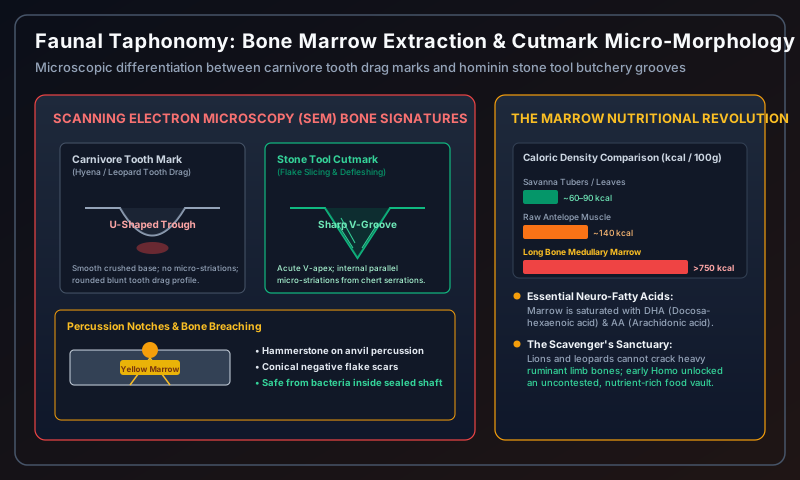
Scanning Electron Microscopy (SEM) Signatures
Under high-magnification scanning electron microscopy, taphonomists Pat Shipman, Richard Potts, and Henry Bunn established rigorous criteria to distinguish carnivore predation from human butchery:
- Carnivore Tooth Scores: When a hyena or leopard drags its conical canine across bone, it crushes the bone cells, producing a shallow, broad U-shaped groove with a rounded, smooth floor.
- Stone Tool Cutmarks: When an Oldowan hominin uses a sharp chert flake to slice tendons or strip periosteum, the microscopic jagged serrations of the stone carve a deep, acute V-shaped notch characterized by distinct, fine, parallel micro-striations lining the groove walls.
- Percussion Impact Flakes & Notches: When a hominin places a dense ungulate femur on a stone anvil and strikes it with a hammerstone, it produces semi-circular percussion notches, negative impact flakes, and radiating butterfly fracture patterns—telltale proof of deliberate bone smashing.
The Lipid Goldmine: Yellow Bone Marrow
In the dangerous African savanna, early Homo did not need to hunt giant buffalo or elephants directly. Saber-toothed felids (such as Homotherium and Megantereon) were hyper-carnivorous apex predators that ate soft viscera and fresh meat before abandoning the carcass. Hyenas lacked the massive jaw crushing power to crack the dense cortical shafts of adult elephant, rhinoceros, or giant giraffe long bones.
The interior medullary cavities of these limb bones remained a sealed, sterile biological safe. By utilizing hammerstones and anvils, early Homo became the premier marrow specialist of the Pleistocene. Long bone marrow delivers an astounding $>750\text{ kcal per }100\text{ grams}$, composed of nearly $100\%$ digestible lipids, oleic acid, and crucial long-chain polyunsaturated fatty acids: Docosahexaenoic Acid (DHA) and Arachidonic Acid (AA)—the irreplaceable molecular building blocks of neural cell membranes and synapses.
4. The Expensive Tissue Hypothesis: Gut vs. Brain
How did early Homo afford the energetic cost of expanding its brain? In 1995, Leslie Aiello and Peter Wheeler formulated one of the most celebrated paradigms in human evolutionary biology: The Expensive Tissue Hypothesis.
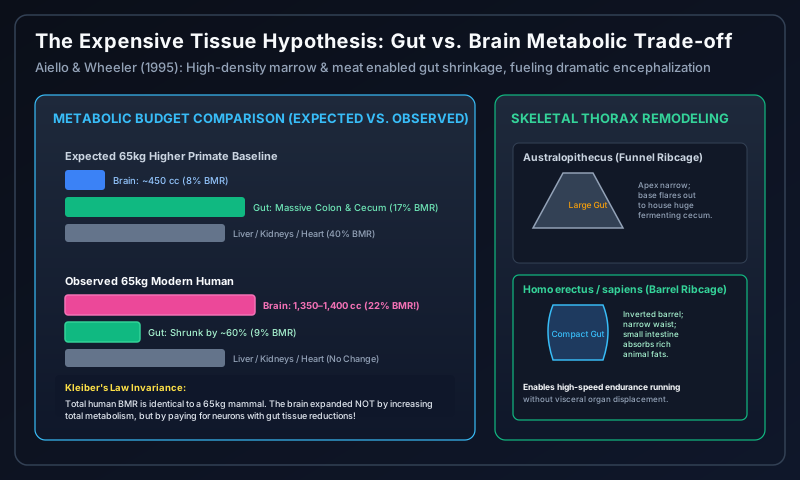
The Metabolic Conundrum
The human brain is an extraordinarily gluttonous organ. In an adult human, the brain represents merely $2\%$ of total body weight, yet it consumes between $20\%$ and $25\%$ of total resting basal metabolic rate (BMR)! Gram for gram, neural tissue consumes more than twenty times the energy of skeletal muscle.
According to Kleiber’s Law ($BMR \propto M^{0.75}$), the total basal metabolic rate of a mammal is strictly governed by its overall body mass. Measurements of human metabolism confirm that our resting metabolic rate is exactly what would be predicted for a standard $65\text{–}70\text{ kg}$ mammal. We do not have a super-charged metabolic engine. How, then, did our ancestors pay for a 750 cc brain without starving?
The Gut-Brain Trade-Off
Aiello and Wheeler examined the five metabolically “expensive tissues” in the mammalian body: the heart, kidneys, liver, brain, and gastrointestinal (GI) tract. Heart and kidney sizes are fixed by circulatory and filtration physics. The liver is tied to detoxification.
The only organ capable of dynamic evolutionary downsizing was the Gastrointestinal Tract:
- The Australopithecine Ape Gut: Herbivorous primates consume voluminous, low-nutrient, fibrous plant leaves and stems. Digesting this material requires a massive, fermenting cecum and an elongated colon filled with symbiotic bacteria. This enormous visceral organ package required a wide, flaring, funnel-shaped ribcage and a broad pelvis.
- The Genus Homo Revolution: By using Oldowan stone flakes to process carcasses and extract calorie-dense bone marrow, early Homo replaced voluminous, fibrous plant matter with concentrated, easily digestible animal fats and proteins. The digestive tract shrank by $\sim 60\%$! The bulky colon retreated, and the small intestine expanded to rapidly absorb fats.
The metabolic energy saved by drastically reducing gut tissue was rechanneled directly into the expanding neocortex. This visceral remodeling is dramatically visible in the fossil record: the clumsy, funnel-shaped ribcage of Australopithecus transformed into the narrow, cylindrical barrel-shaped ribcage and slender waist of Homo. The stage was set for our lineage to walk out of Africa and conquer the globe.