Between four and two million years ago, the African continent became a dynamic crucible of hominin experimentation. The stem hominins of the late Miocene yielded to a prolific, highly successful radiation: the Australopithecines (genus Australopithecus, meaning “southern ape”). Possessing human-like upright posture below the neck while retaining chimpanzee-sized brains above, these gracile hominins perfected habitual terrestrial walking. In the volcanic ash of Tanzania, they left an indelible 27-meter trail of barefoot tracks that humanized deep time. Yet as African climates intensified their cyclical aridity during the Plio-Pleistocene transition, hominins split into two starkly divergent evolutionary pathways: the hyper-specialized chewing machine of robust Paranthropus, and the flexible, tool-crafting lineage of early Homo.
1. Lucy (A.L. 288-1) and the Gracile Australopithecine Architecture
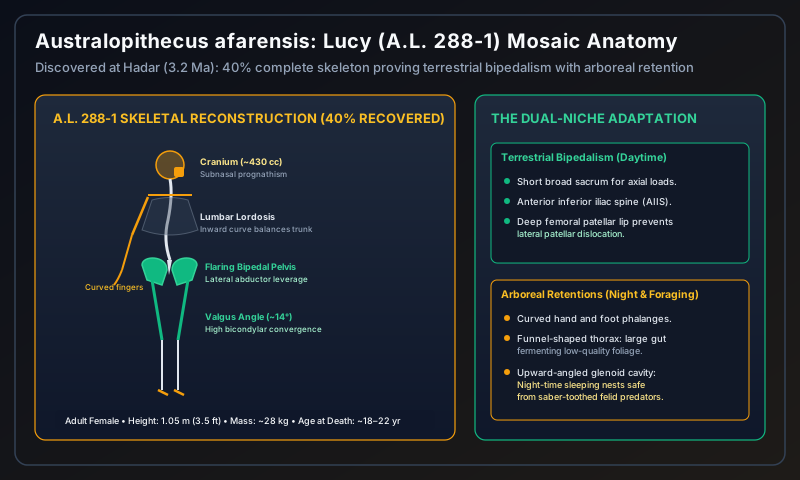
On November 24, 1974, in the scorching Afar badlands of Hadar, Ethiopia, paleoanthropologist Donald Johanson and graduate student Tom Gray spotted a small right proximal ulna eroding from a dry gully. Over the subsequent weeks, their team excavated A.L. 288-1, universally known to the world as “Lucy” (after the Beatles’ song Lucy in the Sky with Diamonds). Preserving roughly $40\%$ of an entire individual skeleton dated to $3.2\text{ million years ago}$, Lucy became the defining icon of Australopithecus afarensis:
The Terrestrial Bipedal Anatomy
Lucy definitively demonstrated that bipedal locomotion preceded the expansion of the human brain by millions of years:
- The Bipedal Pelvic Basin: Lucy’s iliac blades are short, broad, and flared laterally, providing an expanded lever arm for the lesser gluteal muscles (gluteus medius and minimus). This granted her dynamic lateral hip stabilization during the single-limb support phase of walking.
- Lumbar Lordosis: Lucy’s spine possessed an inward curvature (lordosis) in the lower lumbar vertebrae, shifting her torso’s center of gravity backward over the sacral platform and acetabular hip joints.
- The Bicondylar Angle ($\approx 14^\circ$): Lucy’s femurs sloped inward from hip to knee at an acute angle of approximately $14^\circ$—even greater than the modern human average ($9\text{–}10^\circ$) due to her wide pelvic flare and short femoral length. Her knees converged directly beneath her body’s midline, eliminating the energetic penalty of side-to-side waddling.
The Dual-Niche Hypothesis: Arboreal Retentions
Despite her terrestrial locomotion, Lucy was not a replica of a modern human. Her anatomy revealed unmistakable arboreal retentions: her manual and pedal phalanges (finger and toe bones) were noticeably curved, her forearms were relatively long compared to her hindlimbs, and her shoulder socket (glenoid cavity) was angled cranially (upward).
Most anthropologists embrace the Dual-Niche Hypothesis: Australopithecus afarensis was an obligate biped on the ground during the day, foraging across savanna woodlands. But at night, vulnerable to terrifying Plio-Pleistocene predators—such as saber-toothed cats (Homotherium and Megantereon) and giant hyenas (Pachycrocuta)—Lucy climbed into the trees to construct woven sleeping nests, exactly as modern chimpanzees do today.
2. The Laetoli Footprint Trail: Walking Through Deep Time
While fossil bones can be subjected to biomechanical debate, fossilized footprints provide an incontrovertible snapshot of dynamic behavior. In 1978, at Laetoli in northern Tanzania, a team led by Mary Leakey made one of the most sublime discoveries in the history of science: the Laetoli Footprint Trail (Site G).
A Snapshot in Volcanic Ash
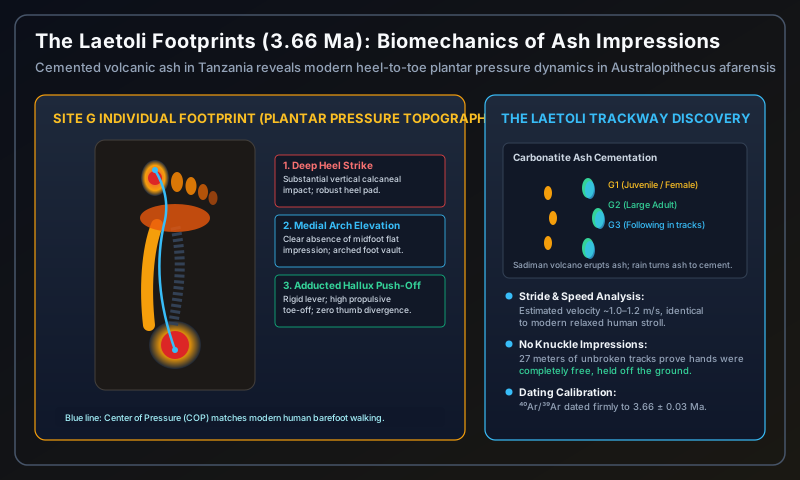
Approximately $3.66\text{ million years ago}$, the nearby Sadiman volcano erupted, dusting the landscape with a fine blanket of carbonatite ash. A gentle rainfall moistened the ash layer, creating a consistency akin to wet cement. Before it set, three hominins—designated G1 (a smaller juvenile or female), G2 (a larger adult male), and G3 (a third individual walking directly behind G2, deliberately stepping into G2’s footprints)—walked together for over $27\text{ meters}$ across the open landscape. Subsequent ash falls sealed and preserved their barefoot impressions for eternity.
Plantar Pressure Dynamics
State-of-the-art 3D laser surface scanning and experimental pedobarographic trials by Robin Crompton, Matthew Bennett, and David Raichlen analyzed the depth contours of the Laetoli tracks:
- Distinct Heel Strike: The posterior margin of the calcaneal impression is deeply depressed and rounded, proving the hominin made initial ground contact with a heavily cushioned heel strike.
- The Medial Longitudinal Arch: Unlike chimpanzee footprints—which produce a uniform, flat-footed depression across the entire midfoot—the Laetoli prints display a conspicuous absence of deep impression under the medial instep, proving the presence of an elevated longitudinal arch supported by the plantar aponeurosis.
- Non-Divergent Adducted Hallux: Unlike Ardipithecus (whose big toe diverged at $45^\circ$), the Laetoli big toe was fully adducted ($0\text{–}5^\circ$ divergence), perfectly aligned parallel with the lateral toes.
- The Terminal Hallux Push-Off: The deepest impression in the anterior footprint is situated directly beneath the ball of the hallux, proving that Australopithecus afarensis completed its stride cycle with an energetic toe push-off, matching the center-of-pressure trajectory of modern barefoot human walking.
3. The Heavy Masticatory Machine: Paranthropus and Megadontia
As the Pliocene gave way to the Pleistocene around $2.6\text{ Ma}$, tectonic activity and Milankovitch orbital cycles drove African climates toward colder, drier, and more unpredictable regimes. The lush woodland mosaic contracted rapidly, replaced by expansive $C_4$ savanna grasslands dominated by tough, abrasive grasses, sedges, and hard-shelled nuts.
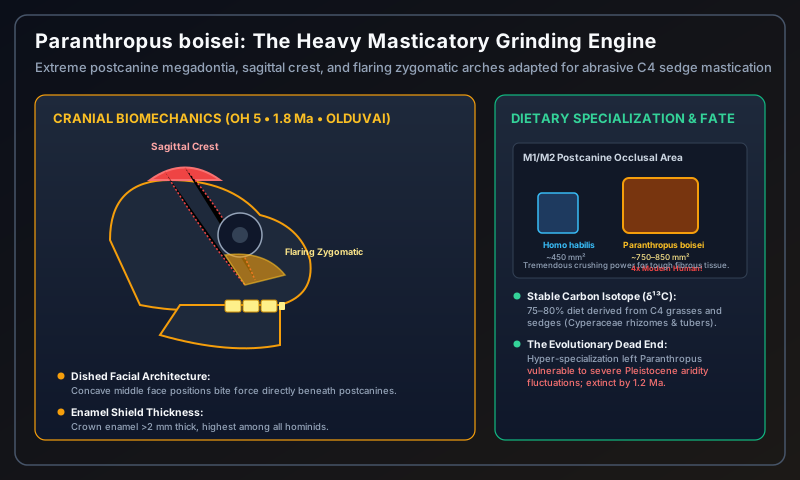
Faced with this caloric crisis, one branch of the australopithecine lineage opted for extreme anatomical specialization: the Robust Australopithecines (genus Paranthropus). Exemplified by Paranthropus boisei in East Africa (discovered by Mary Leakey at Olduvai Gorge in 1959, cataloged as OH 5 / “Nutcracker Man”) and Paranthropus robustus in South Africa, this clade constructed the most powerful grinding apparatus in hominin history:
The Biomechanics of the Crushing Engine
The cranial architecture of Paranthropus boisei was an engineering marvel devoted entirely to generating catastrophic bite forces:
- The Sagittal Crest: To anchor the gargantuan temporalis chewing muscles, the parietal bones fused along the skull’s dorsal midline to form a towering, blade-like bone crest. In modern humans and gracile hominins, the temporalis muscle terminates low on the side of the cranium; in Paranthropus, it swept all the way to the top of the skull and met its counterpart.
- Flaring Zygomatic Arches: The cheekbones (zygomatics) bowed outward laterally and advanced forward, creating a vast sub-zygomatic temporal fossa to allow the massive masseter and temporalis muscle bellies to pass down to the lower jaw without constriction.
- Dished Facial Profile: The nasal bones and maxilla were set back into a concave, dish-like facial profile, positioning the chewing muscles directly over the molar teeth for maximum mechanical bite leverage.
- Postcanine Megadontia: While the front incisors and canines were diminutive and spatula-like, the premolars and molars were gargantuan—measuring up to four times the surface area of modern human molars (earning them the title of megadont). The molar crowns were armored with enamel caps exceeding $2\text{ mm}$ in thickness, the thickest enamel of any known primate.
The Isotopic Surprise: What Did Nutcracker Man Actually Eat?
For decades, anthropologists believed that Paranthropus used its nutcracker teeth exclusively to crack hard-shelled nuts and seeds. But in 2011, geochemist Thure Cerling and paleoanthropologist Matt Sponheimer performed stable carbon isotope analysis ($\delta^{13}\text{C}$) on the enamel of dozens of Paranthropus boisei teeth. The result astonished the scientific community:
Between $75\%$ and $80\%$ of their lifetime diet consisted of $C_4$ plants—not tree nuts (which are $C_3$), but tropical grasses and sedges (specifically the tough, fibrous, silica-rich underground storage organs, rhizomes, and corms of wetland sedges like Cyperus papyrus). Paranthropus had not evolved giant teeth to crack nuts; it had evolved a biological millstone to crush mountain upon mountain of gritty, low-nutrient fibrous tubers!
4. The Fork in the Evolutionary Road
By two million years ago, the African landscape was populated by two radically contrasting hominin cousins living side by side in the same river valleys of Olduvai and Turkana:
- The Specialist Strategy (Paranthropus): Bet its evolutionary future on high-volume, low-quality vegetation, relying on massive teeth and jaws to grind through the dry season.
- The Generalist Strategy (Early Homo): Kept its cheek teeth small, reduced its gut, enlarged its brain, and outsourced food processing outside the body by chipping stones into razor-sharp cutting flakes.
When the Pleistocene climate entered its most severe glacial cycles around $1.2\text{ million years ago}$, seasonal wetlands dried up, and Paranthropus found its hyper-specialized $C_4$ sedge niches destroyed. Unable to adapt, the robust hominins vanished forever into extinction. Meanwhile, the generalist, tool-using branch survived and flourished, inaugurating the glorious, perilous dawn of the genus Homo.