For over three billion years, the struggle for existence on Earth was waged exclusively at the single-cell frontier. Cells competed ruthlessly for nutrients, dividing as rapidly as their metabolic machinery permitted. Yet in the wake of the catastrophic Cryogenian Snowball Earth glaciations, around 600 million years ago, a radical biological pact was forged: individual cells surrendered their reproductive autonomy to unite into cooperative, specialized, macroscopic bodies. In the shallow, oxygen-rich Neoproterozoic seas, this transition spawned the serene, bizarre macroscopic world of the Ediacaran biota—the peaceful dawn of the animal kingdom.
1. The Genetic Toolkit of Multicellularity: Adhesion, Polarity, and Signaling
Multicellularity is not a singular invention; it evolved independently over 25 distinct times across fungi, slime molds, red algae, brown kelp, and green plants. However, the origin of complex, macroscopic Metazoa (animals) required a sophisticated, integrated molecular toolkit that went far beyond mere clonal aggregation.
To construct a viable animal body, cells required three foundational molecular capabilities:
- Intercellular Adhesion: A physical mechanism to bind adjacent cells tightly together into tear-resistant sheets.
- Extracellular Matrix (ECM) Scaffolding: A flexible, structural fibrous matrix providing mechanical support, shape, and tissue anchorage.
- Spatial Morphogenesis & Signaling: Chemical communication networks allowing genetically identical cells to differentiate into distinct tissues (muscle, nerve, skin) based on their relative coordinates.
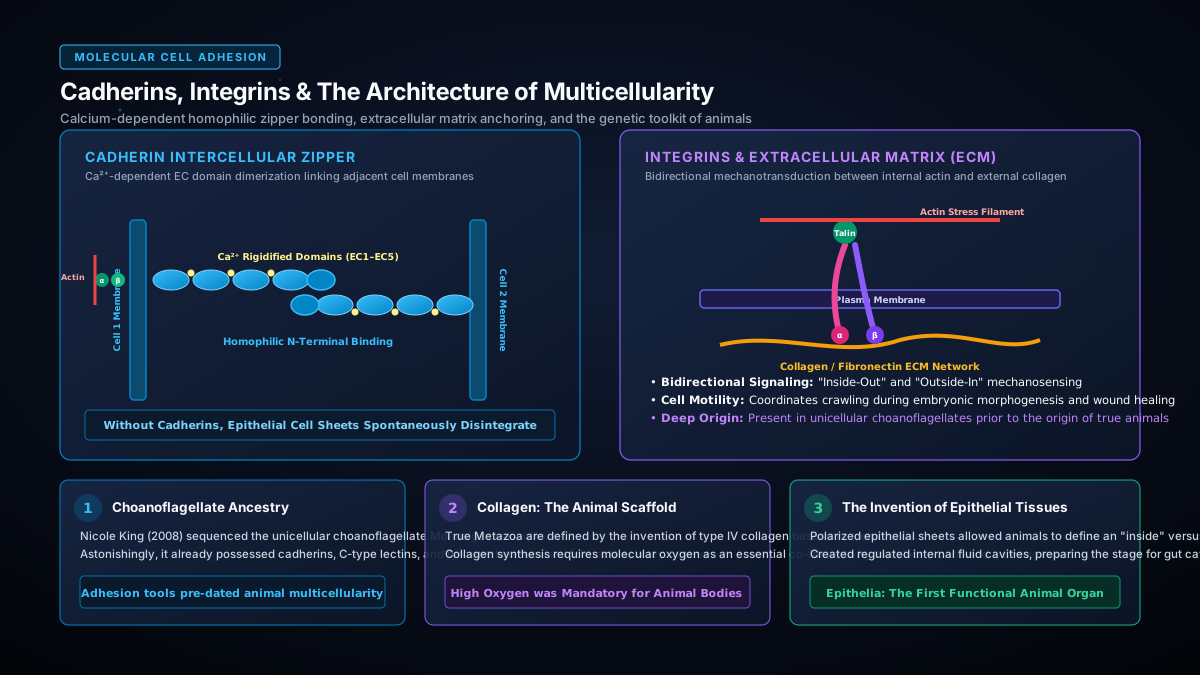
In 2008, evolutionary biologist Nicole King and her team sequenced the genome of Monosiga brevicollis, a single-celled marine choanoflagellate representing the closest living unicellular relative of animals. The results yielded a profound evolutionary revelation: the molecular components for animal multicellularity existed long before true animals evolved.
Unicellular choanoflagellates already possessed classic cadherins, C-type lectins, and tyrosine kinase signaling networks. In solitary protists, these adhesion proteins functioned not to build tissues, but as sticky molecular tentacles deployed on external surfaces to capture bacterial prey. The transition to animal multicellularity was an exquisite evolutionary exaptation: rather than inventing entirely new proteins, natural selection repurposed existing prey-capture receptors to bind daughter cells together, creating the first polarized epithelial sheets.
Crucially, animal multicellularity depended on Type IV collagen, the foundational meshwork of basement membranes. Synthesizing stable triple-helical collagen fibers requires molecular oxygen as an obligate co-factor to hydroxylate proline and lysine amino acids. Without adequate environmental oxygen, cells cannot secrete collagen; without collagen, animals cannot build stable tissues. The expansion of animal bodies was chemically impossible until global oxygen levels crossed the Neoproterozoic threshold.
2. The Ediacaran Garden: Fractal Fronds and Quilted Mattresses
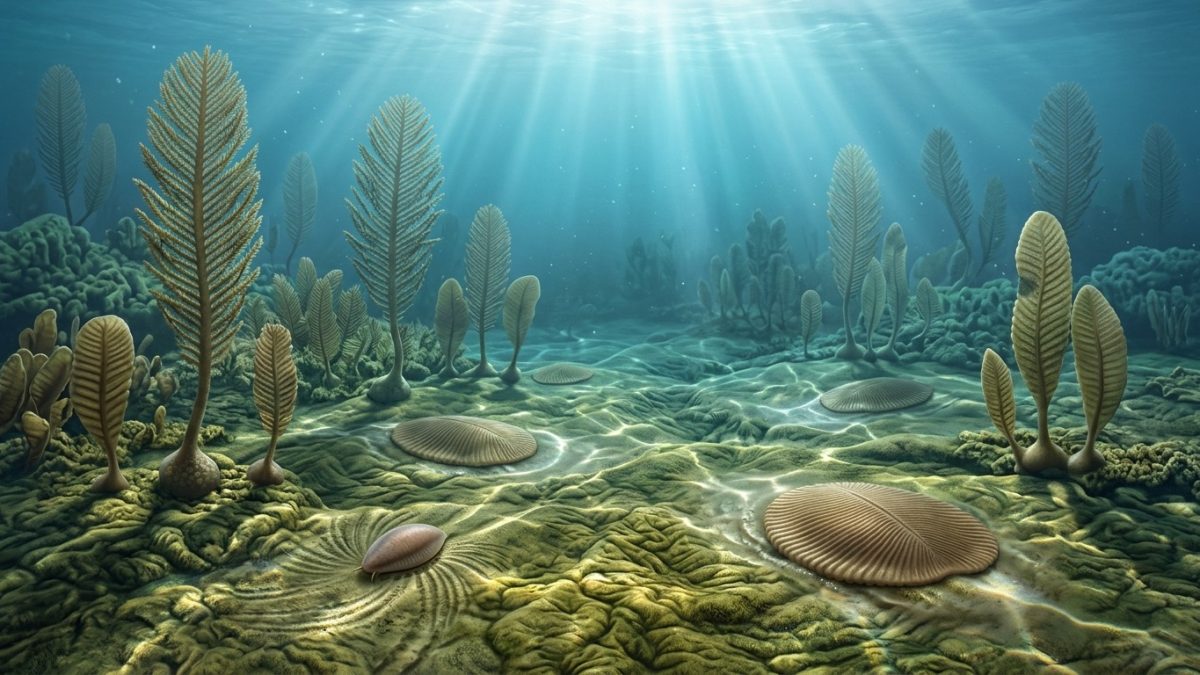
Between $575\text{ and }541\text{ million years ago}$, in the quiet, undisturbed Neoproterozoic seas, there flourished the most enigmatic macroscopic ecosystem in Earth history: the Ediacaran Biota.
First discovered in the Ediacara Hills of South Australia by Reginald Sprigg in 1946, and later identified in Newfoundland and the White Sea of Russia, these fossils perplexed paleontologists for decades. Lacking mineralized shells, jaws, eyes, or limbs, they resembled quilted air mattresses, segmented discs, and undulating ferns anchored to the seafloor.
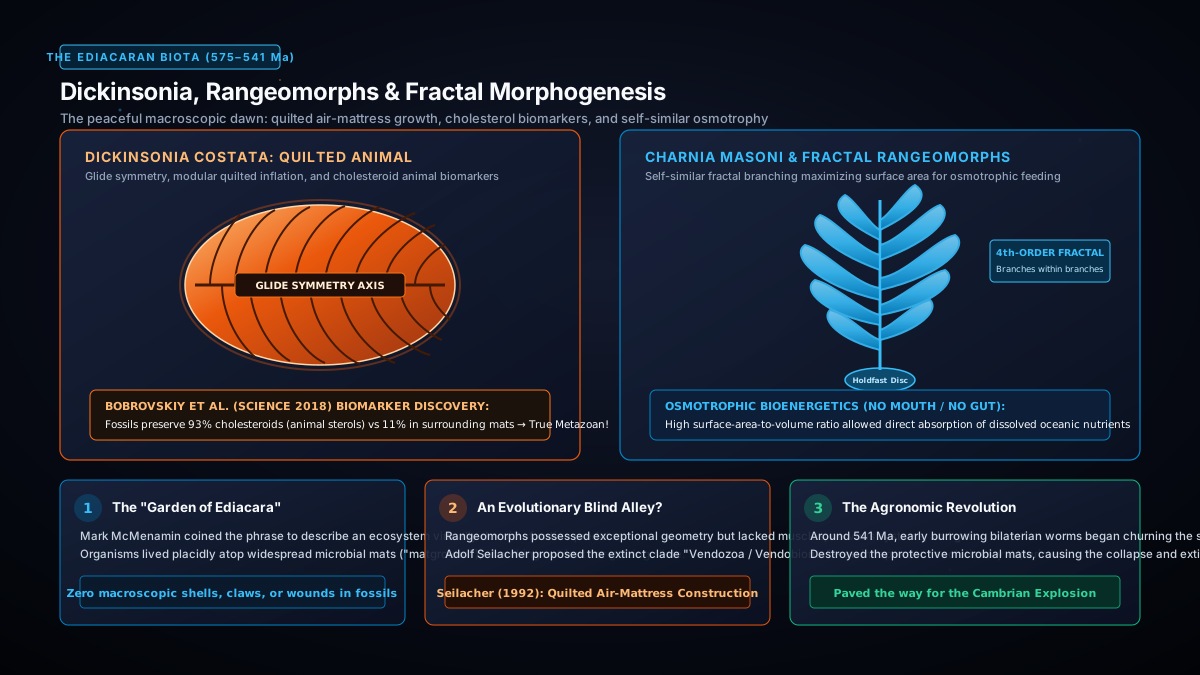
The dominant organisms of the early Ediacaran (the Avalon Assemblage, $575\text{–}560\text{ Ma}$) were the Rangeomorphs (such as Charnia masoni). Rangeomorphs possessed an extraordinary body architecture completely absent in modern animals: self-similar fractal branching. A primary frond branched into secondary frondlets, which branched into tertiary sub-frondlets, which branched into fourth-order microscopic leaflets. This mathematical fractal growth maximized surface area, allowing rangeomorphs to practice osmotrophy—absorbing dissolved organic carbon and nutrients directly from seawater across their skin without requiring a mouth, gut, or circulatory system.
The most iconic Ediacaran fossil is Dickinsonia costata—a flat, ribbed, oval organism reaching over a meter in length. For decades, scientists fiercely debated whether Dickinsonia was a giant lichen, a marine fungus, an extinct protozoan, or a primitive animal. German paleontologist Adolf Seilacher proposed the radical hypothesis of Vendobionta: that Ediacaran organisms were an independent, extinct experiment in multicellularity built from inflated, quilted air-mattress chambers.
The debate was decisively settled in 2018 by Australian biogeochemist Ilya Bobrovskiy. By excavating exceptionally preserved Dickinsonia fossils from 100-meter-high cliffs along the White Sea of Russia, his team extracted organic molecules directly from the fossil tissue. Gas chromatography-mass spectrometry revealed that while surrounding sedimentary microbial mats were dominated by plant/algal stigmasterols, the Dickinsonia specimens contained over 93% cholesteroids (cholesterol and cholestane)—the definitive molecular hallmark of true animal physiology. Dickinsonia was an authentic metazoan.

3. The Environmental Spark and the Emergence of Bilateria
What environmental trigger unleashed this explosion of macroscopic animal life after billions of years of microbial stagnation?
The answer lies in the dramatic climatic convulsions of the preceding Cryogenian Period ($720\text{–}635\text{ Ma}$). During the Sturtian ($717\text{–}660\text{ Ma}$) and Marinoan ($645\text{–}635\text{ Ma}$) glaciations, continental ice sheets kilometers thick ground across global cratons like giant planetary rasp files. When the planet thawed in violent greenhouse super-warm spells, torrents of glacial meltwater washed thousands of cubic kilometers of pulverized mineral dust into shallow seas.
As demonstrated by Jochen Brocks and colleagues (2017), this continental weathering flushed a massive Phosphorus Pulse into the oceans. Bioavailable phosphate ($\text{PO}_4^{3-}$) is the primary limiting nutrient for marine primary productivity. The phosphorus deluge fueled an ecological revolution: ancient cyanobacteria were permanently supplanted by large, lipid-rich eukaryotic green algae. This massive expansion in primary productivity pumped atmospheric oxygen toward 10–20% of present levels, providing the metabolic fuel and collagen-synthesizing capacity demanded by macroscopic animal bodies.
In this enriched late Ediacaran ocean, the peaceful, immobile world of fractal fronds began to crack. Around $555\text{ million years ago}$, an extraordinary animal appeared: Kimberella quadrata.
Unlike immobile rangeomorphs, Kimberella was a committed bilaterian—an organism with clear anterior-posterior and dorsal-ventral axes. It possessed a tough, non-mineralized protective mantle, a muscular ventral foot for directional creeping, and an eversible snout equipped with paired tooth-like denticles. In fossil slabs, Kimberella is frequently preserved at the center of fan-shaped radiating scrape marks known as Radulichnus, created as it systematically rasped and harvested nutritious microbial mats.
Kimberella represents the evolutionary dawn of triploblastic bilaterians: organisms possessing three embryonic germ layers (ectoderm, mesoderm, endoderm), a hydrostatic coelom, and a nervous system concentrated at an anterior head (cephalization). The passive “Garden of Ediacara”—where life lay peacefully atop microbial slime—was drawing to a close.
Conclusion: The Agronomic Revolution and the Vanishing Garden
By $541\text{ million years ago}$, the tranquil Ediacaran world vanished in what paleontologists call the Agronomic Revolution. Newly evolved bilaterian worms began tunneling vertically into the seabed, burrowing through the sediment in search of buried organic matter.
This biological churning—bioturbation—shredded the impenetrable microbial mats that had stabilized seafloors for three billion years. As the mats disintegrated, the specialized anchorages and osmotrophic feeding mechanisms of the sessile Ediacaran fauna collapsed, precipitating their extinction.
In their place, mobile, burrowing, predatory bilaterians inherited the world. Armed with bilateral symmetry, through-guts, and Hox master developmental genes, they were on the brink of executing the most explosive evolutionary radiation in fossil history. In Part 6, we will enter the crucible of the Cambrian Explosion.
Key Academic Citations
- King, N., et al. (2008). The genome of the choanoflagellate Monosiga brevicollis and the origin of metazoans. Nature, 451(7180), 783–788.
- Bobrovskiy, I., et al. (2018). Ancient steroids establish the Ediacaran fossil Dickinsonia as one of the earliest animals. Science, 361(6408), 1246–1249.
- Narbonne, G. M. (2005). The Ediacara biota: Neoproterozoic origin of animals and their ecosystems. Annual Review of Earth and Planetary Sciences, 33, 421–442.
- Brocks, J. J., et al. (2017). The rise of algae in Cryogenian oceans and the emergence of animals. Nature, 548(7669), 578–581.
- Fedonkin, M. A., & Waggoner, B. M. (1997). The Late Precambrian fossil Kimberella is a mollusc-like bilaterian organism. Nature, 388(6645), 868–871.