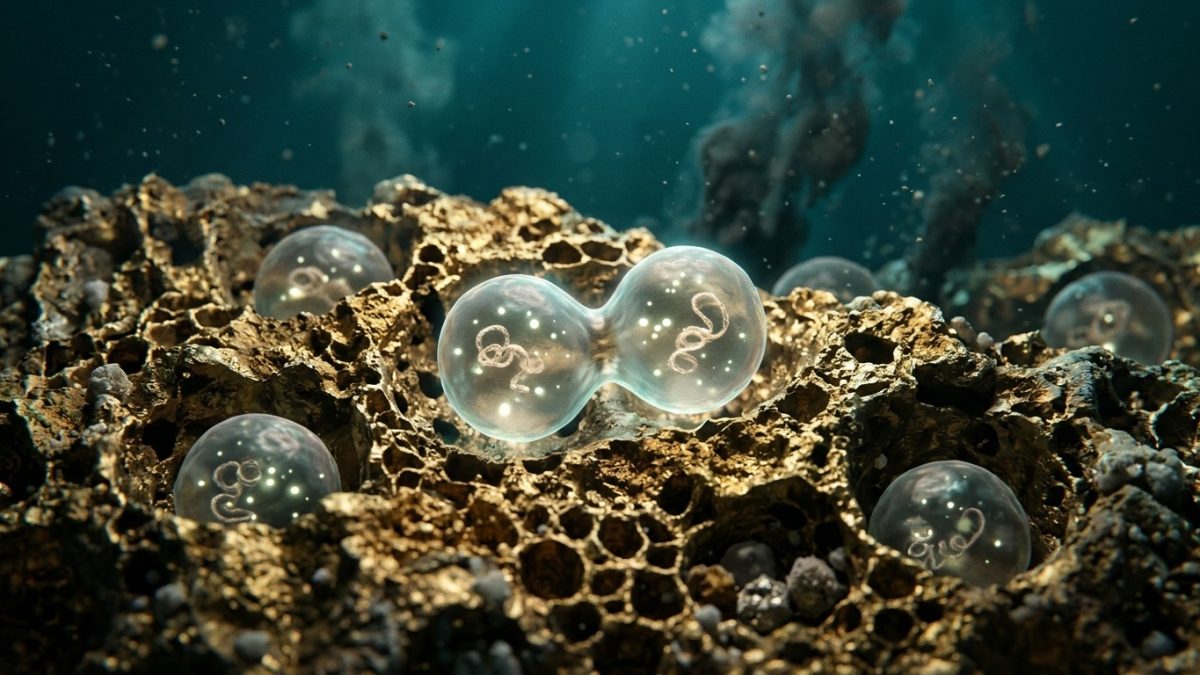
Deep in the warm, anoxic gloom of the Paleoarchean seafloor, approximately 3.8 billion years ago, lived a microscopic entity from which every bacterium in the soil, every archaeon in boiling volcanic springs, every blade of grass, and every human thought is directly descended: the Last Universal Common Ancestor (LUCA). Neither a single freak individual nor a free-swimming modern bacterium, LUCA was a communal population of half-born cells inhabiting the labyrinthine mineral micropores of deep-sea hydrothermal vents, balanced on the thermodynamic knife-edge where geochemical energy became biological heredity.
1. Phylogenomic Archaeology: Reconstructing LUCA’s Molecular Anatomy
Because soft-bodied microbial cells from four billion years ago leave negligible macroscopic fossils, modern evolutionary biologists turn to phylogenomic archaeology. By comparing the complete genomic sequences of tens of thousands of contemporary bacterial and archaeal species across hundreds of distinct phyla, computational algorithms can calculate the evolutionary divergence time and trace genes back to their point of coalescence.
In a milestone 2016 study published in Nature, William Martin, Madeline Weiss, and their colleagues analyzed 6.1 million protein-coding genes across 1,847 bacterial and 134 archaeal genomes. By filtering out horizontal gene transfer (HGT) events and identifying only those gene families exhibiting ancient, un-split orthology present in both primary domains, they reconstructed a high-confidence minimal core genome for LUCA consisting of exactly 355 protein-coding genes.
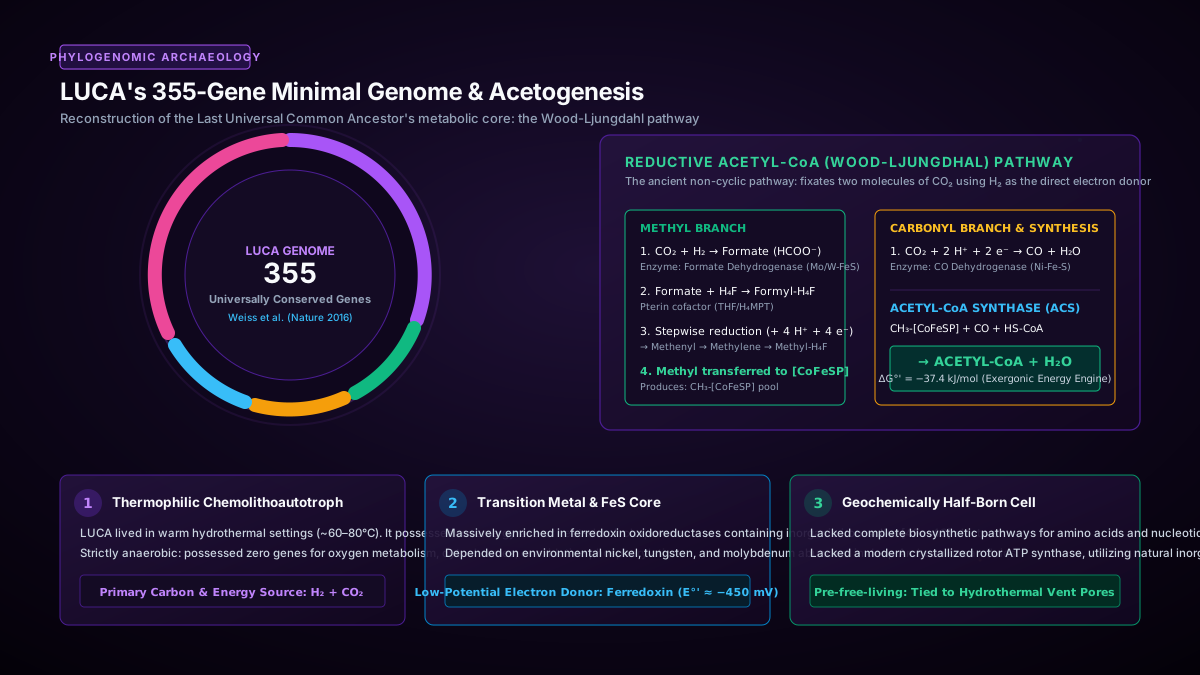
The metabolic profile encoded by these 355 genes paint an unmistakable portrait of LUCA’s physiology:
- Anaerobic Chemolithoautotroph: LUCA possessed zero genes requiring molecular oxygen ($\text{O}_2$). It contained no cytochromes, no quinones, and no capacity for aerobic respiration or oxidative phosphorylation.
- Hyperthermophile / Thermophile: LUCA possessed reverse gyrase and heat-shock chaperones, indicating an optimal living temperature between $60^\circ\text{C}$ and $80^\circ\text{C}$, matching the hydrothermal vent environment.
- The Wood-Ljungdahl Pathway: LUCA fixated inorganic carbon using the linear reductive acetyl-CoA pathway—the only carbon-fixation pathway found in both Bacteria and Archaea that generates net ATP rather than consuming it.
The overall bioenergetic reaction of the Wood-Ljungdahl pathway is exergonic, allowing LUCA to synthesize biomass while releasing metabolic energy:
$$2\text{CO}_2 + 4\text{H}_2 + \text{HS-CoA} \to \text{CH}_3\text{CO-S-CoA} + 3\text{H}_2\text{O} \quad (\Delta G^{\circ\prime} = -37.4\text{ kJ/mol})$$Remarkably, LUCA lacked complete biosynthetic pathways for many basic amino acids and nucleotides, as well as the modern crystallized rotor enzymes of ATP synthase ($\text{F}_1\text{F}_o$). This implies that LUCA was not yet a fully autonomous, free-living organism; it was a “half-born” creature mechanically confined to the catalytic iron-sulfur chambers of alkaline hydrothermal vents, feeding directly on geochemically supplied hydrogen, carbon dioxide, and mineral proton gradients.
2. The Lipid Divide: Why Life Split Into Two Primary Domains
If LUCA represents the universal common ancestor, why did the root of the tree of life split irrevocably into two starkly distinct domains—Bacteria and Archaea—long before eukaryotes emerged?
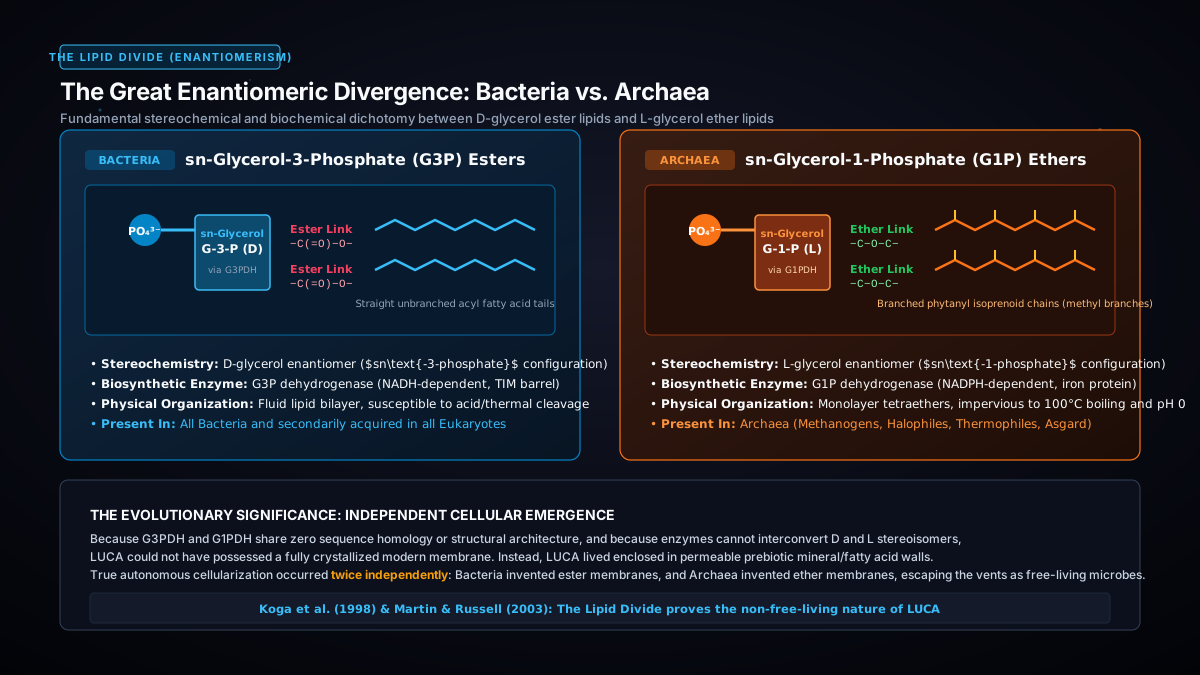
The definitive biochemical answer is known as the Lipid Divide. Every cellular organism requires a hydrophobic membrane to prevent cellular components from dissipating and to sustain a chemiosmotic electrochemical gradient. Yet when we compare the cell membranes of Bacteria and Archaea, we find a fundamental, irreconcilable chemical chasm:
- Glycerol Stereochemistry: Bacterial lipids are constructed from $sn\text{-glycerol-3-phosphate}$ (G3P), synthesized by the enzyme G3P dehydrogenase (G3PDH). In contrast, archaeal lipids are constructed from the enantiomeric mirror-image, $sn\text{-glycerol-1-phosphate}$ (G1P), synthesized by G1P dehydrogenase (G1PDH). These two enzymes belong to completely unrelated protein superfamilies and share zero phylogenetic homology.
- Chemical Linkage: Bacteria link their hydrocarbon tails to the glycerol backbone via ester bonds ($\text{-C(=O)-O-}$). Archaea link their hydrocarbon chains via ether bonds ($\text{-C-O-C-}$), which are significantly more resistant to oxidation, acidic hydrolysis, and thermal breakdown.
- Hydrocarbon Chains: Bacterial membranes consist of unbranched, straight-chain fatty acids synthesized through the fatty acid synthase (FAS) pathway. Archaeal membranes consist of branched isoprenoid chains (repeating 5-carbon phytanyl units) derived from the mevalonate pathway. In extreme thermophiles, archaeal lipids fuse into a single covalent biphytanyl tetraether monolayer that remains completely intact at temperatures exceeding $100^\circ\text{C}$ and at $\text{pH } 0$.
Because the stereocenters of G1P and G3P are enantiomers, an organism cannot gradually mutate from one to the other without destabilizing the packing geometry of its lipid bilayer. As demonstrated by Koga et al. (1998) and Martin & Russell (2003), this chemical divergence proves that LUCA itself lacked a modern, enzymatically synthesized phospholipid membrane. LUCA utilized fragile, leaky prebiotic fatty acid membranes. When independent lineages evolved the enzymatic machinery to synthesize tight, impermeable membranes, they did so via two distinct biochemical pathways—one producing the bacterial ester lineage, the other producing the archaeal ether lineage. Armed with robust, self-sealing envelopes, Bacteria and Archaea independently broke free from their hydrothermal nursery to conquer the primordial oceans.
3. The Universality of the Genetic Code: The Frozen Accident of LUCA
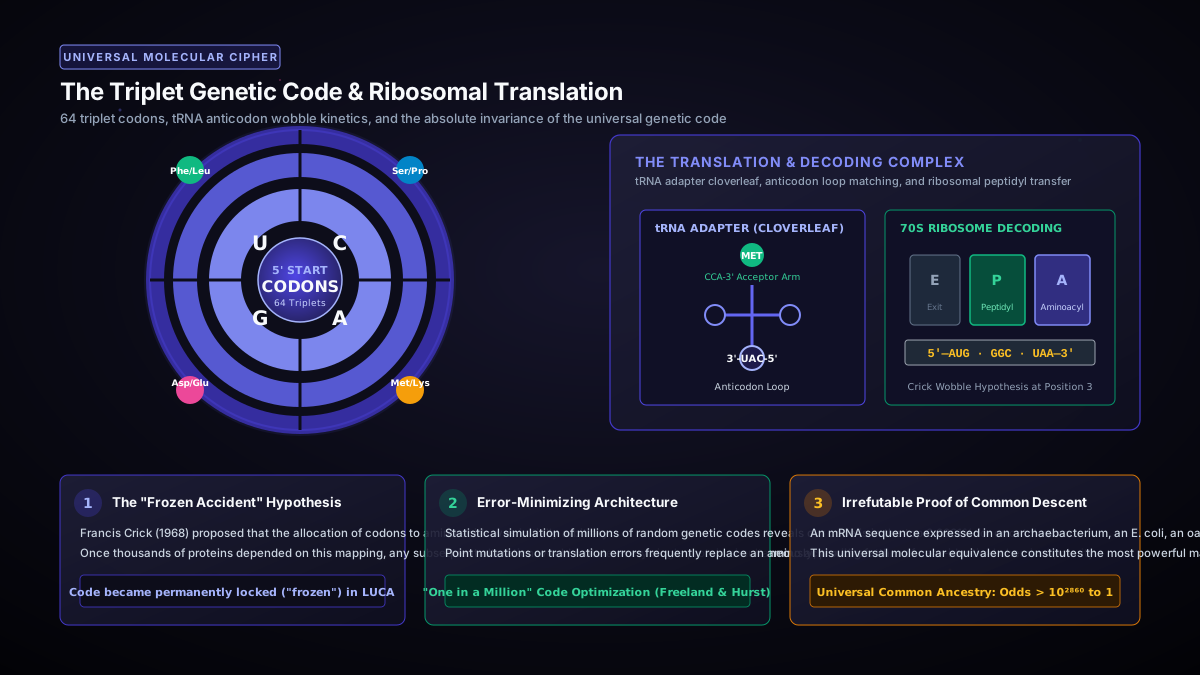
While the lipid membranes of Bacteria and Archaea diverged completely, their interior molecular machinery is virtually identical. Both domains utilize the exact same universal genetic code: a sequence of 64 triplet nucleotide codons specifying the exact same 20 standard L-amino acids (plus stop codons).
Francis Crick famously coined the term The Frozen Accident in 1968 to describe this universal mapping. While the initial association between a given triplet codon (such as $\text{5′-AUG-3′}$ for Methionine) and an amino acid may have possessed chemical or stereochemical affinities in the prebiotic era, once an ancestral organism had evolved thousands of interdependent protein-coding genes, any global reassignment of a codon would simultaneously alter hundreds of vital proteins, resulting in immediate lethality. The code became permanently “frozen” before LUCA diverged.
Furthermore, quantitative bioinformatic analyses by Freeland and Hurst demonstrate that the standard genetic code is not a purely arbitrary random choice: it is an extraordinary “one-in-a-million” error-minimizing masterpiece. Codons differing by only a single nucleotide point mutation typically code for either the identical amino acid (synonymous mutation) or an amino acid with near-identical hydrophobicity and steric volume. For instance, replacing a purine with another purine at the wobble position rarely causes any functional disruption to protein folding:
$$\omega = \frac{K_a}{K_s} \ll 1 \quad (\text{Purifying Selection Dominance})$$This universal invariance is why human insulin can be cloned into a bacterial plasmid and synthesized flawlessly by Escherichia coli cells. The statistical probability of two independent origins of life arriving at the identical 64-codon mapping by pure chance is less than $1 \text{ in } 10^{2,860}$. The genetic code is living mathematical proof that all life on Earth is monophyletic—a single, unbroken family tree extending back to a shared Paleoarchean ancestor.
Conclusion: The Great Departure
By $3.5\text{ billion years ago}$, the two primordial domains had separated forever. Bacteria radiated across shallow marine sediments, developing robust peptidoglycan cell walls, rotary flagella, and vast metabolic repertoires. Archaea populated the planetary extremes: boiling hydrothermal abysses, hyper-saline basins, and deep crustal sediments, pioneering methanogenesis through their unique ether-lipid armor.
For more than half a billion years, life remained exclusively microscopic and predominantly anoxic. But in the sunlight-drenched surface waters of the ocean, a group of photosynthetic bacteria was preparing to execute the most audaciously destructive and creative geochemical coup in planetary history: the oxidation of water and the Great Oxidation Event. In Part 3, we will witness the Solar Energy Revolution.
Key Academic Citations
- Weiss, M. C., et al. (2016). The physiology and habitat of the last universal common ancestor. Nature Microbiology, 1(9), 16116.
- Woese, C. R., & Fox, G. E. (1977). Phylogenetic structure of the prokaryotic domain: the primary kingdoms. Proceedings of the National Academy of Sciences, 74(11), 5088–5090.
- Koga, Y., et al. (1998). Did the last common ancestor have a membrane of lipids with ether or ester linkages? Journal of Molecular Evolution, 46(2), 125–134.
- Crick, F. H. (1968). The origin of the genetic code. Journal of Molecular Biology, 38(3), 367–379.
- Freeland, S. J., & Hurst, L. D. (1998). The genetic code is one in a million. Journal of Molecular Evolution, 47(3), 238–248.