Two hundred and ninety million years ago, long before the first dinosaur laid a claw upon the supercontinent of Pangaea, the continents were ruled by an extraordinary dynasty of stem-mammals: the Synapsida. From sail-backed pelycosaurs like Dimetrodon harnessing solar energy on ancient floodplains, to saber-toothed gorgonopsians and fur-covered cynodonts inventing heterodont chewing, our direct ancestors achieved unquestioned terrestrial hegemony. But at the boundary between the Permian and Triassic periods ($251.9\text{ Ma}$), the planet entered its darkest hour: the Siberian Traps super-volcanic catastrophe. In a geological heartbeat, 96% of all marine species and 70% of terrestrial vertebrates were obliterated in the worst mass extinction in planetary history: The Great Dying.
1. Solar Thermal Engineering: The Dorsal Sail of Dimetrodon
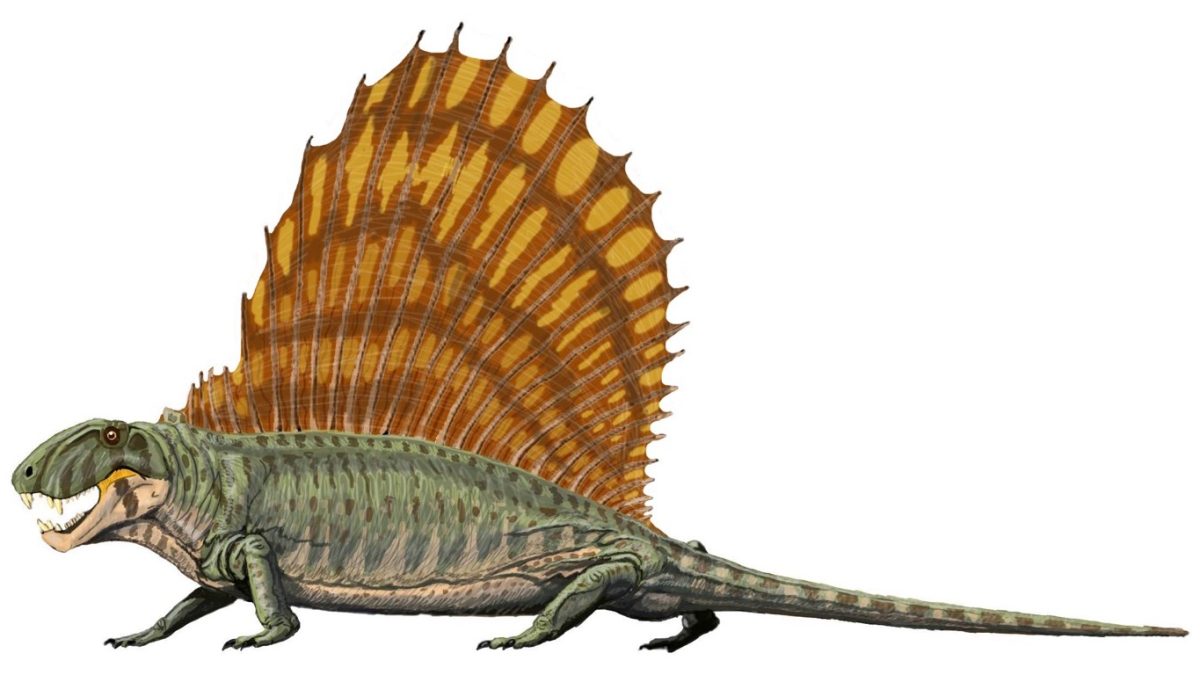
In popular culture, Dimetrodon is frequently misidentified as a dinosaur. In reality, it went extinct forty million years before the earliest dinosaur appeared, and cladistically, it is more closely related to you and me than to any reptile. Dimetrodon belongs to the Pelycosauria, the earliest grade of stem-mammals (Synapsida).
The most striking morphological feature of Dimetrodon limbatus is its towering dorsal sail, supported by neural spine elongations of up to $1.5\text{ metres}$ projecting from its dorsal vertebrae. For decades, paleontologists debated whether the sail served as a sexual display ornament, a defensive barrier against predators, or an aerodynamic wind-sail. In 1973, biophysicists C. D. Bramwell and P. B. Fellgett provided the definitive thermodynamic explanation: the sail was a high-performance solar heat exchanger.
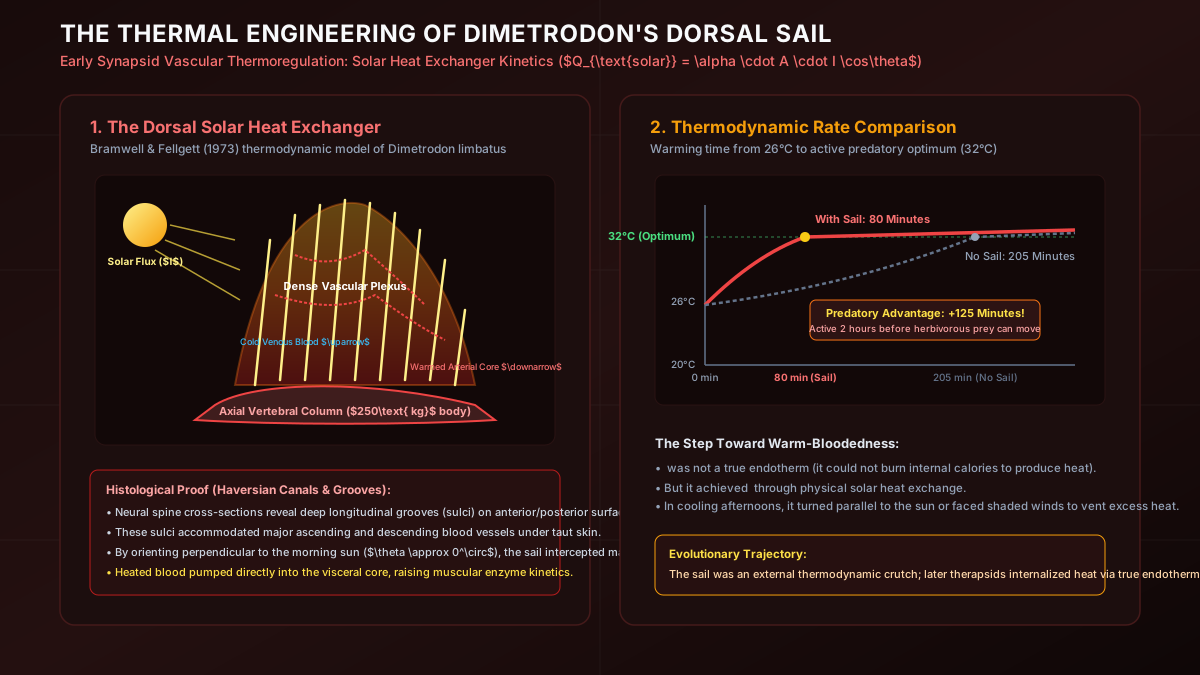
Histological thin-sections of the neural spines reveal deep longitudinal sulci (grooves) running parallel to the bone axis. These grooves housed major ascending arteries and descending veins, which fed into an extensive sub-epidermal vascular capillary network woven throughout the taught skin webbing.
The solar heat absorbed by the sail is governed by the radiative transfer equation: $$Q_{\text{solar}} = \alpha \cdot A_{\text{sail}} \cdot I_{\text{sun}} \cdot \cos\theta$$ Where $\alpha$ is the absorptivity of the skin, $A_{\text{sail}}$ is the surface area of the sail ($\approx 1.2\text{–}1.5\text{ m}^2$), $I_{\text{sun}}$ is solar irradiance, and $\theta$ is the angle of incidence between the sun and the sail plane.
By orienting its body broadside to the rising morning sun ($\theta \approx 0^\circ$), a $250\text{-kg}$ Dimetrodon heated its core blood from a dawn temperature of $26^\circ\text{C}$ to its optimal metabolic hunting temperature of $32^\circ\text{C}$ in just 80 minutes. A sail-less ectothermic animal of equivalent mass required over 205 minutes to reach the same temperature.
This thermodynamic advantage granted Dimetrodon a lethal two-hour window every morning during which it was fully warm, agile, and enzymatically primed, while its herbivorous prey (like the lumbering captorhinid Cotylorhynchus) remained sluggish, stiff, and physiologically immobilized by the morning chill.
2. The Therapsid Metamorphosis: Heterodonty & The Secondary Palate
By the Middle Permian ($270\text{ Ma}$), the pelycosaurs were superseded by a vastly more sophisticated synapsid clade: the Therapsids (“beast-faces”), which later yielded the Cynodonts—the direct precursors to true mammals.
While basal amniotes possessed homodont dentition (uniform, conical peg teeth that could only seize prey), therapsids revolutionized oral biomechanics by inventing heterodonty—the anatomical specialization of distinct tooth categories across the jaw:
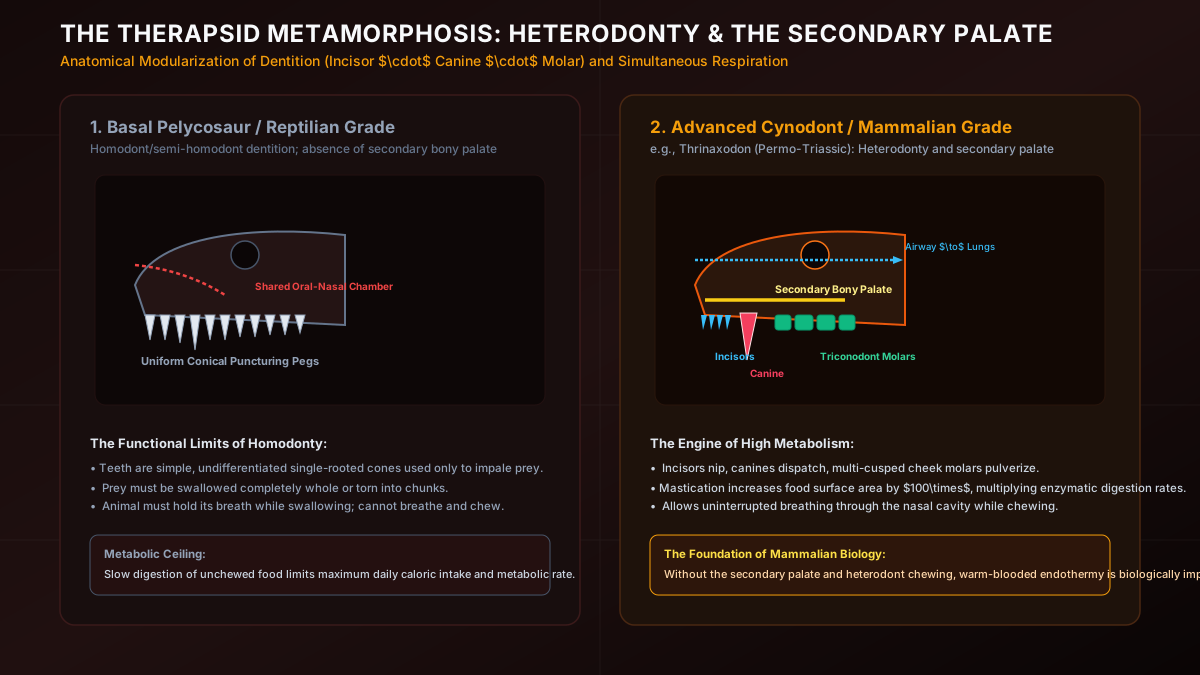
- Incisors: Anterior, chisel-like teeth anchored in the premaxilla, specialized for grasping, nipping, and stripping meat from bone.
- Canines: Elongated, laterally compressed saber fangs anchored deep within the maxilla, designed to puncture vital cervical arteries and deliver swift kills. In apex gorgonopsians like Inostrancevia, canines reached $15\text{ cm}$ in length.
- Postcanines (Premolars & Molars): Complex cheek teeth equipped with multiple cusps (triconodont architecture) and distinct shearing facets. Instead of swallowing food in massive, unchewed chunks, therapsids chewed their food into fine pulp.
The Secondary Bony Palate: Chewing Without Suffocating
Masticating food introduces a lethal physiological conflict: if the mouth is full of food undergoing mechanical chewing, how does the animal breathe?
Reptiles and amphibians possess a primary palate; their nasal openings empty directly into the front of the oral cavity. Consequently, they must hold their breath while swallowing. Advanced cynodonts (such as Thrinaxodon liorhinus) solved this by extending horizontal plates from the maxilla and palatine bones to form the secondary bony palate.
The secondary palate created a permanent, rigid horizontal floor that completely isolated the respiratory nasal passage from the lower oral cavity. Air entered the external nares, flowed along the dorsal passage, and entered the trachea at the back of the pharynx—entirely uninterrupted by food processing in the mouth. This single innovation allowed continuous, high-volume pulmonary gas exchange during prolonged mastication—laying the anatomical foundation for warm-blooded endothermy!
3. The Siberian Traps & The Permian-Triassic Great Dying
By 255 million years ago, synapsids were at the peak of their evolutionary dominion. Then, at $251.9\text{ Ma}$, planetary geology unleashed an apocalypse from which the biosphere barely recovered.
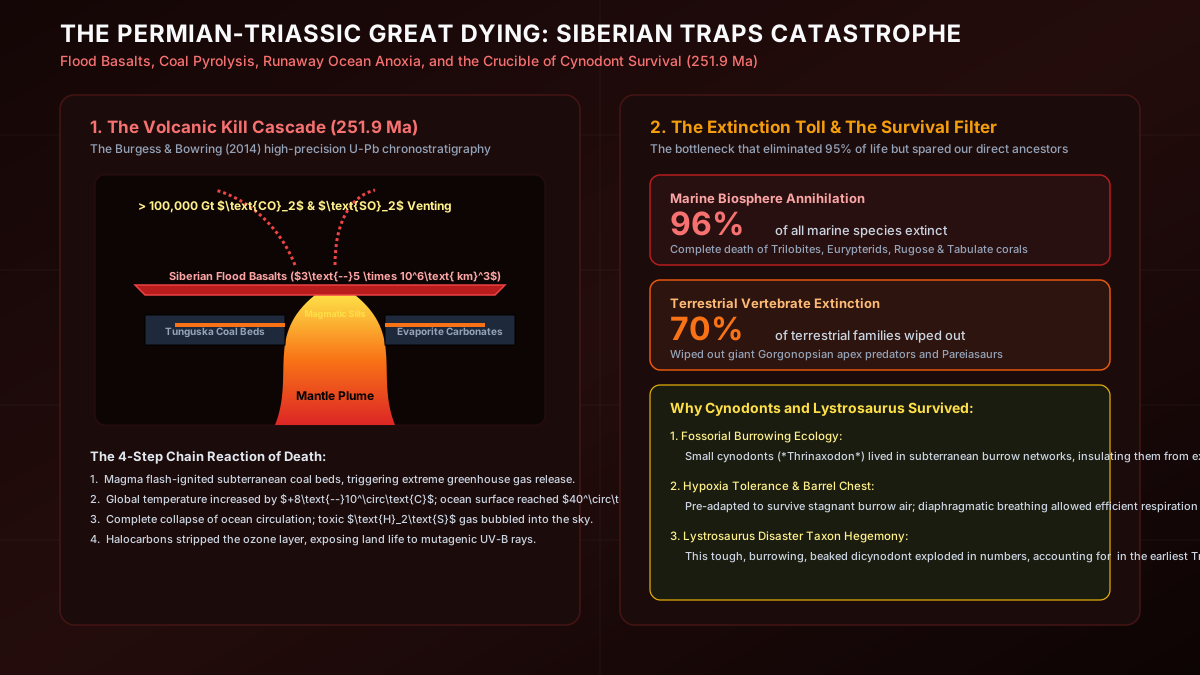
Beneath the northern continent of Siberia, a colossal mantle plume tore through the Earth’s crust, erupting more than 3 to 5 million cubic kilometers of basaltic lava—an area larger than the continental United States covered in liquid rock two kilometers deep: the Siberian Traps.
The Pyrolysis of Tunguska Coal Beds
The basaltic magma alone was not the primary killer. The fatal trigger was where the magma intruded. As the basalt rose, massive underground volcanic sills intersected the giant, organic-rich Tunguska Basin coal deposits, oil shales, and thick evaporite beds. The intense heat flash-pyrolyzed these subterranean fuel beds, turning Siberia into an unimaginably vast volcanic gasification engine.
More than 100,000 Gigatons of carbon dioxide ($\text{CO}_2$), methane ($\text{CH}_4$), and sulfur dioxide ($\text{SO}_2$) were blasted into the stratosphere within a geological pulse of less than 60,000 years (Burgess & Bowring, 2014):
- Super-Greenhouse Thermal Spike: Atmospheric $\text{CO}_2$ soared past $3,000\text{ ppm}$. Global average temperatures spiked by $+8\text{–}10^\circ\text{C}$. Equatorial ocean surface temperatures surpassed $40^\circ\text{C}$ ($104^\circ\text{F}$)—approaching the thermal coagulation limit for complex proteins!
- Ocean Acidification & Anoxia: The oceans absorbed immense volumes of $\text{CO}_2$, forming carbonic acid ($\text{H}_2\text{CO}_3$) that plummeted ocean pH. Because warm water holds vastly less dissolved oxygen, oceanic thermohaline circulation collapsed into total stagnant anoxia.
- Euxinia and Hydrogen Sulfide Eruptions: With oxygen depleted, anaerobic sulfate-reducing bacteria bloomed in the deep abyss, producing immense clouds of toxic hydrogen sulfide ($\text{H}_2\text{S}$) gas. The ocean turned purple, and monstrous bubbles of $\text{H}_2\text{S}$ erupted into the atmosphere, poisoning coastal land communities and reacting with the ozone layer to strip away Earth’s UV-B protection.
4. The Crucible of Survival: Cynodonts and Lystrosaurus
The toll of The Great Dying was catastrophic. 96% of all marine species were wiped out forever: the trilobites, eurypterids, rugose corals, and blastoids vanished completely. On land, 70% of all vertebrate families were extinguished, wiping out the mighty gorgonopsians and pareiasaurs.
Yet, in the smoking ash-fields of the earliest Triassic ($251\text{ Ma}$), our synapsid lineage did not entirely perish. Two groups of stem-mammals miraculously passed through the extinction filter:
- The Fossorial Cynodonts: Small cynodonts like Thrinaxodon and Galesaurus had evolved semi-fossorial burrowing habits. In their underground tunnels, they were insulated from blistering surface temperatures, acid rain, and toxic atmospheric gasses. Their barrel-shaped rib cages and early diaphragmatic breathing pre-adapted them to survive in the chronically low-oxygen, high-$\text{CO}_2$ air of subterranean burrows.
- The Hegemony of Lystrosaurus: The dicynodont Lystrosaurus, a tough, pig-sized herbivore with a horny beak and digging tusks, survived the crucible and underwent the most astonishing demographic explosion in geological history. With all competing predators and large herbivores dead, Lystrosaurus multiplied until it accounted for an unbelievable 95% of all terrestrial vertebrate individuals on Earth—a single genus dominating an entire planet!
Our ancestors had survived the greatest biological bottleneck in planetary history. But in the barren, overheated Triassic world that emerged from the ashes, a new and agile rival lineage was rising to challenge the battered synapsids for the crown of the continents: the Archosaurs.