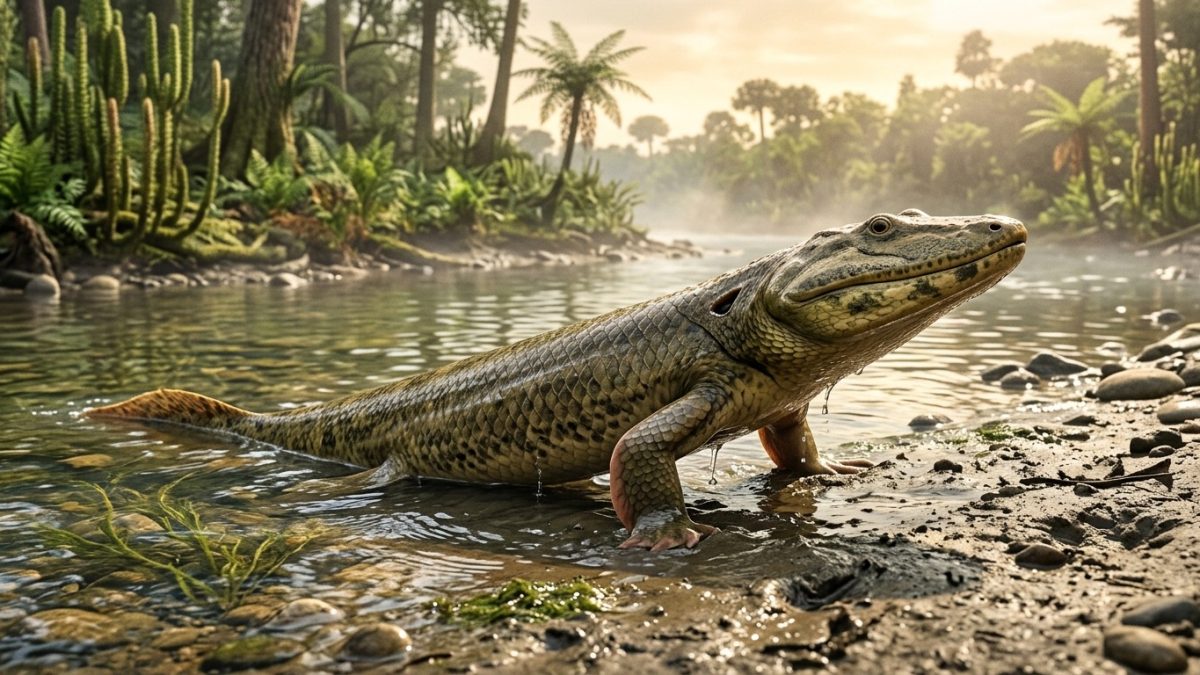
Three hundred and seventy-five million years ago, the edge of the world lay not in the deep open pelagic abyss, but along the sluggish, sun-baked margins of tropical floodplains and braided river deltas. Here, the boundary between water and land was an ambiguous tangle of mudbanks, decomposing vascular plants, and evaporating oxbow lakes. Fish that could only swim were trapped to die as water evaporated or became lethally anoxic. But one adventurous lineage of lobe-finned sarcopterygian fish—the tetrapodomorphs—underwent an anatomical transformation that would rewrite the destiny of vertebrate life: they transformed their fins into weight-bearing walking limbs, disconnected their skulls to invent the first flexible neck, and rewired their sensory systems to perceive the terrestrial realm.
1. The Homologous Tetrapod Limb Archetype: Stylopod, Zeugopod, and Autopod
Every four-limbed vertebrate alive today—from a leaping tree frog to a galloping cheetah, from a soaring hawk’s wing to the human hand typing these words—shares an identical, deeply conserved architectural blueprint: the tripartite tetrapod limb.
Comparative anatomy and developmental genetics reveal that this formula was not invented from scratch on land. Instead, it represents the step-by-step modularization of the internal endochondral skeleton of Devonian lobe-finned fish, progressing through three sequential developmental zones along the proximodistal axis:

- The Stylopod (One Bone): The proximal segment consisting of a single massive endochondral bone that articulates directly with the shoulder or pelvic girdle: the Humerus in the forelimb, or the Femur in the hindlimb. In fish like Eusthenopteron, the humerus possessed massive ventral ridges and entepicondylar crests where powerful propulsive muscles anchored.
- The Zeugopod (Two Bones): The intermediate segment articulating distally with the humerus: the Radius (axial) and Ulna (postaxial) in the forelimb, and the Tibia and Fibula in the hindlimb. This dual-bone arrangement provided rotational stability and mechanical resistance against torsional shearing stresses when propping the torso up on the ground.
- The Autopod (Many Bones): The distal-most segment, encompassing the wrist/ankle bones (carpals/tarsals), palm/foot rods (metacarpals/metatarsals), and articulated finger/toe segments (phalanges). This region represents the most dramatic evolutionary novelty, governed by a secondary late-phase pulse of HoxA and HoxD gene expression that bent the main embryonic skeletal axis anteriorly to sprout walking digits.
2. The Tiktaalik roseae Breakthrough: The First Neck and Wrist
In 2004, on the desolate, frozen cliffs of Ellesmere Island in Nunavut, Canadian Arctic, paleontologists Neil Shubin, Edward Daeschler, and Farish Jenkins made one of the most celebrated fossil discoveries in the history of science: Tiktaalik roseae (popularly known as the “Fishapod”), dating precisely to 375 million years ago.
Tiktaalik sat exactly in the morphological gap between pelagic lobe-finned fish like Panderichthys and early four-limbed amphibians like Acanthostega. While it retained primitive fish traits—such as microscopic scales, swimming fin rays, and functional internal gills—it showcased two unprecedented anatomical breakthroughs that solved the mechanical challenges of living in shallows:
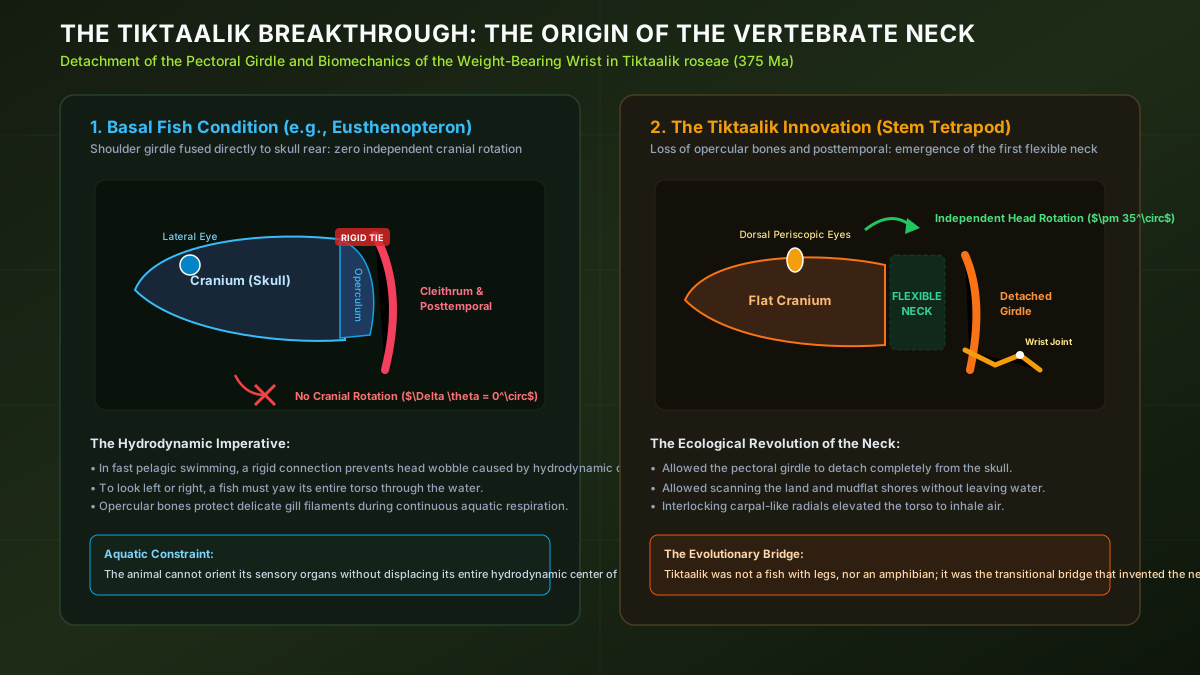
The Detachment of the Pectoral Girdle: The Origin of the Neck
In all swimming fishes, the shoulder girdle (cleithrum, supracleithrum, and posttemporal bones) is solidly bound to the posterior margin of the skull. This rigid fusion is hydrodynamically essential for an animal swimming through dense water, preventing drag-induced head wobble. However, it imposes a crippling constraint: to look left or right, a fish must yaw its entire torso through the water.
Tiktaalik completely lost its opercular bones (the gill covers) and the posttemporal connection. For the first time in vertebrate history, the skull detached from the shoulder girdle, creating a distinct, muscular, flexible neck. Tiktaalik could rest its body flat on the mud while turning its flattened, crocodile-like head up to $35^\circ$ independently in all directions to snatch prey along the waterline.
The Weight-Bearing Flexible Wrist Joint
At the end of its robust pectoral fin, Tiktaalik evolved a transverse mobile hinge joint composed of distinct proto-carpal radials (homologues of our radiale, intermedium, and ulnare). These bones possessed smooth articular facets that allowed the distal fin to flex dorsally by more than $90^\circ$.
This allowed Tiktaalik to place its palms flat against the substrate and perform “pectoral push-ups,” hoisting its heavy chest and lungs out of stagnant water to gulp fresh air and survey the riverbanks. It did not have walking fingers yet, but it had the mechanical wrist that made fingers possible.
3. The Polydactyly Paradox: Acanthostega and Ichthyostega
For over a century, comparative anatomists believed that the five-digit hand (pentadactyly) was the ancestral, optimal archetype for tetrapods. In 1990, Jenny Clack and Michael Coates shattered this dogma with their exquisite restudy of Acanthostega gunnari (365 Ma) and Ichthyostega stensioei from the Late Devonian of East Greenland.
To the astonishment of the scientific community, the limbs of Acanthostega ended not in five digits, but in eight distinct, fully formed articulated fingers on each hand! Its close relative Ichthyostega had seven toes on its hind paddle, while the Russian tetrapod Tulerpeton possessed six digits.
This discovery established the Polydactyly Paradox: the earliest limbs were broadly paddle-like and hyper-digital, acting as flexible, weed-climbing rudders in choked swamp waterways. Digits evolved in water to navigate underwater vegetation, not to walk on dry land! Only later, in the Early Carboniferous, did terrestrial locomotion exert stabilizing selection on the carpus and tarsus, pruning the digit count down to the classic five-toed pattern that characterizes modern amphibians, reptiles, and mammals.
4. Sensory Rewiring: The Middle Ear Impedance-Matching Engine
Transitioning from water to land was not merely an orthopedic challenge; it was a sensory crisis. In aquatic environments, sound waves travel with ease directly through the animal’s body into the otic inner ear because the acoustic impedance of water ($Z_{\text{water}} \approx 1.5 \times 10^6\text{ Pa}\cdot\text{s/m}$) is virtually identical to that of biological soft tissue.
In contrast, air is an extremely tenuous medium with an acoustic impedance four orders of magnitude lower: $$Z_{\text{air}} \approx 415\text{ Pa}\cdot\text{s/m}$$ When airborne sound waves strike the wet, dense fluid of an animal’s inner ear directly, more than 99.9% of the sound energy is reflected back into the atmosphere, rendering the animal effectively deaf to airborne sound.
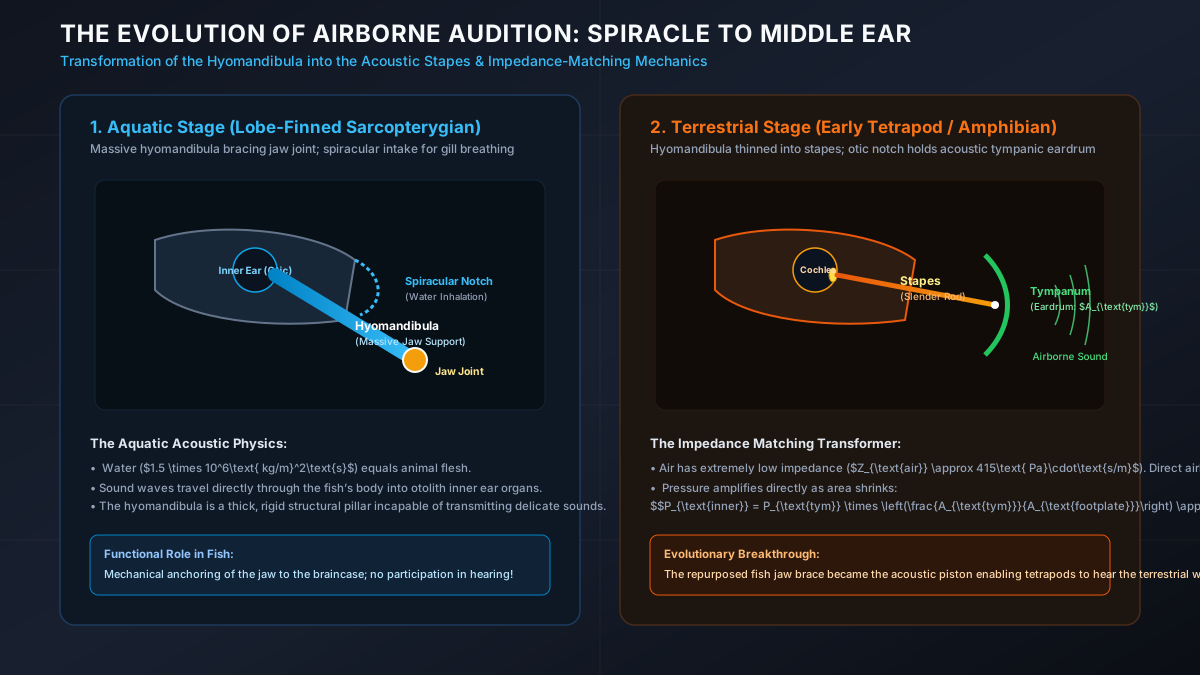
Evolution solved this physical barrier through an extraordinary structural repurposing:
- The Otic Notch & Tympanum: The ancestral spiracular notch at the posterolateral corner of the fish skull broadened into a deep cavity called the otic notch. Across this opening, evolution stretched a thin, taut, highly compliant membrane: the tympanic membrane (eardrum).
- The Transformation of the Hyomandibula into the Stapes: Because the tetrapod lower jaw was now braced directly against the braincase, the massive, pillar-like hyomandibula was freed from its ancient structural duty. It shrank dramatically in thickness, converted into a slender, delicate bone rod—the stapes (columella)—and braced itself between the inner ear’s fluid-filled oval window (fenestra ovalis) and the eardrum.
The stapes acted as a mechanical impedance-matching transformer. By collecting airborne acoustic energy across the relatively large surface area of the eardrum ($A_{\text{tym}}$) and concentrating it onto the tiny footplate of the stapes ($A_{\text{footplate}}$), it generated an enormous mechanical pressure amplification: $$P_{\text{inner}} = P_{\text{tym}} \times \left(\frac{A_{\text{tym}}}{A_{\text{footplate}}}\right) \approx 20\text{–}30\times \text{ amplification}$$ This pressure multiplier overcame the water-air impedance barrier, forcefully driving the lymph fluid of the inner ear cochlea and allowing our terrestrial ancestors to hear the whispers of wind, the rustle of vegetation, and the mating calls of the Carboniferous world.