Three billion years ago, life on Earth faced a hard planetary energetic boundary. Confined to dark hydrothermal seafloors or shallow volcanic mudflats, primitive microbes fed on geochemical trickles of dissolved hydrogen and volcanic hydrogen sulfide. In the sunlit surface waters of the ocean, however, an audacious evolutionary revolution was underway. Cyanobacteria engineered an inorganic manganese-calcium cubane cluster capable of performing the most thermodynamically demanding biochemical feat in nature: cracking the covalent bonds of ambient water to harvest electrons, unleashing molecular oxygen as a byproduct and permanently transforming the geochemistry of the Earth.
1. The Thermodynamics of Water Oxidation: The Mn₄CaO₅ Cluster
Early photosynthetic bacteria were strictly anoxygenic. Purple sulfur and green sulfur bacteria utilized simple photosystems to extract electrons from dissolved hydrogen sulfide ($\text{H}_2\text{S}$) or ferrous iron ($\text{Fe}^{2+}$). While thermodynamically facile due to the low redox potential of hydrogen sulfide ($E^{\circ\prime} \approx -0.25\text{ V}$), this ecology was fundamentally localized: life was tethered to volcanic sulfur springs and mineral seeps.
To liberate itself and colonize the open oceans, life needed an electron donor that was ubiquitous. That donor was water ($\text{H}_2\text{O}$). However, oxidising water to release oxygen is a monumental energetic challenge. Water is an exceptionally stable molecule with an extraordinarily high standard reduction potential:
$$2\text{H}_2\text{O} \to \text{O}_2 + 4\text{H}^+ + 4e^- \quad (E^{\circ\prime} = +0.815\text{ V at pH 7})$$To pull electrons away from water, nature had to create an oxidizing chemical species even more electronegative than oxygen itself. In Photosystem II (PSII), the light-harvesting reaction center chlorophyll pair, P680, achieves an excited-state oxidation potential of $+1.25\text{ V}$—making P680* the most powerful biological oxidizing agent known.
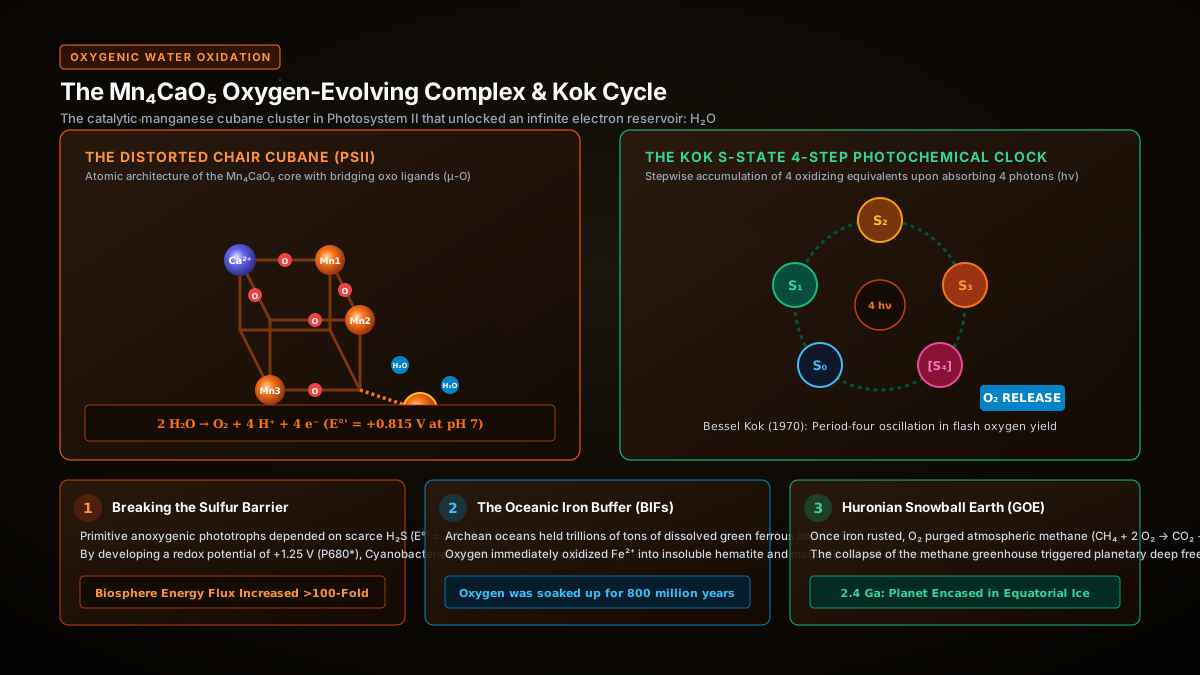
The molecular catalytic engine that manages this four-electron oxidation is the Oxygen-Evolving Complex (OEC), an asymmetric distorted chair cubane composed of four manganese atoms, one calcium atom, and five bridging oxygen ligands: $\text{Mn}_4\text{CaO}_5$.
Because water oxidation requires removing four electrons simultaneously to avoid producing lethal single-electron reactive oxygen intermediates (such as hydroxyl radicals $\cdot\text{OH}$), Bessel Kok demonstrated in 1970 that the OEC functions as a chemical capacitor. Known as the Kok S-state cycle ($S_0 \to S_1 \to S_2 \to S_3 \to [S_4] \to S_0$), the manganese cluster absorbs one photon of light at a time, stepping through progressively higher oxidation states until four oxidizing equivalents have accumulated. At state $S_4$, it spontaneously coordinates two substrate water molecules, forms an $\text{O=O}$ bond, ejects one molecule of $\text{O}_2$ and four protons ($\text{H}^+$), and resets back to $S_0$.
2. The Z-Scheme: Coupling Two Photochemical Engines
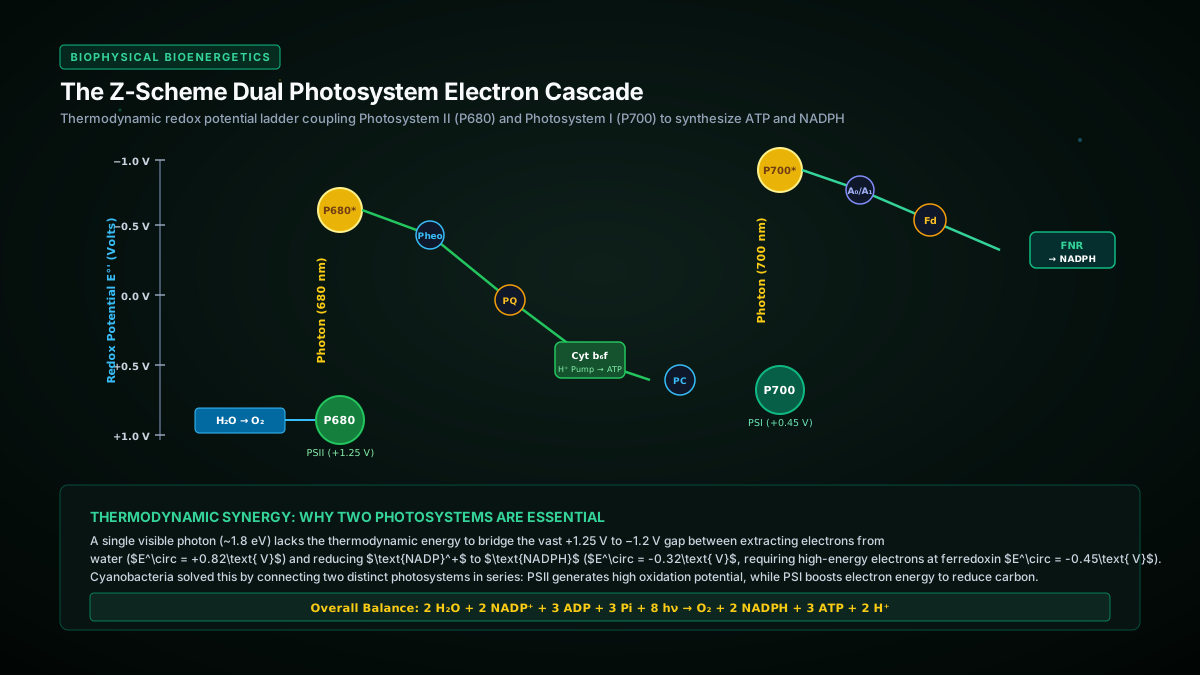
A single photon of visible light ($\sim 1.8\text{ eV}$) does not possess sufficient thermodynamic energy to both rip an electron from water ($+0.82\text{ V}$) and elevate it to the low-potential state required to reduce $\text{NADP}^+$ to $\text{NADPH}$ ($-0.32\text{ V}$, via ferredoxin at $-0.45\text{ V}$).
Cyanobacteria solved this thermodynamic shortfall through a stroke of biophysical brilliance: the Z-Scheme. By wiring two distinct photosystems—Photosystem II (PSII) and Photosystem I (PSI)—in series, electrons receive two sequential optical boosts:
- First Photochemical Boost (PSII): Light absorption at P680 promotes an electron to an excited state ($-0.6\text{ V}$). The electron cascades exergonically through pheophytin, plastoquinone ($Q_A, Q_B$), and the cytochrome $b_6f$ complex. As it moves downhill, cytochrome $b_6f$ translocates protons across the thylakoid membrane, generating a chemiosmotic gradient that synthesizes ATP.
- Inter-Photosystem Shuttle: The mobile copper-containing protein plastocyanin (PC) delivers the electron to the reaction center of Photosystem I (P700).
- Second Photochemical Boost (PSI): Light absorption at P700 excites the electron again to a hyper-reducing potential of $-1.2\text{ V}$. From this peak, the electron cascades through iron-sulfur centers to ferredoxin, and finally to Ferredoxin-$\text{NADP}^+$ Reductase (FNR), generating the biochemical reducing power: $\text{NADPH}$.
The net outcome is a self-sustaining bioenergetic engine powered purely by water and sunlight:
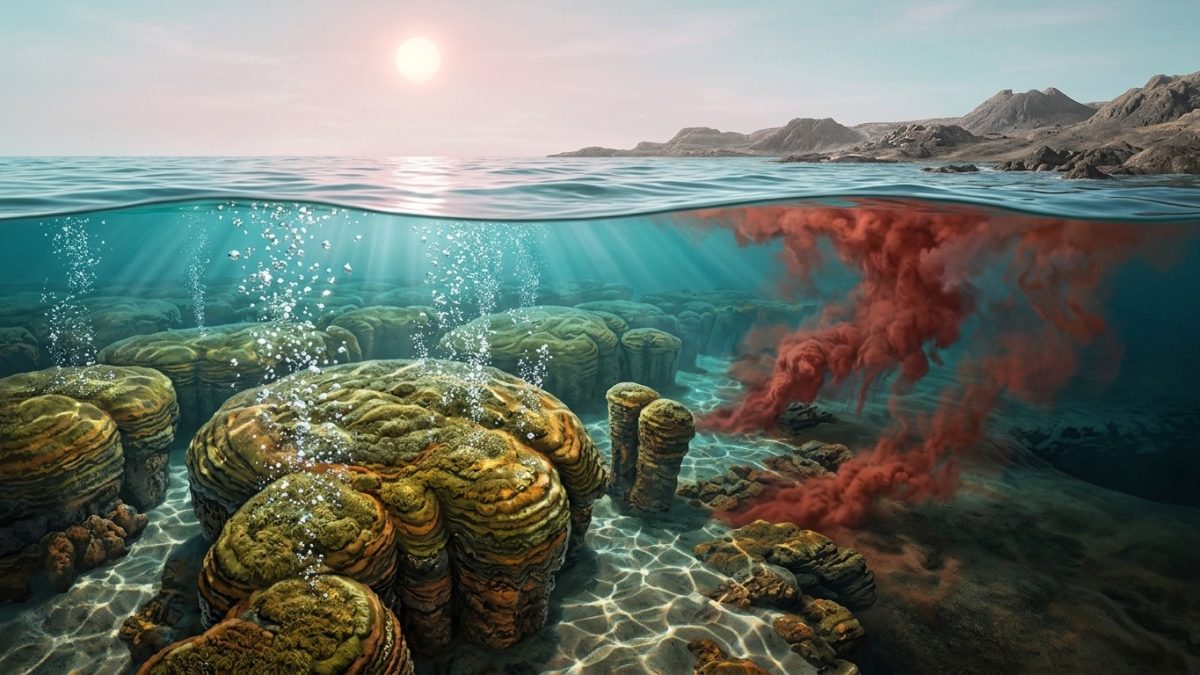
$$2\text{H}_2\text{O} + 2\text{NADP}^+ + 3\text{ADP} + 3\text{P}_i + 8h\nu \to \text{O}_2 + 2\text{NADPH} + 3\text{ATP} + 2\text{H}^+$$With unlimited access to oceanic water and sunlight, the biosphere’s primary productivity exploded by over a hundredfold. Massive cyanobacterial colonies formed undulating coastal microbial reefs known as stromatolites, preserved today in the 3.48-billion-year-old Dresser Formation of Western Australia.

3. The Great Oxidation Catastrophe and the Huronian Snowball Earth
While oxygen was the ultimate metabolic fuel for future complex organisms, to the ancient Archean biosphere it was a lethal poison. Molecular oxygen and its reactive free radicals ($\text{O}_2^{\cdot-}, \text{H}_2\text{O}_2, \cdot\text{OH}$) violently oxidized exposed iron-sulfur enzyme clusters, denatured anaerobic proteins, and shredded naked DNA.
For roughly 800 million years ($3.2\text{–}2.4\text{ Ga}$), the planet remained shielded from free atmospheric oxygen by an enormous geochemical buffer: the Archean oceans were saturated with trillions of tons of dissolved green ferrous iron ($\text{Fe}^{2+}$) leached from basaltic seafloors. As cyanobacteria released oxygen, it reacted instantaneously with dissolved iron, precipitating insoluble rust particles onto the seabed:
$$4\text{Fe}^{2+} + \text{O}_2 + 10\text{H}_2\text{O} \to 4\text{Fe(OH)}_3\text{(s)} + 8\text{H}^+$$This colossal oceanic filtration precipitated the planet’s vast Banded Iron Formations (BIFs)—millions of square kilometers of alternating red jasper chert and silver-black hematite, which comprise over 90% of all iron ore mined on Earth today.
Around $2.4\text{ billion years ago}$, the ocean’s iron sponge was finally exhausted. Dissolved iron dropped to near-zero, and free oxygen began leaking into the atmosphere in what geologists term the Great Oxidation Event (GOE).
The definitive geochemical proof of this transition was discovered by James Farquhar in 2000: prior to $2.33\text{ Ga}$, sedimentary sulfides exhibit anomalous Mass-Independent Fractionation of sulfur isotopes ($\Delta^{33}\text{S} \ne 0$), caused by unfiltered solar UV radiation photolyzing volcanic $\text{SO}_2$. Exactly at $2.33\text{ Ga}$, the $\Delta^{33}\text{S}$ signal abruptly vanishes worldwide to zero, proving that atmospheric oxygen had exceeded $10^{-5}$ Present Atmospheric Level, creating an ozone ($\text{O}_3$) shield.
The atmospheric injection of oxygen had catastrophic climatic consequences. Under the Faint Young Sun (which shone with 20–25% less luminosity than today), the Earth had remained warm due to a potent atmospheric blanket of biogenic methane ($\text{CH}_4$). Atmospheric oxygen reacted with methane, converting it to far weaker greenhouse gases:
$$\text{CH}_4 + 2\text{O}_2 \to \text{CO}_2 + 2\text{H}_2\text{O}$$The greenhouse blanket collapsed. Global temperatures plummeted by tens of degrees. Polar ice sheets expanded across the continents, reflecting incoming solar radiation back into space. This positive ice-albedo feedback triggered the Huronian Glaciation ($2.4\text{–}2.1\text{ Ga}$)—a 300-million-year global deep freeze during which glaciers reached the equator, encasing the entire planet in an icy shell kilometers thick.
Conclusion: The Crucible of Aerobic Life
The Great Oxidation Event was history’s first planetary-scale ecological crisis and the greatest mass extinction of anaerobic life. Yet within the frozen slush and hydrothermal refugia of Snowball Earth, the survivors evolved antioxidant defense mechanisms: superoxide dismutase, catalase, and peroxiredoxins.
More importantly, the stage was set for an energetic leap of staggering proportions. Anaerobic fermentation yielded only 2 ATP molecules per glucose; aerobic respiration using oxygen as the terminal electron acceptor would yield 36 to 38 ATP molecules—an 18-fold increase in bioenergetic efficiency. In Part 4, we will examine how this oxygen-fueled energy bonanza facilitated the most transformative symbiosis in history: the Eukaryotic Leap.
Key Academic Citations
- Kok, B., Forbush, B., & McGloin, M. (1970). Cooperation of charges in photosynthetic O₂ evolution–I. A linear four step mechanism. Photochemistry and Photobiology, 11(6), 457–475.
- Barber, J. (2006). Photosystem II: an enzyme of global significance. Biochemical Society Transactions, 34(5), 619–625.
- Farquhar, J., Bao, H., & Thiemens, M. (2000). Atmospheric influence of Earth’s earliest sulfur cycle. Science, 289(5480), 756–758.
- Lyons, T. W., Reinhard, C. T., & Planavsky, N. J. (2014). The rise of oxygen in Earth’s early ocean and atmosphere. Nature, 506(7488), 307–315.
- Fischer, W. W., Hemp, J., & Johnson, J. E. (2016). Evolution of oxygenic photosynthesis. Annual Review of Earth and Planetary Sciences, 44, 647–672.