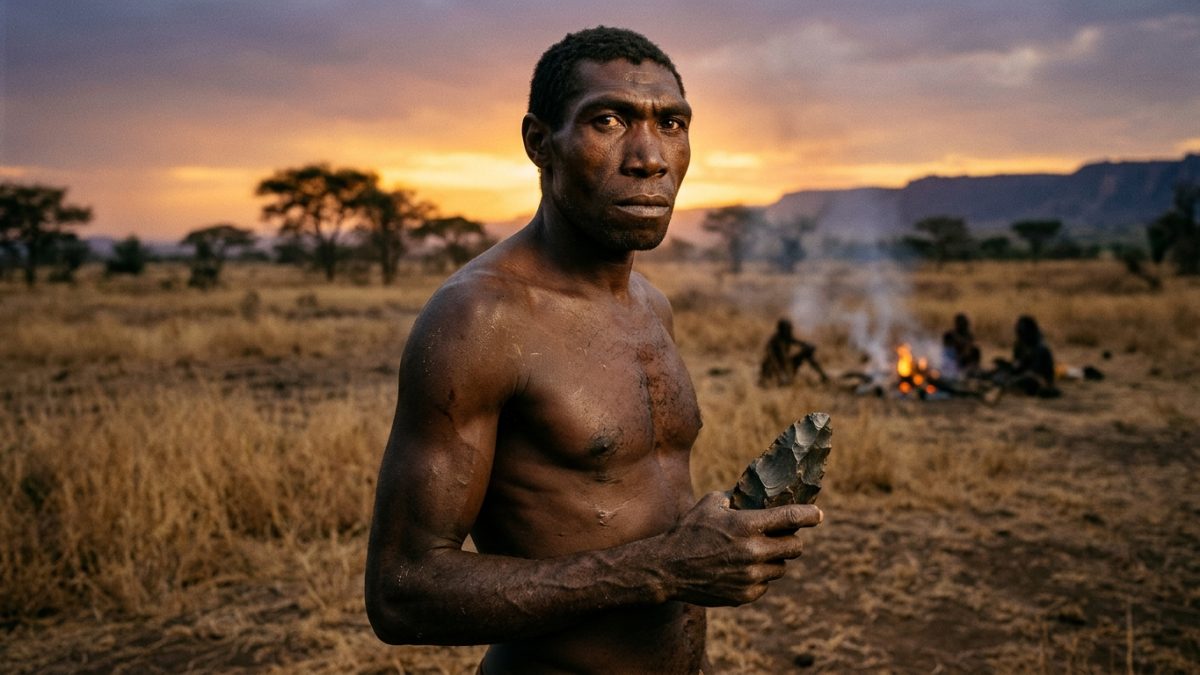
One million nine hundred thousand years ago, the African continent produced a biological and behavioral titan: Homo erectus (often termed Homo ergaster in its early African phase). Leaving behind the small-bodied, ape-like proportions of their ancestors, Homo erectus evolved tall, slender, modern human postcranial skeletons engineered for long-distance Endurance Running. Coupled with the loss of insulating body fur and an explosive proliferation of eccrine sweat glands, they became nature’s ultimate daytime persistence hunters. In their hands, stone tool technology leapt from opportunistic Oldowan flakes to mathematically symmetrical Acheulean handaxes. Most crucially, by taming the primordial power of fire, they predigested their food, ignited the nocturnal campfire culture, and became the first hominin species to march out of Africa and settle across the entire breadth of the Old World—from the Republic of Georgia to the volcanic islands of Java and the glacial caves of northern China.
1. Turkana Boy (KNM-WT 15000) & The Endurance Running Hypothesis
In August 1984, legendary fossil hunter Kamoya Kimeu spotted a tiny scrap of dark cranial bone on the banks of the Nariokotome River near Lake Turkana, Kenya. Over five field seasons, Alan Walker and Richard Leakey excavated KNM-WT 15000, universally celebrated as “Turkana Boy”. Dated to $1.6\text{ million years ago}$, this is the most complete early hominin skeleton ever unearthed (preserving over $80\%$ of all bones):

A Modern Human Body Plan
Turkana Boy was an adolescent male approximately 8 to 9 years old at death, yet he already stood $1.60\text{ m}$ ($5\text{ ft }3\text{ in}$) tall and would have matured to an imposing $1.85\text{ m}$ ($6\text{ ft }1\text{ in}$) and $68\text{ kg}$. His brain capacity was roughly $880\text{–}900\text{ cm}^3$—more than double that of an australopithecine. Most remarkably, his limb proportions were completely modern: long, slender legs, shortened forearms, and a narrow, cylindrical barrel-shaped ribcage.
The Bramble & Lieberman Endurance Running Complex
Why did Homo erectus evolve such long legs and narrow waists? In 2004, Dennis Bramble and Daniel Lieberman published a seminal paper in Nature demonstrating that humans are exceptional endurance runners. While quadrupeds can easily outsprint humans over short distances ($100\text{–}400\text{ meters}$), humans can outrun almost every mammal on Earth over marathon distances ($10\text{–}40\text{ kilometers}$) in hot weather:
- The Nuchal Ligament: Quadrupedal apes lack a functional nuchal ligament because their heads are supported horizontally by dorsal neck muscles. Humans and Homo erectus evolved a distinct median ridge on the occipital bone where a thick, elastic nuchal ligament anchors the head, preventing the heavy cranium from pitching violently forward with each running bounce.
- Thoracic Counter-Rotation: Quadrupedal apes have shoulders locked close to the ribcage. In Homo erectus, the shoulder girdle decoupled from the skull, and the narrow waist separated the ribcage from the pelvis. When the right leg strides forward, the left arm swings forward, allowing the torso to twist in the opposite direction. This counter-rotates the body’s angular momentum without wasting energy.
- The Gluteus Maximus: In humans, the gluteus maximus is hypertrophied into the largest muscle in the body. Electromyographic studies prove that the gluteus maximus is virtually inactive during ordinary walking on level ground; it fires vigorously only during running, where it acts as a colossal tensile brake preventing the upright trunk from pitching forward at the moment of foot impact!
- The Achilles Tendon Spring: Homo erectus lengthened the Achilles tendon, creating a biological spring capable of absorbing and returning over $50\%$ of elastic strain energy with each bounce.
The Human Radiator: Eccrine Sweating & Fur Loss
Running generates staggering amounts of internal metabolic heat ($>1,000\text{ Watts}$). Quadrupedal mammals (such as zebras, antelopes, and cheetahs) are cloaked in fur and can dissipate heat only through respiratory panting. However, an animal cannot gallop and pant at the same time, because galloping mechanically compresses the lungs in a 1:1 stride-to-breath ratio. If forced to gallop continuously in hot weather, a quadruped cannot breathe fast enough to shed heat, and its core body temperature climbs precipitously toward fatal heat stroke ($>42\text{–}43^\circ\text{C}$).
Homo erectus evolved the ultimate physiological countermeasure: loss of body hair (naked skin) combined with a spectacular multiplication of eccrine sweat glands ($2\text{–}4\text{ million active glands}$). By secreting a thin film of watery sweat across naked skin, humans exploit the immense latent heat of vaporization of water ($2,260\text{ kJ/kg}$). This permitted Persistence Hunting: hunting parties tracked antelopes during the blazing midday heat ($38\text{–}42^\circ\text{C}$)—when lions and leopards slept in the shade—relentlessly chasing their prey at a steady trot until the animal collapsed from hyperthermic heat exhaustion, unable to stand.
2. The Mastery of Fire & The Cooking Hypothesis
While stone tools provided sharp teeth outside the body, the control of fire provided an artificial external digestive system. In 2009, Harvard biological anthropologist Richard Wrangham published Catching Fire: How Cooking Made Us Human, arguing that the adoption of cooked food was the primary catalyst for the dramatic evolutionary expansion of Homo erectus:

The Biochemistry of Cooking
Cooking is not merely a culinary preference; it is a profound chemical transformation that dramatically increases net energy yield:
- Starch Gelatinization: Underground storage organs (tubers, corms, and rhizomes) contain tightly wound, semi-crystalline granules of amylose and amylopectin. In raw starch, human salivary and pancreatic amylase enzymes can only digest roughly $50\%$ of the carbohydrates; the rest passes unabsorbed into the colon. Heating starch in water above $65^\circ\text{C}$ causes the crystalline granules to absorb water, swell, and burst—uncoiling the glucan chains and boosting enzymatic glucose absorption to over $95\%$!
- Protein Denaturation: Heat uncoils the rigid triple-helix structure of animal collagen and tenderizes muscle fibers (actin and myosin), converting tough gristle into soluble, easily digestible gelatin. Furthermore, heat neutralizes plant toxins (cyanogenic glucosides, lectins, and protease inhibitors) and kills lethal food-borne pathogens.
- The Energetic Dividend: Wrangham and Rachel Carmody demonstrated through metabolic feeding experiments that cooking increases the net caloric gain from food by $30\%$ to $50\%$, while simultaneously slashing the energetic cost of digestion by more than half.
The Archaeological Horizons of Fire
Detecting ash and microscopic charcoal in deep time is notoriously challenging, but multiple ancient sites confirm early fire use:
- Wonderwerk Cave, South Africa ($1.0\text{ Ma}$): Michael Chazan, Francesco Berna, and their team identified micro-charcoal and calcined (burned) bone fragments deep within the cave interior—30 meters from the entrance—precluding natural wildfire origin.
- Swartkrans, South Africa ($1.0\text{ Ma}$): C.K. Brain recovered over 270 burned animal bones heated to temperatures above $400^\circ\text{C}$.
- Gesher Benot Ya’aqov, Israel ($780\text{ ka}$): Naama Goren-Inbar documented discrete, spatial clusters of burnt flint artifacts and wood alongside Acheulean bifaces, proving systematic, repetitive hearth management.
The Social Hearth and the Sleep Revolution
The consequences of fire extended far beyond nutrition. Living great apes spend $5\text{–}6\text{ hours every single day}$ aggressively chewing tough raw vegetation. Cooking collapsed human chewing time to less than 40 minutes per day! This liberated over four hours of daylight every day for tool crafting, social networking, and child rearing.
Furthermore, nocturnal campfires built a glowing defensive perimeter against lions, leopards, and hyenas. For the first time in hominin history, our ancestors could safely abandon the trees and sleep together on the ground. This enabled longer, deeper periods of consolidated REM sleep, which neuroscientists identify as essential for memory consolidation, creative cognitive processing, and emotional regulation. Around the flickering light of the evening hearth, human social communication transformed: as Polly Wiessner demonstrated in 2014, while daytime conversation focuses on economic logistics, nighttime hearthside talk transforms into storytelling, mythology, empathy, and collective cultural bonding.
3. Acheulean Mode 2: The Mental Template of the Handaxe
Around $1.76\text{ million years ago}$, at Kokiselei near Lake Turkana, Kenya, stone knapping underwent its second great technological leap: the birth of the Acheulean Industrial Complex (Mode 2), named after the French site of Saint-Acheul.

The Geometry of Bilateral Symmetry
Unlike Oldowan Mode 1 choppers (which were produced simply by flaking an edge opportunistically), the Acheulean Biface (Handaxe / Cleaver) represents a profound cognitive milestone: The Imposition of a Mental Template:
- Bifacial Flaking: The knapper works both sides of a large cobble or giant flake, detaching dozens of thinning flakes to create a continuous sharp perimeter edge.
- Bilateral and Bifacial Symmetry: The handaxe conforms to a strict, elegant geometric shape—typically an elongated teardrop, oval, or amygdaloid form. If sliced down the middle, the left and right halves are precise mirror images. Many handaxes from Africa, Europe, and India adhere closely to the classical Golden Ratio ($\Phi \approx 1.618$).
- The Multi-Tool of the Pleistocene: The Acheulean handaxe was the ultimate Swiss Army knife: the sharp pointed tip was used for piercing and digging, the lateral knife-like edges for slicing through elephant hides and dismembering joints, and the heavy rounded basal butt for cracking nuts and crushing bones.
For more than one and a half million years—the longest enduring technological tradition in human history—the Acheulean handaxe remained the standard gear of our lineage, passed down through observational learning across thousands of generations.
4. The Grand Diaspora: Conquering the Old World
Powered by high-calorie cooked meat, endurance running, and Acheulean technology, Homo erectus broke free from the African cradle. The fossil record documents a stunning intercontinental diaspora across the Old World:
1. Dmanisi, Georgia ($1.85\text{–}1.77\text{ Ma}$)
Perched beneath the ruins of a medieval fortress in the southern Caucasus mountains, David Lordkipanidze and his international team excavated five complete hominin skulls (D2700, D3444, and the magnificent Skull 5 / D4500). These Georgian hominins—sometimes classified as Homo erectus georgicus—were small-bodied ($1.45\text{–}1.50\text{ m}$) with modest brains ($550\text{–}775\text{ cm}^3$), proving that hominins did not require giant 1,000 cc brains to migrate out of Africa.
Crucially, skull D3444 belonged to an elderly individual whose teeth had all fallen out years prior to death; the jawbone alveoli had completely resorbed. This individual could not chew raw meat or tough roots; they survived for years only because the social band collectively chewed or cooked soft food for them—the earliest documented evidence of social compassion and elder care in the fossil record.
2. Java Man, Indonesia ($1.6\text{–}1.0\text{ Ma}$)
In 1891, Dutch anatomist Eugène Dubois discovered a thick cranial vault with prominent browridges and a modern femur along the Solo River at Trinil, Java, naming it Pithecanthropus erectus (“erect ape-man”). Subsequent discoveries at Sangiran and Mojokerto revealed that Homo erectus had expanded across the exposed Sunda continental shelf into Southeast Asian subtropical rainforests nearly two million years ago!
3. Peking Man at Zhoukoudian, China ($750\text{–}300\text{ ka}$)
In the 1920s and 30s, Davidson Black and Franz Weidenreich unearthed fossils representing over 40 individuals in Dragon Bone Hill cave at Zhoukoudian, near Beijing. Peking Man possessed a large brain ($1,000\text{–}1,225\text{ cm}^3$), robust supraorbital tori (browridges), and thick cranial bones. Zhoukoudian proved that Homo erectus was capable of surviving the bitterly cold, freezing winters of northern China, relying on cave shelters, animal skins, and hearth fires.
The Movius Line
In 1948, Harvard archaeologist Hallam Movius noticed a profound geographic boundary across the Old World: while Acheulean bifacial handaxes dominated Africa, Europe, and the Indian subcontinent, they were virtually absent east of the Bay of Bengal. In China and Southeast Asia, hominins utilized simple core and flake toolkits. Known as the Movius Line, this dichotomy is explained by ecological adaptation: in the lush tropical forests of East and Southeast Asia, Homo erectus almost certainly utilized the extraordinary versatility of bamboo—a material far lighter, sharper, and more rapidly renewable than stone, whose organic fibers decay without leaving a trace in the lithic record.
For nearly two million years, Homo erectus reigned as the master of the Pleistocene world. But as the glacial cycles deepened in the late Middle Pleistocene, regional populations began to diverge, laying the groundwork for the most complex, enigmatic chapter in our odyssey: the archaic mosaic of Neanderthals, Denisovans, and modern Homo sapiens.