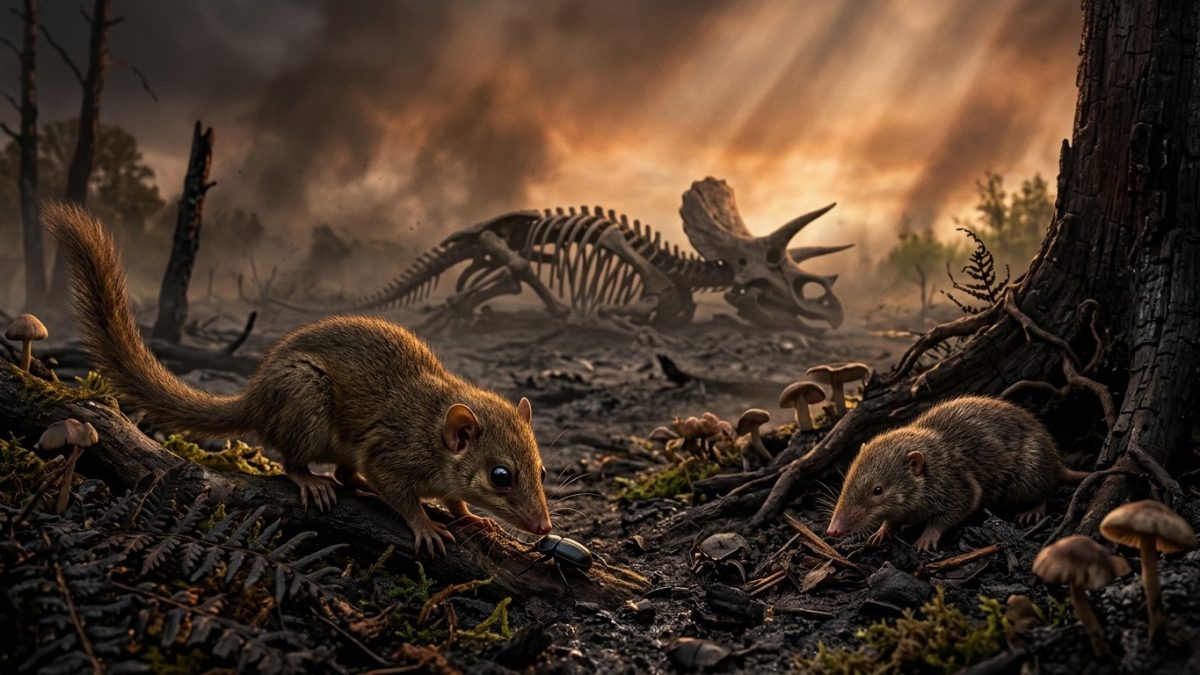
For one hundred and fifty million years—an incomprehensible stretch of time spanning the entire Jurassic and Cretaceous periods—our mammalian ancestors lived under a biological state of siege. With dinosaurs monopolizing every diurnal ecological niche across the continents, mammals were exiled into the dark, freezing shadows of the night. Yet this prolonged exile was not an evolutionary dead end; it was the crucible that forged the defining architecture of mammalian biology. Known as the Nocturnal Bottleneck, this era forced mammals to sacrifice reptilian daytime color vision in exchange for an unprecedented expansion of the auditory and olfactory neocortex, the evolution of tactile whiskers, endothermic fur, and lactation. When a 10-kilometer asteroid struck Chicxulub 66 million years ago, this nocturnal survival toolkit allowed shivering burrowing mammals to outlive the dinosaur titans.
1. The Reichert-Gaupp Transformation: From Jaw Bones to Middle Ear Ossicles
One of the most astonishing homological transformations in vertebrate morphology is the evolutionary migration of the lower jaw hinge into the acoustic middle ear. Formulated originally through comparative embryology by Karl Bogislaus Reichert in 1837 and Ernst Gaupp in 1913, the Reichert-Gaupp Theory revealed that mammals did not evolve their three-ossicle middle ear from scratch—they dismantled their ancestors’ lower jaw to build it.
In all reptiles, amphibians, and basal synapsids, the lower jaw is a composite structure constructed of up to seven distinct bones. The primary mechanical hinge connecting the lower jaw to the skull is formed by the Articular bone (at the posterior tip of the mandible) articulating with the Quadrate bone (anchored to the braincase). Only a single auditory bone existed in the ear: the slender stapes.
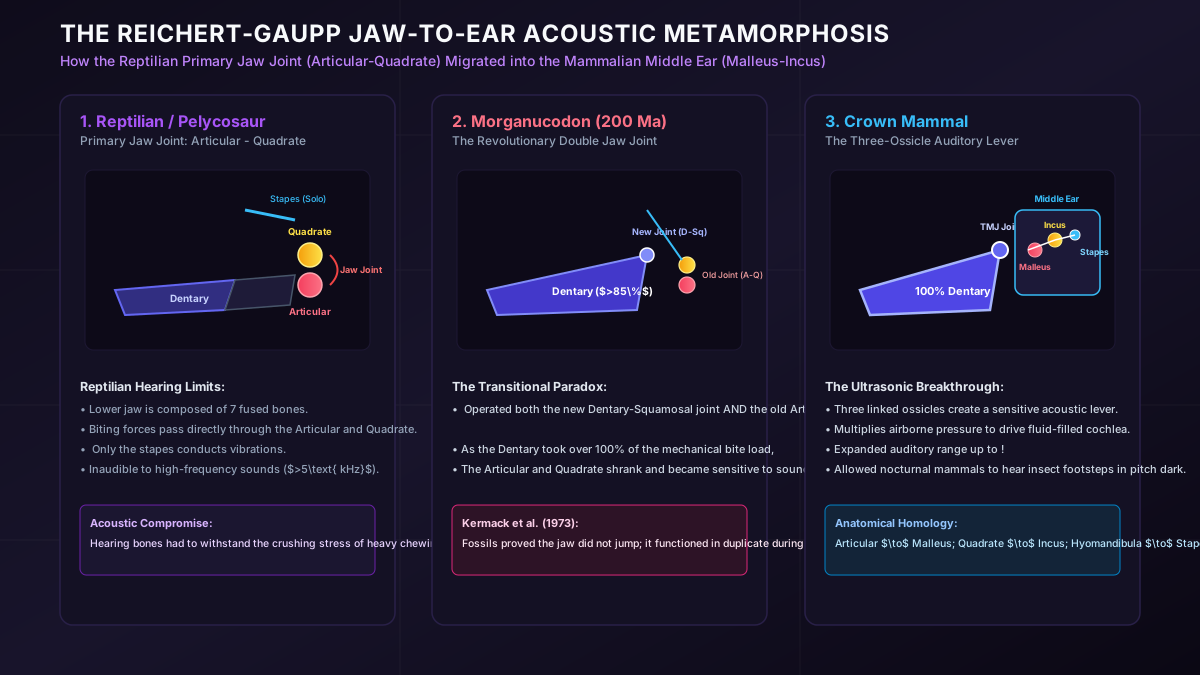
This anatomical configuration imposed a severe functional conflict: the bones responsible for transmitting delicate sound waves were the very same bones bearing the crushing mechanical stresses of chewing. In the Late Triassic, stem-mammals like Morganucodon ($200\text{ Ma}$) solved this through a breathtaking evolutionary stepping stone: The Double Jaw Joint.
As the tooth-bearing Dentary bone enlarged to encompass over $85\%$ of the mandible, it sprouted a backward-reaching condyle that articulated directly with the squamosal bone of the skull—forming our modern temporomandibular joint (TMJ). For millions of years, Morganucodon chewed using both the new Dentary-Squamosal joint AND the ancient Articular-Quadrate joint simultaneously!
Once the robust Dentary-Squamosal joint bore 100% of the mechanical bite load, the ancient hinge bones decoupled completely from the feeding apparatus. They shrank dramatically, decoupled from the mandible, and migrated into the petrosal cavity of the skull:
- The Articular transformed into the Malleus (Hammer).
- The Quadrate transformed into the Incus (Anvil).
- The Angular transformed into the delicate Ectotympanic ring holding the eardrum.
Joined with the ancestral Stapes (Stirrup), these three articulated ossicles formed an exquisite mechanical impedance-matching lever system. By converting low-force, high-amplitude eardrum vibrations into high-force, low-amplitude cochlear fluid pulses, mammals expanded their auditory bandwidth into the ultrasonic realm ($>100\text{ kHz}$)—allowing them to hear the fluttering wings and rustling footsteps of insects in pitch-black night.
2. Neurosensory Remodeling: Whiskers, Neocortex, and Dichromacy
Living exclusively in the nocturnal realm for over 150 million years exerted severe, opposing selective pressures on the mammalian genome and nervous system—a phenomenon formally known as the Nocturnal Bottleneck Hypothesis (Heesy & Hall, 2010):
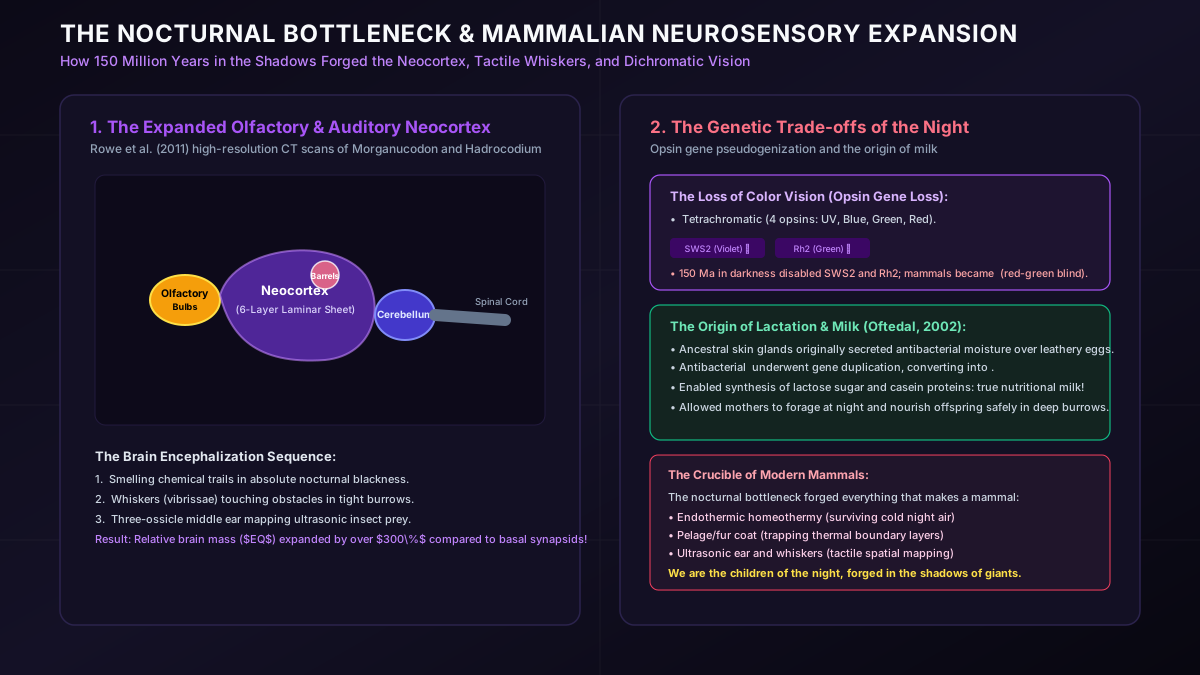
The Genetic Sacrifice: Loss of Color Vision
Ancestral amniotes were tetrachromats, possessing four distinct retinal cone opsin pigments: ultraviolet/violet ($SWS1$), blue ($SWS2$), green ($Rh2$), and red ($LWS$). In the pitch blackness of the Mesozoic night, color vision was useless; photons were scarce, favoring high-sensitivity rod photoreceptors over color cones.
Through neutral genetic drift and loss of purifying selection, mammals lost two entire opsin genes: $SWS2$ and $Rh2$ became non-functional pseudogenes. All ancestral placental and marsupial mammals were reduced to dichromatic vision (effectively red-green colorblind)—a visual handicap that persists in nearly all non-primate mammals today (dogs, cats, horses, and deer see the world in muted blues and yellows).
The Sensory Compensation: The 6-Layered Neocortex
To navigate the darkness, mammals reallocated neural real estate to smell and touch. High-resolution CT scans of early Jurassic stem-mammals like Hadrocodium wui reveal that their relative brain-to-body mass ratio (Encephalization Quotient, $EQ$) tripled compared to therapsids:
- Giant Olfactory Bulbs: Mammalian olfactory receptors exploded to over 1,000 distinct genes, creating an exquisite chemical mapping system capable of tracking scent plumes in the dark.
- Vibrissae and the Barrel Cortex: Mammals evolved specialized tactile sensory hairs—whiskers (vibrissae)—around the snout, richly innervated by the trigeminal nerve. In the primary somatosensory cortex, each individual whisker was mapped to an anatomically discrete cylinder of neurons known as a cortical barrel, creating a high-resolution, three-dimensional tactile image of tight subterranean burrows.
- The Origin of Lactation: In 2002, Olav Oftedal demonstrated that ancestral skin glands originally secreted antibacterial moisture containing lysozyme over permeable eggshells. Through gene duplication, lysozyme mutated into $\alpha$-lactalbumin, triggering the biochemical synthesis of lactose sugar and casein proteins: true nutritional milk! Lactation allowed mammalian mothers to forage in cold night air and return to nurse altricial offspring safely hidden within underground burrows.
3. The Chicxulub Cataclysm: The 66-Million-Year-Old Crucible
Sixty-six million years ago, the Mesozoic world came to an abrupt, violent termination. A carbonaceous asteroid measuring 10 to 15 kilometers in diameter slammed into the shallow carbonate and sulfate platforms of the Yucatán Peninsula at a velocity of $20\text{ km/s}$ ($45,000\text{ mph}$): the Chicxulub Impact.
The impact dissipated an unfathomable $10^8\text{ megatons of TNT}$ of kinetic energy—equivalent to one hundred million Hiroshima atomic bombs detonating simultaneously. It excavated a transient crater 100 kilometers wide and 30 kilometers deep, vaporizing thousands of cubic kilometers of gypsum evaporites ($\text{CaSO}_4$) and injecting over 500 Gigatons of sulfur aerosols and 10,000 Gigatons of soot into the upper stratosphere.
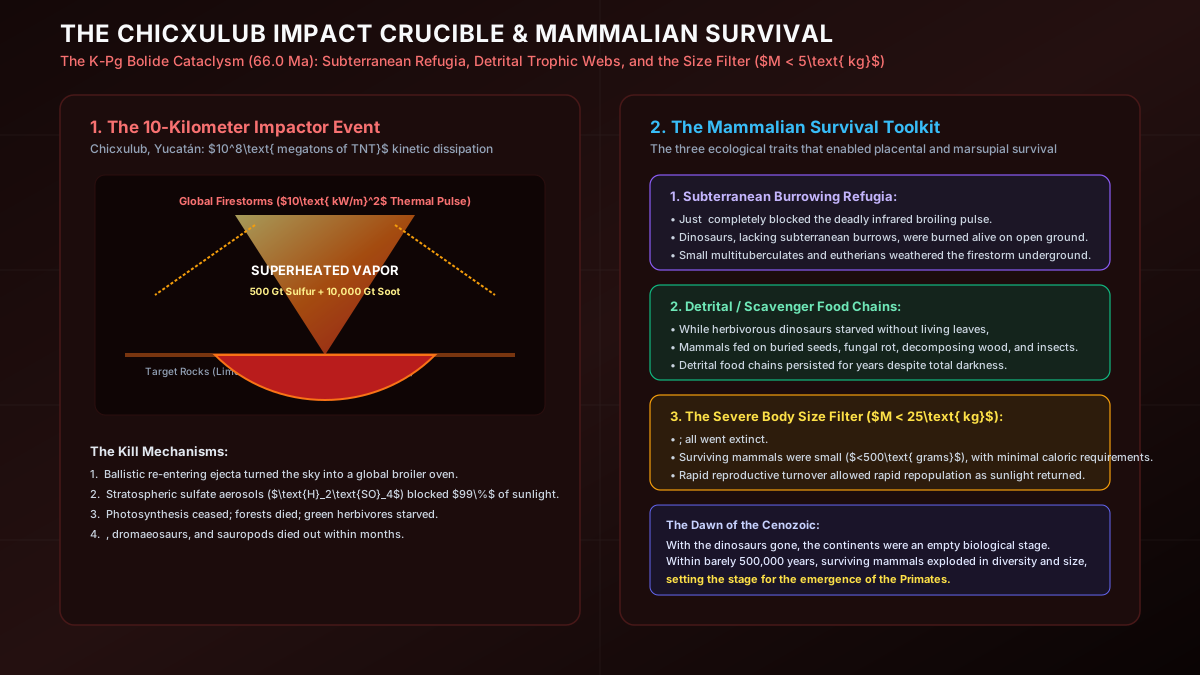
The Thermal Broiler and the Long Nuclear Winter
The extinction unfolded in two lethal temporal phases:
- The Thermal Pulse (Hours 1 to 4): Billions of tons of sub-orbital ejecta spherules re-entered Earth’s atmosphere, frictionally heating the upper air to incandescent temperatures ($>1,000^\circ\text{C}$). The sky glowed red-hot, delivering a global infrared thermal radiation pulse of $10\text{ kW/m}^2$—baking Earth’s surface like a broiler oven and igniting spontaneous global wildfires.
- The Impact Winter (Years 1 to 10): Sunlight was extinguished by stratospheric soot and sulfuric acid aerosols. Surface solar irradiance dropped by over $95\%$. Global temperatures plummeted by $10\text{–}15^\circ\text{C}$, halting terrestrial and marine photosynthesis and collapsing the primary producers that anchored dinosaurian food webs.
4. Why Mammals Survived While Dinosaurs Died
The K-Pg boundary was not a random culling; it was an uncompromising ecological and biophysical filter. Every single non-avian dinosaur species on Earth perished. Why did our mammalian ancestors survive?
- The Subterranean Thermal Buffer: Soil is an extraordinary thermal insulator. Theoretical modeling proves that a soil depth of just $10\text{ to }20\text{ centimeters}$ completely shielded subterranean burrowers from the lethal four-hour infrared broiling pulse. Surface-dwelling dinosaurs had nowhere to hide and were incinerated alive; mammals were safely sleeping underground.
- Detrital Trophic Independence: When photosynthesis collapsed, herbivorous dinosaurs (like Triceratops and Edmontosaurus) that required hundreds of kilograms of fresh green vegetation daily starved within weeks, dragging apex predators like Tyrannosaurus rex down with them. Mammals, by contrast, were generalist detritivores and scavengers. They fed on buried seed caches, fungal rot, decaying wood, and soil insects—a food web that thrived in the dark for years.
- The Severe Body Size Filter ($M < 25\text{ kg}$): Paleontological census demonstrates that 100% of non-marine terrestrial animals exceeding $25\text{ kg}$ went extinct. The surviving mammals were tiny ($<500\text{ grams}$), with minimal absolute caloric requirements and rapid reproductive turnover rates.
When the stratospheric soot finally settled and sunlight pierced the ash clouds of the early Paleocene, the mighty dinosaur empire was gone forever. Emerging from their subterranean burrows into an empty world of endless opportunity, the stage was set for our humble ancestors to embark on the most explosive evolutionary radiation in mammalian history—a radiation that would lead directly to the emergence of the Primates.