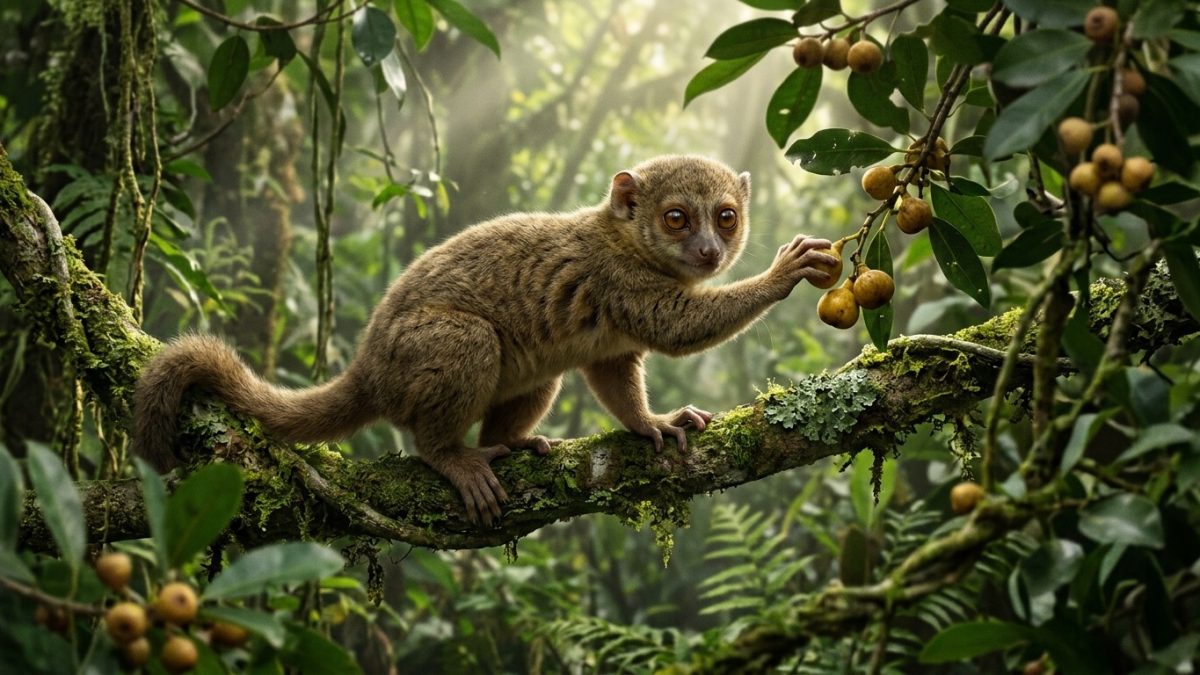
Sixty-six million years ago, the catastrophic Chicxulub asteroid impact erased the non-avian dinosaurs and cleared the continental ecological canvas. Into this profound vacuum stepped the surviving nocturnal mammals. Within a geological blink of ten million years during the Paleocene and early Eocene epochs ($66\text{–}50\text{ Ma}$), mammals underwent one of the most breathtaking adaptive radiations in Earth history. Among these pioneering placental lineages emerged our direct order: the Primates. Abandoning the dark forest floor, stem primates ascended into the sunlit, three-dimensional labyrinth of the dense subtropical rainforest canopy. There, intense selective pressures forged the definitive biological toolkit of humanity: grasping hands with opposable digits and flat nails, forward-facing stereoscopic eyes with postorbital protection, high-resolution color processing, and a dramatically expanded cognitive neocortex.
1. Conquering the Canopy: Competing Hypotheses of Primate Origins
What specific ecological crucible transformed a generalized insectivorous ground mammal into a specialized arboreal primate? For over a century, evolutionary biologists and biological anthropologists have debated three premier evolutionary models:
- The Arboreal Hypothesis (Smith & Wood Jones, 1912–1916): Grafton Elliot Smith and Frederic Wood Jones proposed that the defining primate traits evolved primarily as generalized adaptations for life in the trees. Navigating precarious branches required grasping hands and feet rather than claws, while three-dimensional movement favored binocular vision and depth perception over olfaction.
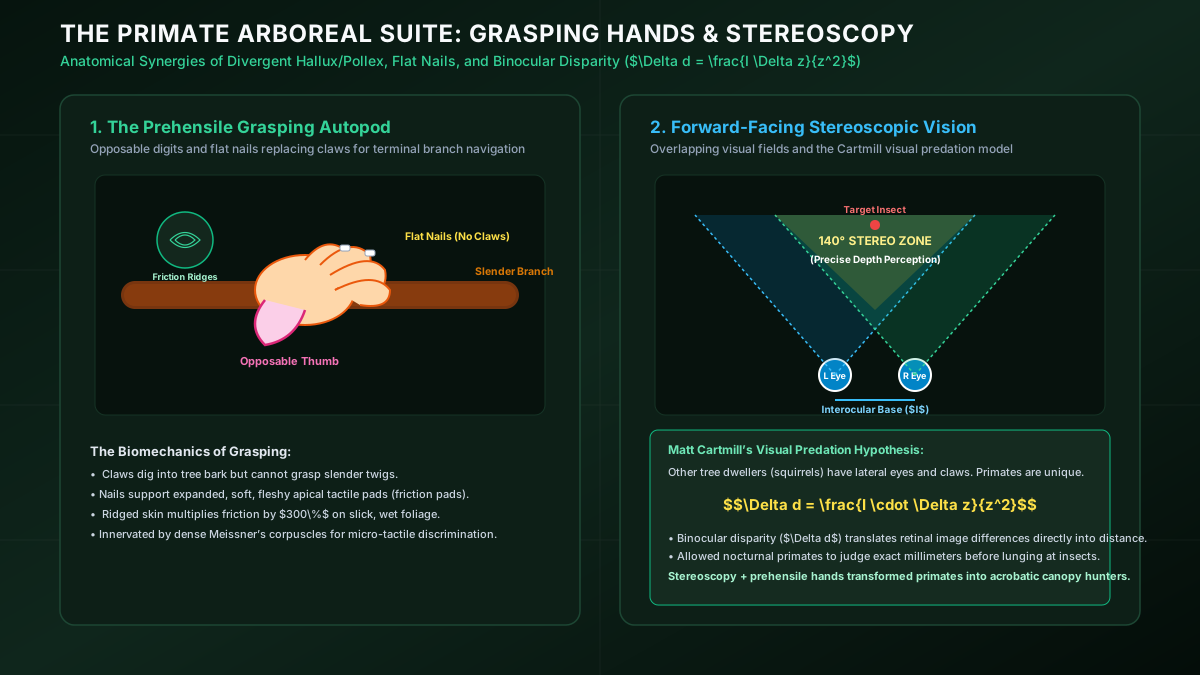
- The Visual Predation Hypothesis (Matt Cartmill, 1974): Cartmill pointed out that many non-primate arboreal mammals (such as squirrels and tree shrews) thrive in canopies using sharp claws and lateral eyes. Instead, Cartmill argued that primates evolved convergent features with terrestrial ambush predators like cats and owls: forward-facing binocular eyes with wide visual overlap and stereoscopic depth perception evolved specifically to hunt nocturnal insects in the fine-branch terminal canopy, using grasping paws to snatch prey silently.
- The Angiosperm Co-evolution Hypothesis (Robert Sussman, 1991): Sussman observed that the radiation of modern primates in the early Eocene coincided precisely with the explosive evolutionary radiation of modern fruiting and flowering trees (angiosperms). Primates evolved their grasping extremities, sensitive friction-ridge tactile pads, and color vision not to hunt swift insects, but to harvest terminal-branch fruits, seeds, and nectar in the dense, tangled outer canopy.
Today, paleontologists embrace a Synthetic Model: basal plesiadapiforms and stem euprimates first adapted to fine-branch feeding on fruits, flowers, and exudates (as Sussman proposed), which pre-adapted the autopod for precision grasping. Once in the terminal canopy, visual predation on insects (as Cartmill proposed) drove optical convergence, the origin of the postorbital bar, and the expansion of the visual cortex.
The Anatomy of the Grasping Autopod
Unlike claws, which rely on mechanical piercing into bark, primate hands and feet evolved opposable first digits (the pollex in the hand, the hallux in the foot). The ungual phalanges broadened and flattened, replacing curved keratinous claws with flat nails. This exposed sensitive apical skin cushions richly invested with Meissner’s corpuscles and papillary friction ridges (dermatoglyphics, or fingerprints), providing exquisite tactile feedback and non-slip friction against slick wet branches.
2. Adapoids vs. Omomyids: The Great Eocene Primate Schism
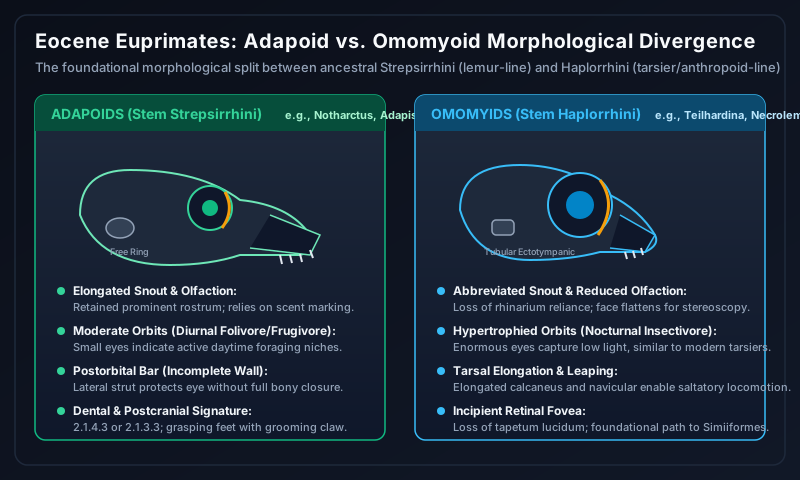
At the base of the Eocene epoch ($56\text{ Ma}$), true primates—known as Euprimates (“primates of modern aspect”)—burst into the fossil record across North America, Europe, and Asia. From their inception, Euprimates were bifurcated into two dominant evolutionary super-families, representing the ancestral roots of the two major suborders living today:
1. Adapoids (Superfamily Adapoidea — Stem Strepsirrhini)
Adapoids (such as Notharctus in North America, Adapis in Europe, and the exquisitely preserved German fossil Darwinius masillae nicknamed “Ida”) were medium-bodied arboreal primates (weighing $1\text{–}8\text{ kg}$):
- Cranial & Sensory Architecture: Retained relatively long, pointed rostra and functional nasal turbinates, reflecting continued reliance on olfactory communication and scent marking. Their eye sockets were of moderate size, proving they were primarily diurnal (day-active).
- Dentition: Retained four premolars ($2.1.4.3$) or three ($2.1.3.3$), with shearing crests on molar cusps optimized for masticating fibrous leaves (folivory) and hard seeds.
- Postcranial Locomotion: Possessed long, powerful hindlimbs, grasping halluces, and mobile vertebral columns suited for quadrupedal branch running and climbing. Adapoids represent the stem clade of modern Strepsirrhines (the lemurs of Madagascar and lorises of Africa and Asia).
2. Omomyids (Superfamily Omomyoidea — Stem Haplorrhini)
Contemporaneous with the adapoids were the omomyids (such as Teilhardina, Necrolemur, and Tetonius), which were diminutive creatures typically weighing under $500\text{ grams}$:
- Cranial & Sensory Architecture: Exhibited drastically shortened snouts and flat faces, signaling a marked reduction in olfactory apparatus in favor of vision. Their orbits were hypertrophied (enormously enlarged), indicating an obligate nocturnal lifestyle hunting insects and small invertebrates.
- Acoustic & Cranial Synapomorphies: Developed a tubular ossified ectotympanic ear canal extending laterally from the auditory bulla, and postorbital plates beginning to close off the back of the eye socket—fundamental anatomical hallmarks of modern Haplorrhines.
- Saltatory Locomotion: The calcaneus and navicular bones in the ankle were significantly elongated, forming a powerful anatomical lever for vertical clinging and explosive leaping through the understory canopy—traits preserved today in their living relatives, the tarsiers, and foundational to the anthropoid monkeys and apes.
3. The PETM Hyperthermal Spike and Circumpolar Primate Radiation
How did euprimates suddenly appear simultaneously across Asia, Europe, and North America at exactly 56 million years ago? The answer lies in one of the most extreme, abrupt global climate shocks in Earth history: the Paleocene-Eocene Thermal Maximum (PETM).

The Geochemical Mechanism of the PETM
At approximately $56.0\text{ Ma}$, a massive, rapid injection of light carbon (amounting to an estimated $4,500\text{–}6,000\text{ Gigatons of Carbon}$, comparable to burning all modern human fossil fuel reserves) flooded the global oceans and atmosphere. Triggered by intense North Atlantic Igneous Province (NAIP) volcanism baking organic-rich sediments, paired with runaway destabilization of seafloor methane clathrates ($\text{CH}_4$), atmospheric $p\text{CO}_2$ surged beyond $1,500\text{ ppm}$.
The resulting global greenhouse anomaly raised global temperatures by $5\text{–}8^\circ\text{C}$ in less than 20,000 years. Tropical and subtropical temperatures expanded relentlessly toward the poles. At $75^\circ\text{N}$ latitude—in modern frozen archipelagos like Ellesmere Island and Spitsbergen—paleobotanists find fossilized swamp cypresses, palm trees, and crocodilian reptiles. There were no polar ice sheets; the Arctic Ocean was a warm, brackish, frost-free inland sea.
The High-Latitude Canopy Highway
Because the high Arctic was cloaked in dense, continuous subtropical rainforest, the high-latitude continental bridges connecting Asia, North America, and Europe (the Beringian Land Bridge across the Pacific and the Thulean / De Geer Bridges across the North Atlantic) transformed into lush arboreal corridors. Basal euprimates, incapable of surviving freezing winter temperatures, were able to migrate across the top of the globe without ever descending from the tree canopy.
Paleontologist Philip Gingerich and his colleagues discovered that the basal omomyid Teilhardina dispersed across Asia (T. asiatica), Europe (T. belgica), and North America (T. brandti) in less than $25,000\text{ years}$—a stunningly rapid intercontinental radiation fueled entirely by the PETM thermal corridor. The warming created the golden age of early primates, populating the northern hemisphere with vibrant arboreal lineages.
4. Encephalization and the Foundations of Anthropoidea
The transition from basal plesiadapiforms to crown Euprimates was not merely a locomotor and sensory adaptation; it was an intellectual revolution. Relative brain size—measured by the Encephalization Quotient ($EQ$)—expanded dramatically beyond any contemporary mammalian baseline.
Life in the high canopy demanded complex cognitive processing:
- 3D Spatial Mapping: Leaping through fine branches required calculating landing vectors, branch elasticity, and spatial trajectories in real time, driving the expansion of the parietal cortex and cerebellar coordination circuits.
- Episodic Foraging Memory: Angiosperm trees produce fruit asynchronously across vast forest expanses. Primates that could remember which trees were ripening, where they were located, and the fastest arboreal pathways between them gained a decisive caloric advantage, stimulating temporal lobe and hippocampal expansion.
- The Visual Cortex Explosion: The primary visual cortex ($V1$) expanded to occupy the entire posterior pole of the occipital lobes. New associative visual areas ($V2, V3, V4, MT$) evolved to decode color contrast, fine texture, and high-speed motion parallax.
By the late Eocene and early Oligocene ($36\text{–}34\text{ Ma}$), as global climates cooled and the grand Eocene forests contracted, these arboreal, large-brained, visually acute euprimates laid the morphological foundation for the next monumental chapter in our family history: the rise of the Anthropoidea—the true higher primates, monkeys, and apes.