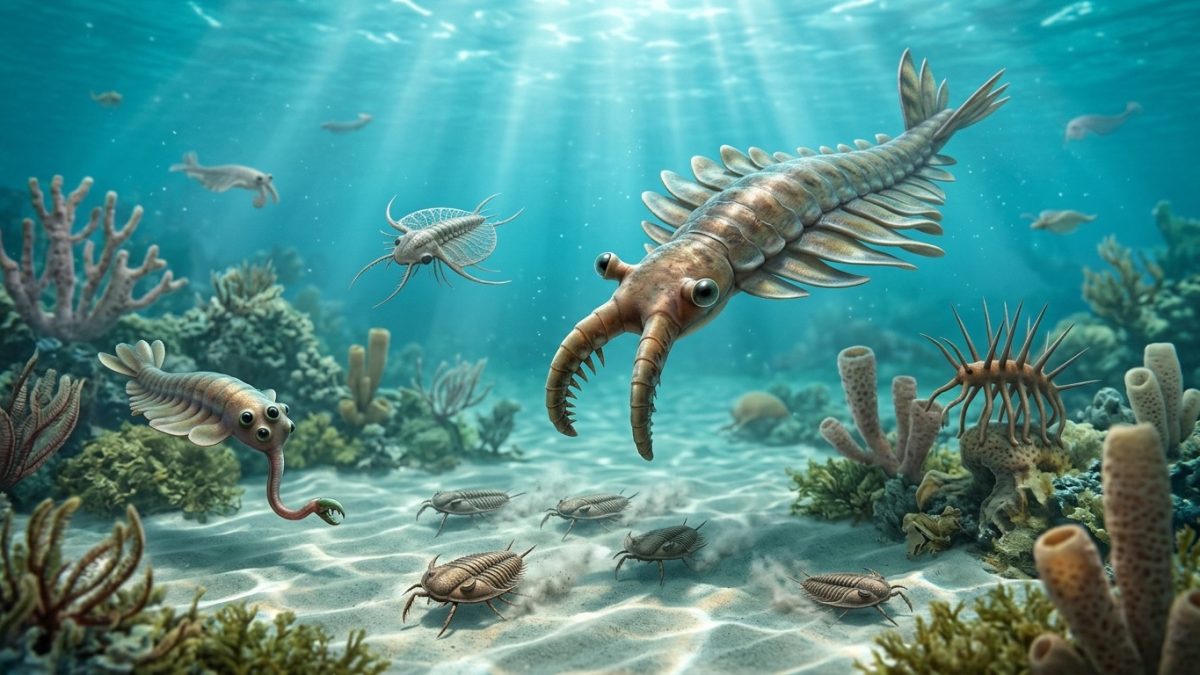
Fifty-four million years into the dawn of the Phanerozoic Eon, between 541 and 485 million years ago, the fossil record underwent an explosive transformation so sudden that it troubled Charles Darwin to the end of his life. In barely twenty million years—a fleeting heartbeat in geological time—virtually every major animal body plan (phylum) that inhabits modern Earth materialized out of apparent nowhere. From the deep-sea muds emerged armored trilobites viewing the world through stone lenses, segmented arthropods with crushing claws, swimming chordates with stiff notochords, and metre-long apex leviathans executing the first macroscopic predatory hunts in history.
1. The Evo-Devo Engine: Hox Genes and Spatial Colinearity
For more than a century after Darwin, paleontologists debated whether the Cambrian Explosion represented an explosion of life itself or merely an “explosion of fossils”—the sudden appearance of mineralized shells that preserved easily. The advent of evolutionary developmental biology (Evo-Devo) in the late 20th century provided the definitive genetic explanation: the Cambrian animals did not invent thousands of separate genetic blueprints; they inherited an ancient, pre-existing master operating system known as the Homeobox (Hox) gene cluster.
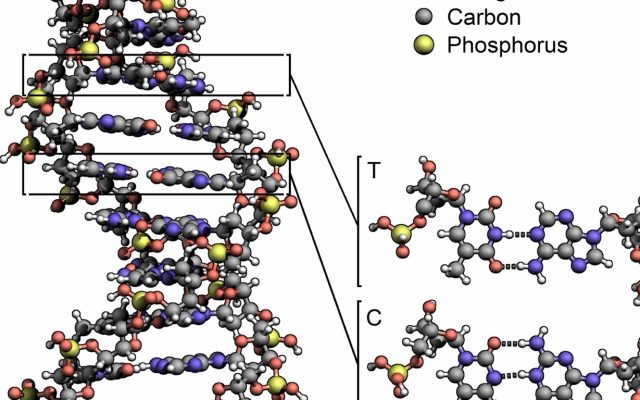
Hox genes encode master transcription factors equipped with a conserved 60-amino-acid DNA-binding domain called the homeodomain. The homeodomain’s recognition $\alpha$-helix inserts precisely into the major groove of target DNA, binding the core sequence $\text{5′-TAAT-3′}$ to activate or repress batteries of hundreds of downstream structural genes.

The organizing genius of the Hox cluster is the rule of Spatial and Temporal Colinearity, discovered by Edward B. Lewis (1995 Nobel Prize). The linear physical order of Hox genes along a chromosome directly mirrors their expression sequence along the animal’s body axis:
- Genes at the $3’\text{-end}$ of the cluster (such as labial and proboscipedia) activate earliest in development and specify the anterior head structures.
- Genes in the middle of the cluster (Deformed, Scr, Antennapedia, Ultrabithorax) dictate the thoracic segments, directing the outgrowth of walking legs, claws, or antennae.
- Genes at the $5’\text{-end}$ (abdominal-A, Abdominal-B) turn on latest and establish the posterior abdominal segments and genital apparatus.
By dividing the bilaterian body into independent developmental compartments, the Hox cluster solved an insurmountable architectural problem. A mutation altering the limbs of a thoracic segment (such as transforming a walking leg into a grasping claw) could occur without causing fatal collateral disruptions to the adjacent head or digestive organs. This modularity enabled an exponential expansion into morphospace:
$$Y = a X^b \quad \implies \quad \log Y = \log a + b \log X \quad (\text{Allometric Body Diversification})$$Natural selection did not need to invent new genes to create a crab, a millipede, or a chordate; it simply rewrote the non-coding cis-regulatory switches that controlled where and when these ancient Hox master genes turned on and off.
2. The Light Switch Hypothesis: Trilobites and Optical Calcite Lenses
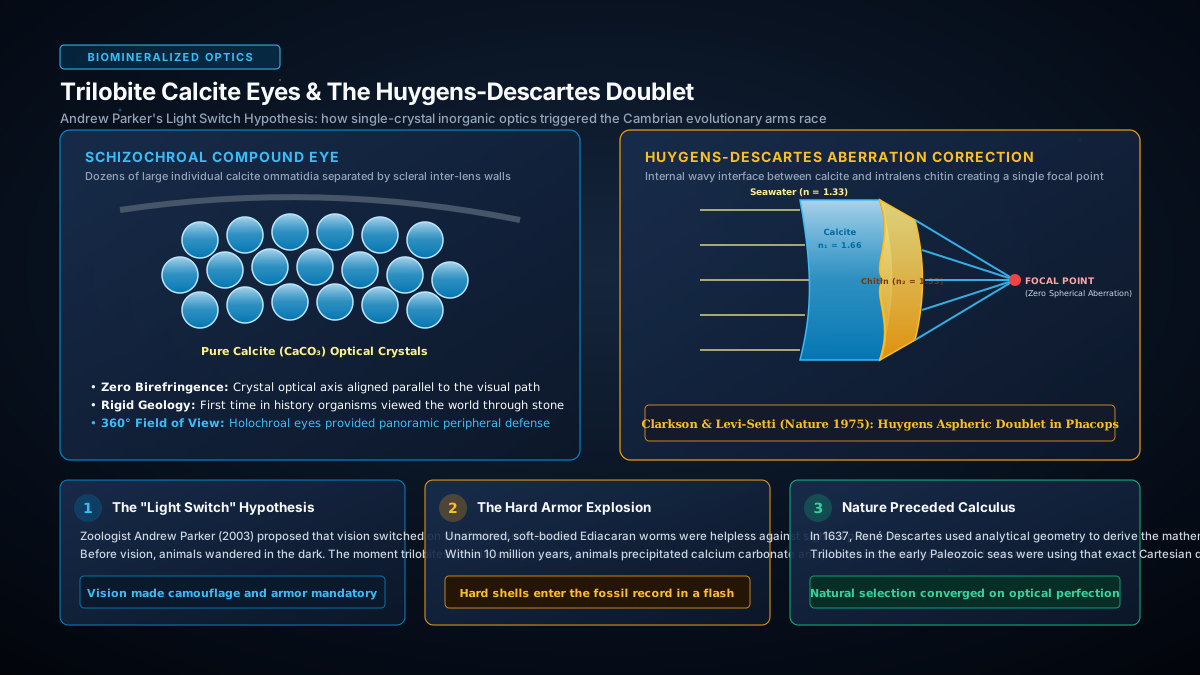
While Hox genes provided the developmental engine, what provided the external ecological spark that ignited the explosion? In 2003, Oxford zoologist Andrew Parker proposed the Light Switch Hypothesis: the sudden emergence of the Cambrian fauna was triggered by the evolution of acute image-forming vision.
Before the Cambrian, the marine world was visually dark. Organisms possessed simple non-directional light-sensitive pigment spots, capable only of distinguishing day from night. Around $530\text{ million years ago}$, Trilobites achieved a biological and physical milestone: they evolved the first sophisticated compound eyes in animal history.
Because soft proteinaceous lenses decompose underwater, trilobites executed an unprecedented feat of biomineralization: their optical lenses were constructed from pure, inorganic single-crystal calcite ($\text{CaCO}_3$). Calcite is an exceptionally rigid, clear mineral, but it possesses a severe optical flaw: birefringence (double refraction). Light entering an ordinary calcite crystal splits into two rays polarized at right angles, producing double, blurry ghost images. Trilobites eliminated this flaw with crystallographic precision: every single lens was grown with its optical axis oriented strictly parallel to the incoming light ray, reducing birefringence to zero!
Furthermore, early trilobite lenses suffered from spherical aberration: light entering the curved outer perimeter of a lens bends more sharply than light entering the center, blurring the image. In a classic 1975 Nature paper, Euan Clarkson and Riccardo Levi-Setti discovered that advanced phacopid trilobites solved this with a Cartesian doublet lens.
The upper lens was made of pure calcite ($n_1 = 1.66$); beneath it sat a lower lens of magnesium-rich chitinous material ($n_2 = 1.53$). The two layers met at a wavy, mathematically precise aspheric curve that exactly matched the optical equations derived by mathematicians René Descartes and Christiaan Huygens in the 17th century:
$$n_1 \sin \theta_1 = n_2 \sin \theta_2 \quad (\text{Snell’s Law of Refraction at the Cartesian Boundary})$$Trilobites possessed 360-degree, aberration-free panoramic underwater vision 500 million years before humans invented calculus. The moment vision was switched on, darkness vanished. Predators could spot unarmored prey from meters away, and prey could spot approaching carnivores. Vision transformed the peaceful Ediacaran slime world into a lethal optical colosseum.
3. The Apex Predator and the Biomineralized Arms Race
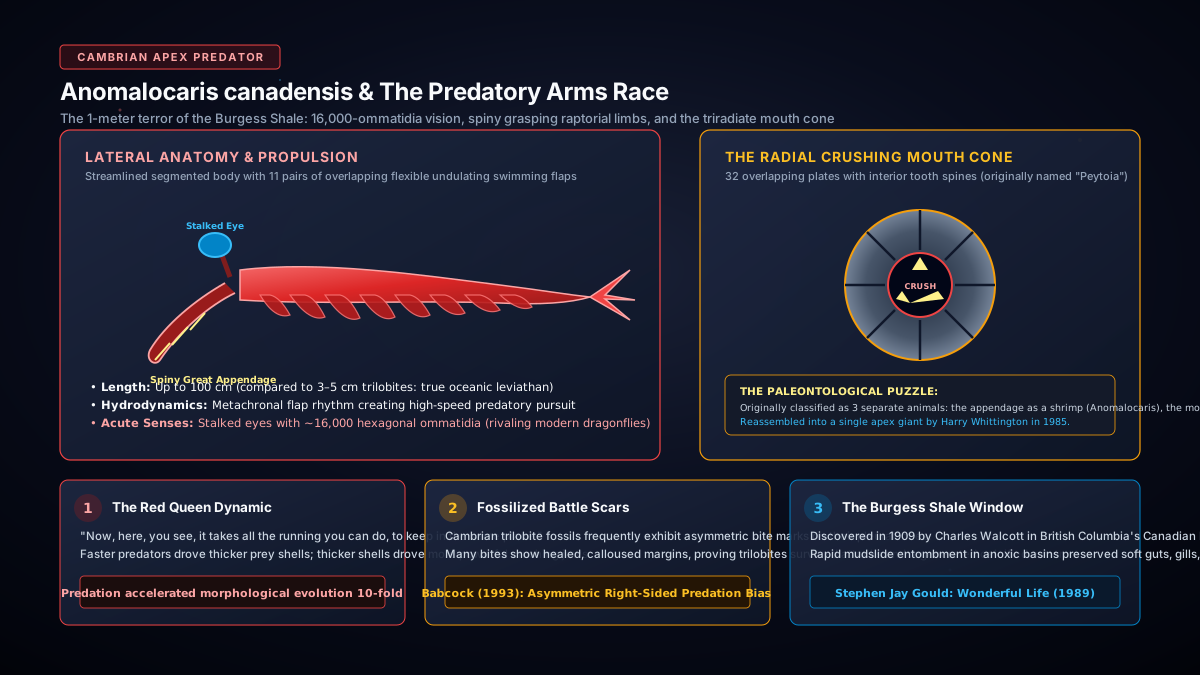
Vision immediately ignited history’s first Red Queen predatory arms race. The undisputed apex carnivore of the Cambrian seas was Anomalocaris canadensis, preserved with breathtaking soft-tissue fidelity in the 508-million-year-old Burgess Shale of British Columbia, Canada.
Reaching lengths of $60\text{ to }100\text{ cm}$, Anomalocaris was an oceanic titan in a world where typical creatures measured barely three centimeters. Its sleek, streamlined body was propelled by eleven pairs of overlapping lateral swimming flaps that undulated in metachronal waves. On its head perched two massive stalked compound eyes housing over 16,000 hexagonal ommatidia—a visual resolution rivaling modern dragonflies.
To capture prey, Anomalocaris wielded a pair of segmented, spiny “great appendages” that could curl downward to seize skittering trilobites. It then shoved prey into its circular mouth cone—a radial nightmare composed of 32 overlapping chitinous plates surrounding an inner ring of serrated teeth. By contracting these plates, Anomalocaris applied crushing, shearing mechanical forces that cracked defensive exoskeletons.
The fossilized evidence of this Cambrian arms race is etched directly into the rock. Paleontologist Loren Babcock (1993) documented extensive asymmetric bite scars on Cambrian trilobite fossils. Many trilobites show healed, calloused margins where their calcified carapaces were bitten through by an apex predator, survived the strike, and successfully molted and regenerated their mineral armor.
This predatory pressure unleashed an explosive cascade of natural selection:
- Hard Fortifications: Soft-bodied organisms were systematically exterminated unless they armored themselves. In the span of a few million years, mollusks invented calcium carbonate shells, brachiopods secreted phosphatic valves, and arthropods developed hardened, jointed cuticles.
- Locomotive Breakthroughs: Sluggish bottom-crawlers were replaced by streamlined swimming swimmers and deep-burrowing infaunal worms escaping into the sediment.
- Sensory Sophistication: Antennae, chemical chemoreceptors, and statocysts (balance organs) evolved in rapid succession to detect predatory pressure waves.
Conclusion: The Architecture of the Modern Biosphere
By the close of the Cambrian Period at $485\text{ million years ago}$, the foundations of the modern biosphere had been permanently established. The morphospace of animal architecture was fully staked out: Arthropoda, Mollusca, Annelida, Brachiopoda, Echinodermata, and Chordata all occupied distinct ecological niches.
Yet swimming quietly in the shadows of the giant Anomalocaris was a tiny, translucent, five-centimeter creature that possessed no shell, no claws, and no mineralized armor: Pikaia gracilens. Inside its flexible body lay a simple, stiffened longitudinal rod—the notochord. In Part 7, we will follow this humble ribbon of flesh and witness the Chordate Dawn: the origin of the skull, the brain, and the human backbone.
Key Academic Citations
- Gould, S. J. (1989). Wonderful Life: The Burgess Shale and the Nature of History. W. W. Norton & Company.
- Parker, A. (2003). In the Blink of an Eye: How Vision Sparked the Big Bang of Evolution. Basic Books.
- Clarkson, E. N. K., & Levi-Setti, R. (1975). Trilobite eyes and the optics of Descartes and Huygens. Nature, 254(5502), 663–667.
- Whittington, H. B., & Briggs, D. E. (1985). The largest Cambrian animal, Anomalocaris, Burgess Shale, British Columbia. Philosophical Transactions of the Royal Society B, 309(1141), 569–609.
- Lewis, E. B. (1978). A gene complex controlling segmentation in Drosophila. Nature, 276(5688), 565–570.
- Carroll, S. B. (2005). Endless Forms Most Beautiful: The New Science of Evo Devo. W. W. Norton & Company.