While kinematics abstracts a robot as purely geometric links and joints moving in empty space, manipulator dynamics governs how forces and torques actually cause motion under physical mass, inertia, gravity, and contact. The equations of motion form the mathematical foundation for model-based feedforward control, trajectory optimization, and simulation. The classical Lagrangian formulation provides profound geometric insight into energy conservation and passivity through Christoffel symbols and the skew-symmetry property.
1. The Lagrangian Formulation of Manipulator Dynamics
For an (n)-degree-of-freedom manipulator with generalized joint coordinates (q in mathbb{R}^n) and generalized velocities (dot{q} in mathbb{R}^n), the Lagrangian (mathcal{L}) is defined as the difference between total kinetic energy (mathcal{K}) and potential energy (mathcal{P}):
[
mathcal{L}(q, dot{q}) = mathcal{K}(q, dot{q}) – mathcal{P}(q) = rac{1}{2} dot{q}^T M(q) dot{q} – mathcal{P}(q)
]
Where (M(q) in mathbb{R}^{n imes n}) is the configuration-dependent mass (inertia) matrix. By Euler-Lagrange mechanics:
[
rac{d}{dt} left( rac{partial mathcal{L}}{partial dot{q}}
ight) – rac{partial mathcal{L}}{partial q} = au
]
Expanding the derivatives yields the standard equation of motion for an open kinematic chain:
[
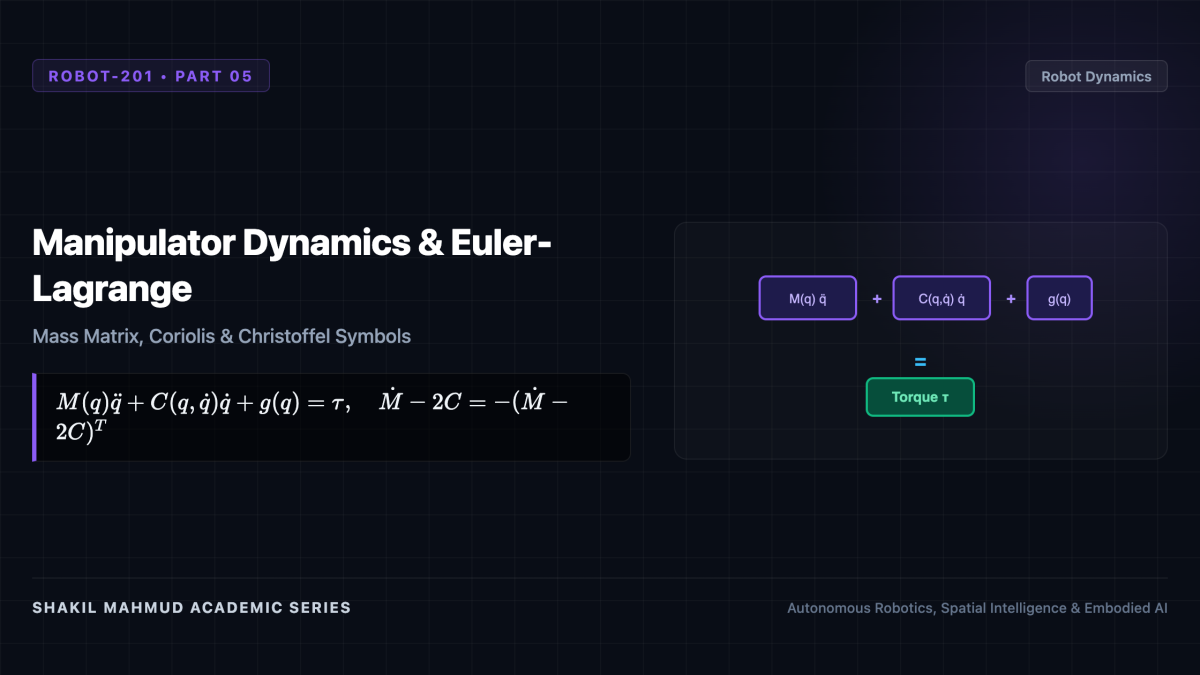
M(q) ddot{q} + C(q, dot{q}) dot{q} + g(q) = au
]
Where:
- (M(q)): Symmetric and strictly positive-definite ((M(q) = M^T(q) > 0)), serving as the Riemannian metric tensor on the robot’s configuration manifold.
- (C(q, dot{q}) dot{q}): Vector of Coriolis and centrifugal forces, quadratic in joint velocities.
- (g(q) =
abla_q mathcal{P}(q)): Vector of conservative gravitational torques. - ( au in mathbb{R}^n): Vector of generalized actuator torques applied at the joints.
2. Christoffel Symbols and the Coriolis Matrix
The (kj)-th element of the Coriolis matrix (C(q, dot{q})) is derived via Christoffel symbols of the first kind (Gamma_{ijk}(q)):
[
C_{kj}(q, dot{q}) = sum_{i=1}^n Gamma_{ijk}(q) dot{q}_i = rac{1}{2} sum_{i=1}^n left( rac{partial M_{kj}}{partial q_i} + rac{partial M_{ki}}{partial q_j} – rac{partial M_{ij}}{partial q_k}
ight) dot{q}_i
]
Defining (C) via Christoffel symbols guarantees the fundamental Skew-Symmetry Property:
[
N(q, dot{q}) = dot{M}(q) – 2 C(q, dot{q}) quad implies quad s^T N(q, dot{q}) s = 0 quad orall s in mathbb{R}^n
]
This skew-symmetry represents the conservation of kinetic energy in the mechanical system: (rac{d}{dt} left( rac{1}{2} dot{q}^T M(q) dot{q}
ight) = dot{q}^T au – dot{q}^T g(q)). It is the critical building block for designing provably stable Lyapunov-based non-linear tracking controllers and adaptive parameter estimators.
3. The Recursive Newton-Euler Algorithm (RNEA)
While the Euler-Lagrange method is algebraically transparent, evaluating its symbolic Christoffel terms scales poorly with degrees of freedom ((mathcal{O}(n^4)) computational complexity). For real-time 1 kHz robot control, robotics utilizes the Recursive Newton-Euler Algorithm (RNEA), which achieves (mathcal{O}(n)) linear complexity via a two-pass recursive propagation:
- Forward Kinematic Recursion (Base ( o) Tip): Propagates spatial velocities (mathcal{V}_i) and accelerations (dot{mathcal{V}}_i) link by link using spatial transformations:
[
mathcal{V}_i = A_i^T mathcal{V}_{i-1} + mathcal{S}_i dot{q}_i, quad dot{mathcal{V}}_i = A_i^T dot{mathcal{V}}_{i-1} + mathcal{S}_i ddot{q}_i + mathcal{V}_i imes (mathcal{S}_i dot{q}_i)
] - Link Dynamic Inversion: Computes the net spatial dynamic wrench on each rigid link using the (6 imes 6) spatial inertia dyadic (mathcal{I}_i):
[
mathcal{F}_i^* = mathcal{I}_i dot{mathcal{V}}_i – mathcal{V}_i imes^* (mathcal{I}_i mathcal{V}_i)
] - Backward Dynamic Recursion (Tip ( o) Base): Transmits forces and moments backward from the end-effector to resolve required motor torques:
[
mathcal{F}_i = mathcal{F}_i^* + A_{i+1} mathcal{F}_{i+1}, quad au_i = mathcal{S}_i^T mathcal{F}_i
]
Modern dynamics engines (Pinocchio, MuJoCo, Drake) execute RNEA in under 2 microseconds, enabling real-time Model Predictive Control (MPC) on multi-legged quadrupeds and humanoids.