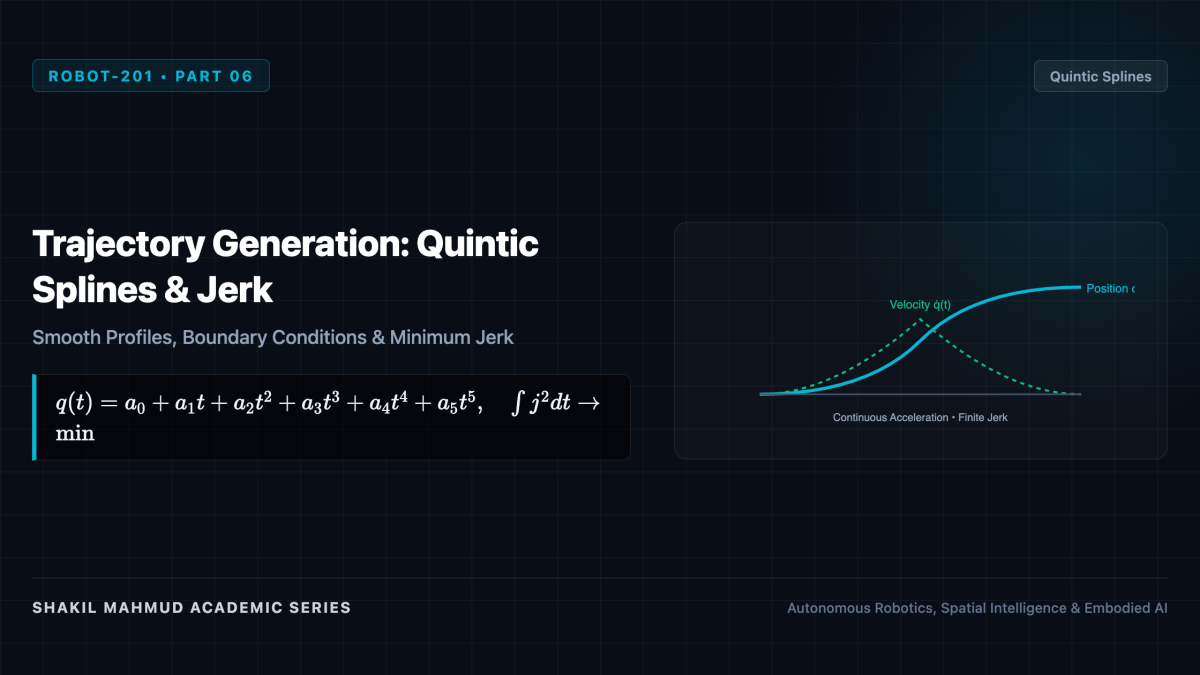
A geometric path in space specifies purely where a robot moves; a trajectory specifies both the path and the exact time history of position, velocity, acceleration, and jerk. Directing industrial arms or mobile humanoids requires continuous, smooth trajectory profiles that respect physical actuator limits (motor velocity saturation, peak torque, and thermal dissipation) while avoiding high-frequency jerk spikes that excite mechanical resonance, shake gears, and degrade precision.
1. Trapezoidal Velocity Profiles (LSPB)
The workhorse trajectory of industrial robotics is the Trapezoidal Velocity Profile, also termed Linear Segment with Parabolic Blends (LSPB):
- Phase 1 (Constant Acceleration): (ddot{q}(t) = a_{max}), velocity ramps up linearly (dot{q}(t) = a_{max} t), position curves parabolically.
- Phase 2 (Constant Velocity / Cruise): (ddot{q}(t) = 0), (dot{q}(t) = v_{max}), position increases linearly.
- Phase 3 (Constant Deceleration): (ddot{q}(t) = -a_{max}), velocity ramps down linearly to zero.
The total motion time (T) given travel distance (D = q_f – q_0) is:
[
T = rac{D}{v_{max}} + rac{v_{max}}{a_{max}} quad left( ext{provided } D ge rac{v_{max}^2}{a_{max}}
ight)
]
While time-optimal under pure acceleration limits, the trapezoidal profile exhibits a fatal physical flaw: step discontinuities in acceleration at the blend boundaries, producing theoretically infinite jerk ((j(t) = dddot{q}(t) o infty)). Infinite jerk shocks gearbox teeth and induces persistent structural vibration.
2. S-Curve Profiles and Jerk Limitation
To prevent structural resonance, modern motion controllers employ 7-Segment S-Curve Profiles, which bound the maximum jerk to a finite value (j(t) in [-j_{max}, j_{max}]):
- Linear ramp-up of acceleration with jerk (+j_{max}).
- Constant acceleration (ddot{q} = a_{max}) (jerk (= 0)).
- Ramp-down of acceleration with jerk (-j_{max}) to cruise velocity (v_{max}).
- Constant cruise velocity (acceleration (= 0), jerk (= 0)).
- Ramp-up of deceleration with jerk (-j_{max}).
- Constant deceleration (ddot{q} = -a_{max}).
- Ramp-down of deceleration with jerk (+j_{max}) to rest.
The continuous, S-shaped acceleration trajectory eliminates vibration, ensuring millimeter-precise placement and doubling the service life of harmonic drive gearboxes.
3. Quintic (5th-Order) Polynomial Splines
When connecting multiple discrete waypoints in joint space, polynomial splines interpolate smoothly between knots. A 3rd-order (cubic) spline (q(t) = c_0 + c_1 t + c_2 t^2 + c_3 t^3) possesses only 4 coefficients, matching only start and end positions and velocities ((q_0, dot{q}_0, q_f, dot{q}_f)), leaving accelerations discontinuous.
A 5th-Order (Quintic) Polynomial Spline provides 6 independent coefficients, matching initial and final positions, velocities, and accelerations simultaneously:
[
q(t) = a_0 + a_1 t + a_2 t^2 + a_3 t^3 + a_4 t^4 + a_5 t^5
]
For a rest-to-rest motion over time interval ([0, T]) with boundary conditions ({q(0)=q_0, dot{q}(0)=0, ddot{q}(0)=0}) and ({q(T)=q_f, dot{q}(T)=0, ddot{q}(T)=0}), the unique analytical solution is:
[
q(t) = q_0 + (q_f – q_0) left[ 10 left(rac{t}{T}
ight)^3 – 15 left(rac{t}{T}
ight)^4 + 6 left(rac{t}{T}
ight)^5
ight]
]
Differentiating verifies that velocity (dot{q}(t)) and acceleration (ddot{q}(t)) start and end strictly at zero with zero jerk discontinuities.
4. Biological Minimum-Jerk Motion (Flash & Hogan)
In 1985, Tamar Flash and Neville Hogan discovered that human arm reaching movements naturally follow the mathematical path that minimizes total squared jerk over the movement duration:
[
min_{x(t)} int_0^T left( left(rac{d^3 x}{dt^3}
ight)^2 + left(rac{d^3 y}{dt^3}
ight)^2
ight) dt
]
Solving this calculus of variations Euler-Lagrange problem yields precisely the quintic polynomial trajectory! When humanoid robots generate minimum-jerk reaching motions, their movements appear remarkably natural, predictable, and ergonomically safe to human co-workers.