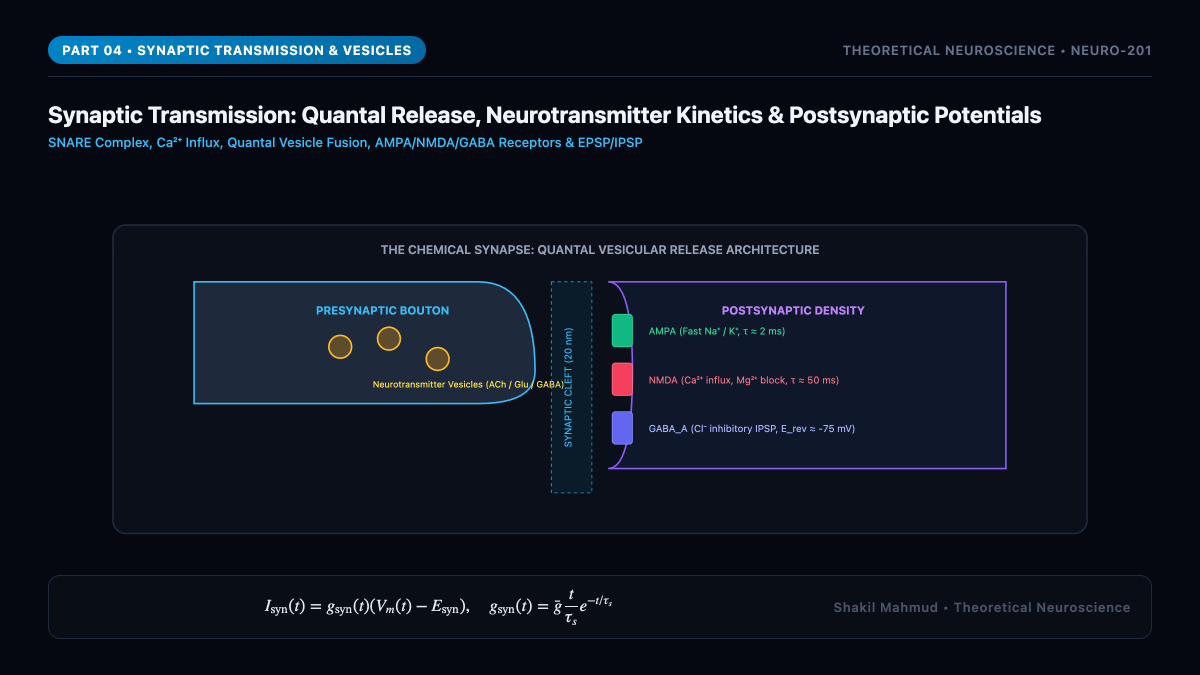
While action potentials propagate electrical signals rapidly along the axon, the transmission of information between neurons takes place at specialized chemical junctions: Synapses. By transforming an electrical voltage spike into the probabilistic exocytosis of chemical neurotransmitter vesicles across a $20text{ nm}$ synaptic cleft, the synapse introduces signal gain, non-linear rectification, and dynamic plasticity. Synaptic transmission is the fundamental physical site of memory, learning, and computational gating in the nervous system.
1. Quantal Release & The Katz Binomial Model
In the 1950s, Bernard Katz and colleagues discovered at the neuromuscular junction that neurotransmitter release is not continuous, but discrete or quantal, occurring in uniform packets corresponding to individual synaptic vesicles.
Katz formalized this via the Binomial Release Model. A presynaptic bouton contains $N$ independent release sites (the readily releasable pool). Upon an action potential arriving, each site has an independent probability $p$ of releasing a single vesicle. The probability of releasing $k$ quanta is given by:
P(k) = binom{N}{k} p^k (1 – p)^{N – k}
The mean number of released quanta (the quantal content $m$) and its variance are:
m = langle k rangle = N p, quad sigma^2 = N p (1 – p)
Depolarization opens voltage-gated calcium channels ($text{Ca}_V$). The resulting localized microdomain calcium influx triggers the $text{Ca}^{2+}$-sensor synaptotagmin, catalyzing SNARE complex assembly and membrane fusion within $200,mutext{s}$.
2. Postsynaptic Conductance Kinetics: The Alpha Function
Once released, neurotransmitter molecules diffuse across the cleft and bind to postsynaptic ligand-gated ionotropic receptors. The resulting time-varying postsynaptic conductance $g_{text{syn}}(t)$ is classically modeled by the Alpha Function:
g_{text{syn}}(t) = bar{g}_{text{syn}} frac{t}{tau_s} e^{-t / tau_s} Theta(t)
where $bar{g}_{text{syn}}$ is the peak conductance, $tau_s$ is the characteristic synaptic time constant, and $Theta(t)$ is the Heaviside step function. The postsynaptic synaptic current entering the dendritic branch is:
I_{text{syn}}(t) = g_{text{syn}}(t) (V_m(t) – E_{text{syn}})
where $E_{text{syn}}$ is the reversal potential determined by receptor ionic selectivity:
- Excitatory Synapses ($E_{text{syn}} approx 0text{ mV} > V_{text{rest}}$): Inward depolarizing current producing an Excitatory Postsynaptic Potential (EPSP).
- Inhibitory Synapses ($E_{text{syn}} approx -70text{ to } -80text{ mV} le V_{text{rest}}$): Outward hyperpolarizing current producing an Inhibitory Postsynaptic Potential (IPSP) or shunting inhibition.
3. Receptor Biophysics: AMPA, NMDA & $text{GABA}_A$
The three dominant ionotropic receptor channels in the mammalian forebrain dictate circuit temporal dynamics:
- AMPA Receptors: Fast glutamatergic excitation ($tau_{text{rise}} < 1text{ ms}, tau_{text{decay}} approx 2text{ ms}$). Permeable to $text{Na}^+$ and $text{K}^+$, mediating rapid information transfer.
- NMDA Receptors: Slow glutamatergic kinetics ($tau_{text{decay}} approx 50text{–}100text{ ms}$) permeable to $text{Ca}^{2+}$. Critically, at resting membrane potentials, extracellular $text{Mg}^{2+}$ ions physically plug the channel pore. Depolarization expels the $text{Mg}^{2+}$ ion by electrostatic repulsion:
g_{text{NMDA}}(V, t) = bar{g}_{text{NMDA}} frac{s(t)}{1 + frac{[text{Mg}^{2+}]_o}{3.57} e^{-0.062 V}}
Because NMDA activation requires both presynaptic glutamate and postsynaptic depolarization, it functions as a molecular coincidence detector.
- $text{GABA}_A$ Receptors: Fast chloride conductances ($E_{text{Cl}} approx -75text{ mV}, tau_s approx 5text{ ms}$) mediating fast feedforward and recurrent cortical inhibition.
4. Short-Term Synaptic Plasticity (Depression & Facilitation)
Synaptic transmission is not a static gain multiplier; synapses filter spike trains through frequency-dependent Short-Term Plasticity (STP):
- Short-Term Depression (STD): High-frequency spike trains deplete the readily releasable vesicle pool faster than recycling kinetics, acting as a low-pass or novelty-detecting filter.
- Short-Term Facilitation (STF): Residual calcium accumulates in the presynaptic terminal, progressively increasing the release probability $p$ for successive spikes, acting as a high-pass burst detector.
Formalized by the Tsodyks-Markram phenomenological model, short-term plasticity equips biological synapses with dynamic temporal kernels unmatched by conventional artificial weight matrices.




