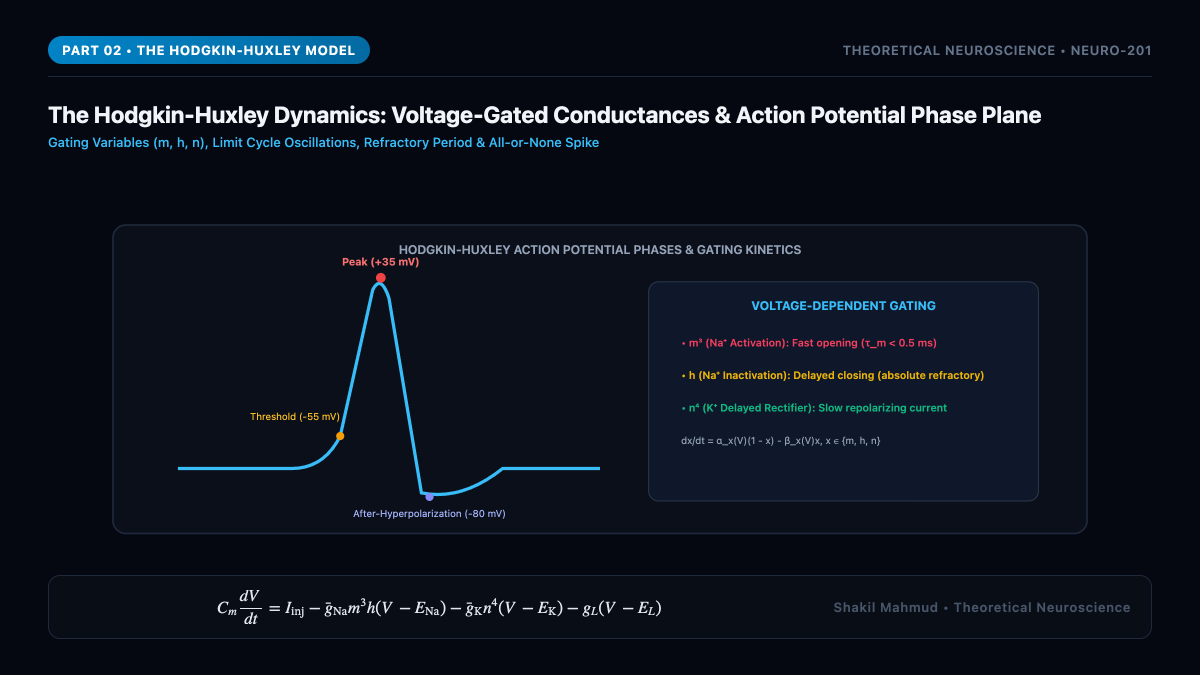
In 1952, Alan Hodgkin and Andrew Huxley published a landmark series of papers deciphering the electrophysiology of the giant squid axon. Their mathematical triumph was the formulation of a set of four coupled non-linear ordinary differential equations that quantitatively reconstructed the generation and propagation of the Action Potential—the all-or-none electrical spike that serves as the universal computational bit of neural communication. This work established quantitative biophysics and earned the 1963 Nobel Prize in Physiology or Medicine.
1. Voltage-Clamp Methodology & Conductance Separation
The core challenge in measuring ionic currents during a spike is that current changes voltage, which in turn alters channel conductances. Hodgkin and Huxley employed the newly invented Voltage-Clamp technique, utilizing negative feedback to clamp the membrane potential $V_m$ at command voltages while recording the required transmembrane current.
By systematically varying extracellular ionic concentrations (e.g., replacing extracellular $text{Na}^+$ with choline), they decomposed the total membrane current into an early inward transient current carried by sodium ions ($I_{text{Na}}$) and a delayed outward sustained current carried by potassium ions ($I_{text{K}}$):
I_{text{ion}} = g_{text{Na}}(V, t) (V – E_{text{Na}}) + g_{text{K}}(V, t) (V – E_{text{K}}) + g_L (V – E_L)
2. Phenomenological Gating Kinetics ($m, h, n$)
Hodgkin and Huxley modeled ionic conductances not as fixed values, but as maximum conductances multiplied by dimensionless gating probabilities representing the opening and closing of independent sub-molecular charged gating particles:
- Potassium Conductance ($n^4$): $g_{text{K}} = bar{g}_{text{K}} n^4$. Four identical independent gating subunits must be open simultaneously for the channel to conduct.
- Sodium Conductance ($m^3 h$): $g_{text{Na}} = bar{g}_{text{Na}} m^3 h$. Three fast activation gates ($m$) and one slow inactivation gate ($h$) govern sodium influx.
Each gating variable $x in {m, h, n}$ follows first-order Markovian transition kinetics governed by voltage-dependent forward and backward rate constants $alpha_x(V)$ and $beta_x(V)$:
frac{dx}{dt} = alpha_x(V)(1 – x) – beta_x(V)x = frac{x_infty(V) – x}{tau_x(V)}
where the steady-state activation curve is $x_infty(V) = frac{alpha_x(V)}{alpha_x(V) + beta_x(V)}$ and the voltage-dependent time constant is $tau_x(V) = frac{1}{alpha_x(V) + beta_x(V)}$.
3. The Full 4-Dimensional Hodgkin-Huxley Equations
Combining capacitive displacement with ionic conductances yields the canonical 4D dynamical system:
C_m frac{dV}{dt} = I_{text{ext}} – bar{g}_{text{Na}} m^3 h (V – E_{text{Na}}) – bar{g}_{text{K}} n^4 (V – E_{text{K}}) – g_L (V – E_L)
frac{dm}{dt} = alpha_m(V)(1 – m) – beta_m(V)m
frac{dh}{dt} = alpha_h(V)(1 – h) – beta_h(V)h
frac{dn}{dt} = alpha_n(V)(1 – n) – beta_n(V)n
4. Anatomy of an Action Potential: Limit Cycles & Bifurcations
The generation of an action potential follows a non-linear trajectory:
- Depolarization: A stimulus raises $V_m$ above threshold ($approx -55text{ mV}$). The activation gates $m$ open rapidly ($tau_m < 0.2text{ ms}$), increasing $g_{text{Na}}$ and triggering explosive regenerative sodium influx (Hodgkin cycle).
- Peak & Inactivation: As $V_m$ approaches $E_{text{Na}} approx +50text{ mV}$, the inactivation gates $h$ close slowly, quenching sodium influx. Simultaneously, delayed rectifier potassium channels open ($n$ increases).
- Repolarization & Refractoriness: Outward $I_{text{K}}$ rapidly repolarizes the membrane. The persistent potassium conductance causes after-hyperpolarization toward $E_{text{K}} approx -90text{ mV}$.
In dynamical systems theory, continuous injected current $I_{text{ext}}$ causes the stable fixed point at rest to undergo an Andronov-Hopf Bifurcation, destabilizing into a stable limit cycle oscillation that corresponds to periodic spike trains.




