Visual perception feels immediate and effortless: open your eyes, and a coherent three-dimensional world of objects, faces, and motion materializes in consciousness. Yet on the retina, the image is merely a flickering two-dimensional mosaic of noisy photon detections. The brain deconstructs and reconstructs this reality through the Ventral Visual Stream. Beginning with David Hubel and Torsten Wiesel’s Nobel Prize-winning discoveries in the primary visual cortex (V1), theoretical neuroscience models vision as a hierarchical feedforward cascade of localized filtering and pooling operations that inspired the entire architecture of modern Deep Convolutional Neural Networks (CNNs).
1. Hubel & Wiesel: The Receptive Field Hierarchy
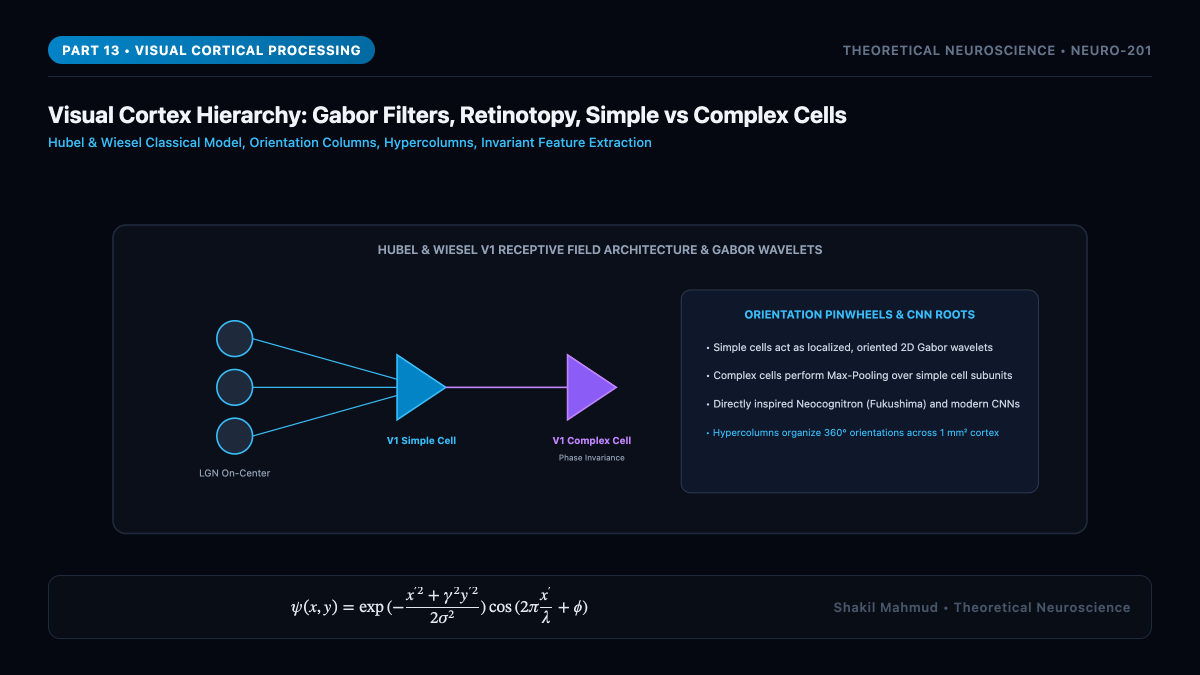
In 1959, Hubel and Wiesel discovered that while retinal ganglion cells and lateral geniculate nucleus (LGN) neurons respond to circularly symmetric spots of light (on-center/off-surround), neurons in V1 respond exclusively to oriented bars and edges of light. They classified V1 neurons into two computational classes:
- Simple Cells: Possess spatially distinct, mutually antagonistic “ON” and “OFF” subregions. Firing rate depends linearly on the precise alignment and spatial phase of an oriented line stimulus within its receptive field.
- Complex Cells: Exhibit spatially overlapping ON and OFF responses. They maintain orientation tuning while exhibiting phase and position invariance: firing strongly when an oriented bar moves anywhere within their receptive field.
Hubel and Wiesel proposed a classic feedforward model: several aligned, circularly symmetric LGN receptive fields converge onto a single V1 simple cell, and multiple simple cells with identical orientation but staggered spatial phases converge via non-linear pooling onto a complex cell.
2. Mathematical Representation: The 2D Gabor Wavelet
In 1980, John Daugman proved that the spatial receptive field profiles of V1 simple cells are mathematically optimal: they minimize the two-dimensional joint Heisenberg-Gabor uncertainty relation in space and spatial frequency ($Delta x Delta k_x = 1/2$). They are modeled by 2D Gabor Wavelets—a sinusoidal carrier modulated by an elliptical Gaussian envelope:
psi(x, y; lambda, theta, phi, sigma, gamma) = expleft( -frac{x’^2 + gamma^2 y’^2}{2sigma^2} right) cosleft( 2pi frac{x’}{lambda} + phi right)
where rotated coordinates are $x’ = x costheta + y sintheta$ and $y’ = -x sintheta + y costheta$, with orientation $theta$, wavelength $lambda$, phase $phi$, Gaussian aspect ratio $gamma$, and envelope standard deviation $sigma$. A simple cell computes the spatial inner product of the visual input luminance $I(x, y)$ with its Gabor kernel:
r_{text{simple}} = left[ iint I(x, y) psi(x, y) , dx dy right]_+
3. Energy Model of Complex Cells & The Origins of Max-Pooling
To model phase invariance, Eero Simoncelli and David Heeger formulated the Standard Energy Model: a complex cell sums the squared outputs of a pair of simple cells in spatial quadrature (phases differing by $90^circ$, $phi = 0$ and $phi = pi/2$):
r_{text{complex}} = r_{text{even}}^2 + r_{text{odd}}^2 = left( int I psi_{cos} right)^2 + left( int I psi_{sin} right)^2
By Euler’s identity ($cos^2 + sin^2 = 1$), phase cancels completely, yielding invariant orientation energy. In 1980, Kunihiko Fukushima expanded this alternating sequence of linear filtering (S-cells) and non-linear pooling (C-cells) into the Neocognitron, which directly spawned Yann LeCun’s LeNet and modern deep CNNs.
4. Cortical Architecture: Orientation Pinwheels & Divisive Normalization
Across the surface of V1, orientation preferences are mapped continuously into geometric singularities called Pinwheel Centers, where columns representing all $180^circ$ of orientation radiate from a single topological vortex.
Furthermore, Matteo Carandini and David Heeger demonstrated that V1 outputs are shaped by Divisive Normalization: a neuron’s linear response is divided by the pooled activity of its surrounding neighbors:
R_i = frac{A_i^p}{sigma^p + sum_j A_j^p}
Divisive normalization prevents contrast saturation, mediates cross-orientation suppression, and performs efficient redundancy reduction across natural image statistics.