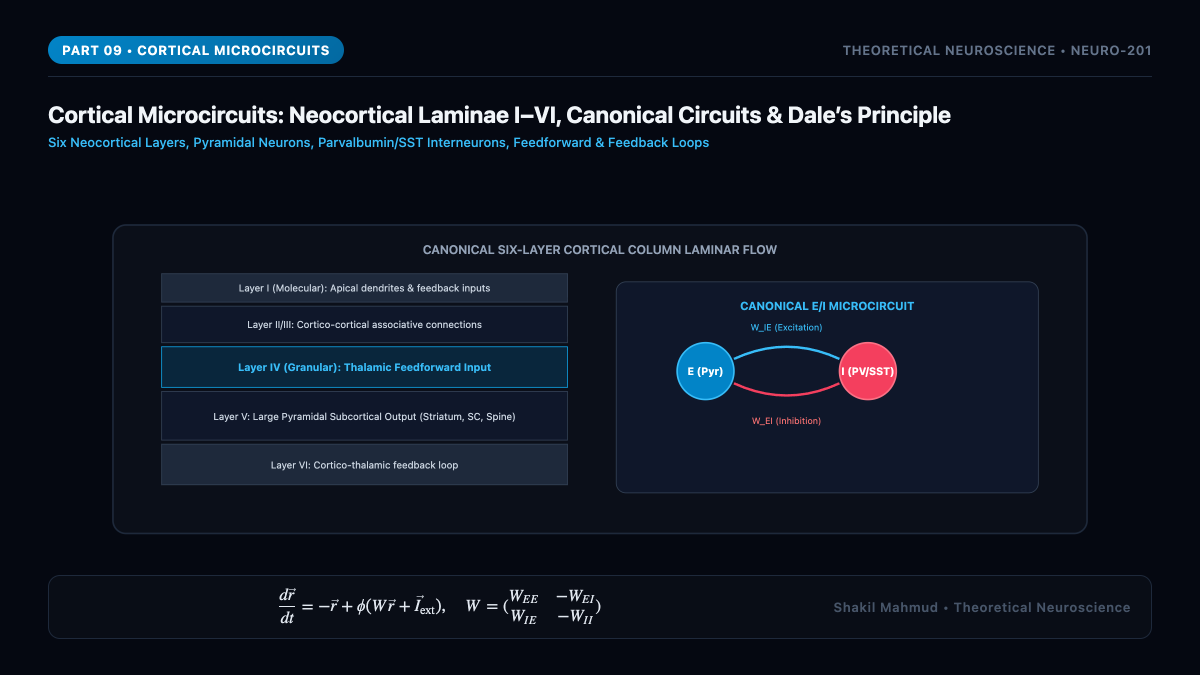
The human cerebral cortex is a 2-millimeter thick sheet containing approximately 16 billion neurons and 150 trillion synapses, folded into intricate gyri and sulci. Despite mediating cognitive functions as diverse as sensory vision, speech syntax, and abstract mathematics, the neocortex exhibits a remarkably uniform, repeated modular microstructure: the Canonical Cortical Microcircuit. Organized into six distinct laminar layers, these columns process information through coordinated interactions between glutamatergic pyramidal neurons and diverse GABAergic interneuron subtypes under the biophysical constraint of Dale’s Principle.
1. The Six Neocortical Laminae
From the pial surface down to white matter, the neocortex is partitioned into six distinct horizontal laminae, each with specialized connectivity and computational roles:
- Layer I (Molecular Layer): Devoid of cell bodies; contains horizontal axons and apical dendritic tufts of deeper pyramidal neurons, acting as the primary reception zone for top-down attentional and feedback signals.
- Layer II/III (Supragranular Layers): Populated by small-to-medium pyramidal neurons that establish dense horizontal, cortico-cortical associative connections between adjacent columns and across cortical areas.
- Layer IV (Granular Layer): The primary recipient of bottom-up feedforward sensory inputs from the thalamus (e.g., LGN for vision). Dominated by excitatory spiny stellate neurons that relay inputs up to Layer II/III.
- Layer V (Infragranular Output Layer): Contains large burst-firing pyramidal neurons whose axons provide the main descending motor and subcortical outputs (projecting to the striatum, superior colliculus, brainstem, and spinal cord).
- Layer VI (Polymorphic Layer): Provides massive reciprocal regulatory feedback projections back to the specific thalamic relay nuclei, closing the cortico-thalamic loop.
2. Dale’s Principle & The Taxonomy of GABAergic Interneurons
In 1935, Sir Henry Dale hypothesized that a mature biological neuron releases the same chemical neurotransmitter at all of its axonal terminals: Dale’s Principle. Consequently, cortical neurons divide strictly into two non-overlapping populations:
- Excitatory Pyramidal Neurons (~80%): Glutamatergic, long-range projecting cells that depolarize downstream targets.
- Inhibitory Interneurons (~20%): GABAergic, strictly local cells providing targeted inhibition.
Inhibitory interneurons are classified by molecular markers into three canonical classes:
- Parvalbumin (PV) Basket & Chandelier Cells: Fast-spiking interneurons providing soma- and axon-initial-segment-targeted feedforward inhibition ($g_{text{GABA}_A}$), responsible for gamma oscillations ($30text{–}80text{ Hz}$) and spike gain control.
- Somatostatin (SST) Martinotti Cells: Target distal apical dendrites, mediating feedback inhibition that gates dendritic NMDA spikes and top-down attentional modulation.
- $5text{HT}_{3A}text{R} / text{VIP}$ Interneurons: Inhibit SST interneurons, providing disinhibitory gating that opens transient transmission windows during active learning.
3. Wilson-Cowan Recurrent Mean-Field Dynamics
To mathematically model the collective activity of a cortical column without tracking single action potentials, Hugh Wilson and Jack Cowan (1972) formulated coupled mean-field differential equations governing the coarse-grained firing rates of excitatory ($r_E$) and inhibitory ($r_I$) neural populations:
tau_E frac{dr_E}{dt} = -r_E + phi_E(w_{EE} r_E – w_{EI} r_I + I_E)
tau_I frac{dr_I}{dt} = -r_I + phi_I(w_{IE} r_E – w_{II} r_I + I_I)
where $phi(cdot)$ is a non-linear sigmoidal response function. Depending on the synaptic coupling weights $w_{AB}$, the Wilson-Cowan system exhibits bistable switching (working memory attractors), limit cycle oscillations (cortical rhythms), or excitable transient amplification.
4. The Canonical Circuit & Computational Universality
In 1989, Rodney Douglas and Kevan Martin demonstrated that the basic laminar loop—Layer IV feedforward input $to$ Layer II/III amplification and recurrent association $to$ Layer V subcortical motor output $to$ Layer VI thalamic gain modulation—is preserved across species and sensory modalities. This universal microcircuit acts as an all-purpose computational building block, performing predictive filtering, divisive normalization, and Bayesian belief propagation across the cerebral mantle.




