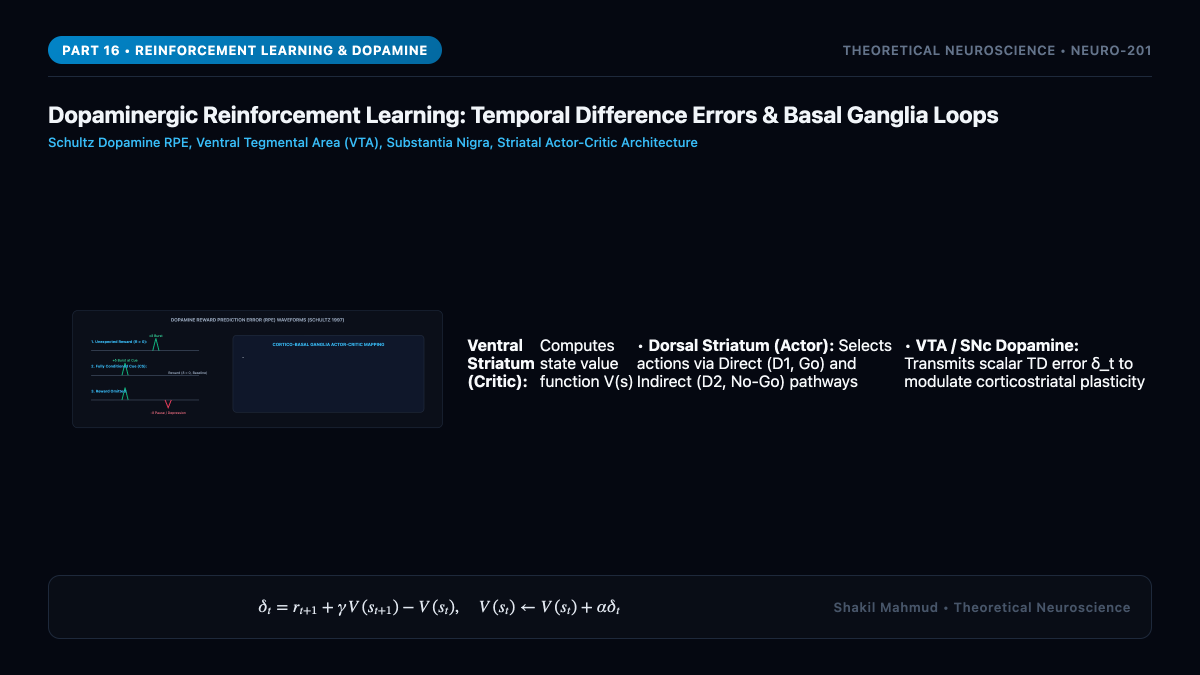
One of the most spectacular convergences between computer science and biological neuroscience occurred in the late 1990s in the study of reward and decision-making. Independently, computer scientists Richard Sutton and Andrew Barto had developed Temporal Difference (TD) Learning for artificial reinforcement learning, while neurophysiologist Wolfram Schultz recorded the firing of midbrain dopaminergic neurons in behaving primates. When Peter Dayan and Read Montague compared the two discoveries, they realized that midbrain dopamine neurons do not broadcast pleasure; they transmit the precise scalar Reward Prediction Error ($delta_t$) that powers mathematical reinforcement learning.
1. The Temporal Difference (TD) Algorithm
In reinforcement learning, an agent in state $s_t$ aims to predict the expected discounted cumulative future reward, defined as the value function $V(s_t)$:
V(s_t) = mathbb{E}left[ sum_{k=0}^infty gamma^k r_{t+k+1} right]
where $gamma in [0, 1)$ is the temporal discount factor. Rather than waiting until the end of an episode to compute total reward, Sutton and Barto’s $text{TD}(0)$ Error evaluates the difference between successive temporal predictions:
delta_t = r_{t+1} + gamma V(s_{t+1}) – V(s_t)
The state value is iteratively updated via gradient ascent:
V(s_t) leftarrow V(s_t) + alpha , delta_t
2. Schultz’s Dopamine Triad & The RPE Waveform
In 1997, Schultz, Dayan, and Montague published their historic correlation, demonstrating that midbrain dopamine neurons in the Ventral Tegmental Area (VTA) and Substantia Nigra pars compacta (SNc) match the TD error $delta_t$ with uncanny biophysical precision:
- Unpredicted Reward ($r > 0, V(s) = 0 implies delta > 0$): Dopamine neurons fire a rapid phasic burst ($30text{–}40text{ Hz}$) upon receiving an unexpected juice reward.
- Conditioned Cue ($V(s_{text{cue}}) = gamma V(s_{text{reward}}) implies delta = 0$ at reward): After conditioning, the phasic burst migrates backward in time to the earliest predictive conditioned stimulus (CS). When the predicted reward arrives, $delta_t = r – V = 0$; dopamine firing remains at its baseline rate.
- Reward Omitted ($r = 0, V > 0 implies delta < 0$): If the expected reward is withheld, dopamine neurons exhibit a complete pause or depression of firing below baseline at the precise second the reward was anticipated.
3. Corticostriatal Basal Ganglia as an Actor-Critic Architecture
The mammalian basal ganglia is anatomically organized into an Actor-Critic Architecture:
- The Critic (Ventral Striatum / Nucleus Accumbens): Receives cortical sensory state inputs and computes the state value function $V(s)$. Projects inhibitory feedback to the VTA to cancel predicted reward signals, computing the prediction error $delta_t$.
- The Actor (Dorsal Striatum — Caudate & Putamen): Selects voluntary behavioral actions via two competing, opposing output pathways:
- Direct Pathway (“Go”, D1 Receptors): Expresses low-affinity $text{G}_s$-coupled D1 dopamine receptors. Phasic dopamine bursts ($delta > 0$) potentiate corticostriatal synapses via LTP, reinforcing successful actions.
- Indirect Pathway (“No-Go”, D2 Receptors): Expresses high-affinity $text{G}_i$-coupled D2 dopamine receptors. Dopamine pauses ($delta < 0$) disinhibit D2 synapses, driving LTP in the indirect pathway to suppress unrewarded actions.
4. Three-Factor Synaptic Plasticity
In classical Hebbian learning, weight change depends only on two factors: presynaptic and postsynaptic activity ($dw propto r_{text{pre}} r_{text{post}}$). However, reinforcement learning requires a global feedback signal. At corticostriatal synapses, learning obeys a Three-Factor Learning Rule:
frac{dw_{ij}}{dt} = eta , delta_t cdot e_{ij}(t), quad tau_e frac{de_{ij}}{dt} = -e_{ij} + r_i(t) r_j(t)
Coincident pre- and post-synaptic activity creates an intracellular chemical eligibility trace $e_{ij}(t)$. If a diffuse dopamine pulse $delta_t$ arrives within a critical multi-second time window while the eligibility trace is active, the synapse is permanently potentiated or depressed. This biological three-factor rule bridges the temporal gap between fleeting motor actions and delayed environmental outcomes.




