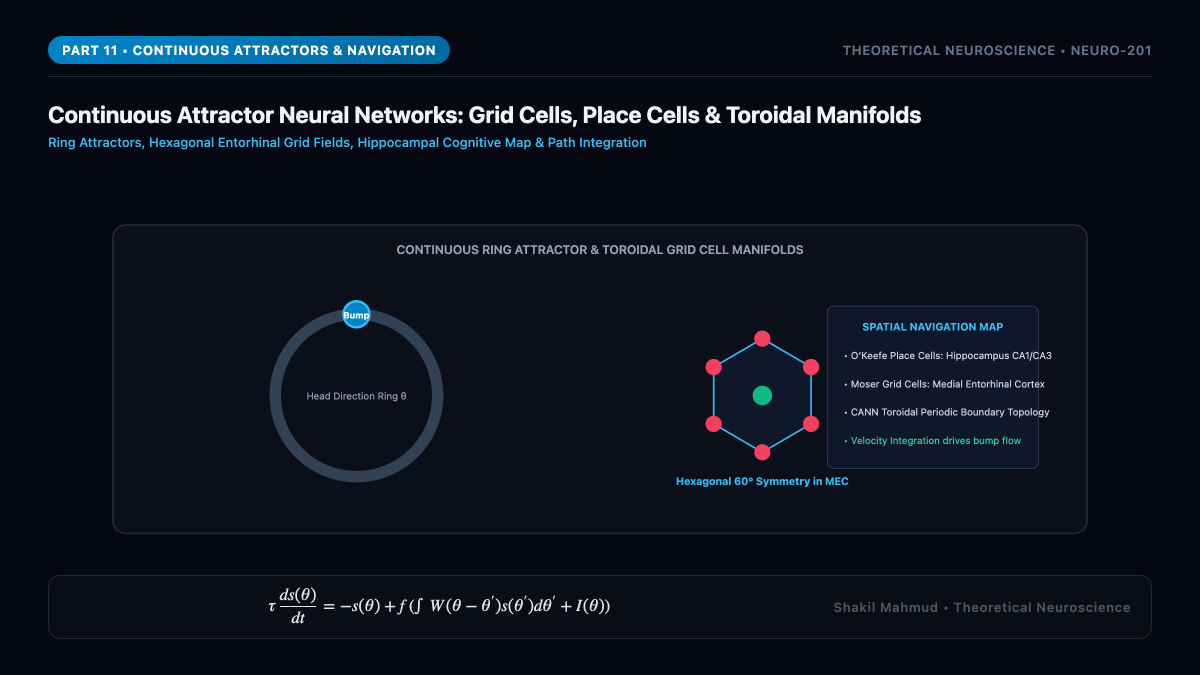
How does the brain represent the external spatial universe? In navigating the physical world, an animal must continuously estimate its self-position in total darkness using only internal velocity cues—an algorithmic computation known as Path Integration. In 2014, John O’Keefe, May-Britt Moser, and Edvard Moser were awarded the Nobel Prize for discovering the mammalian brain’s internal positioning system: Place Cells in the hippocampus and Grid Cells in the medial entorhinal cortex (MEC). Theoretical neuroscience models this cognitive map as a Continuous Attractor Neural Network (CANN) living on a Toroidal Manifold.
1. The Continuous Ring Attractor & Head-Direction System
The simplest continuous attractor is the 1D Ring Attractor, which encodes an angular variable $theta in [0, 2pi)$ such as head direction (Taube et al.). The network consists of a ring of neurons whose recurrent connectivity depends symmetrically on angular distance via a “Mexican-hat” kernel (local excitation, surround inhibition):
W(theta, theta’) = J_0 + J_2 cos(theta – theta’)
The dynamics of the neural firing rate $s(theta, t)$ obey the non-linear integro-differential equation:
tau frac{partial s(theta, t)}{partial t} = -s(theta, t) + fleft( int_{-pi}^pi W(theta – theta’) s(theta’, t) dtheta’ + I_{text{ext}}(theta) right)
Even with zero external input ($I_{text{ext}} = 0$), spontaneous symmetry breaking produces a localized bump of active firing at an arbitrary angular position $theta_0$. Asymmetrical inputs driven by angular head velocity $omega(t) = dtheta/dt$ shift the bump around the ring, tracking orientation via path integration.
2. Hexagonal Grid Cells & The Toroidal Manifold $mathbb{T}^2$
While hippocampal place cells fire at single localized positions in an environment, MEC grid cells fire at multiple periodic locations forming a breathtakingly regular triangular or Hexagonal Lattice spanning the entire 2D exploration arena.
In 2006, Burak and Fiete formulated the 2D Continuous Attractor Model for grid cells. Because a 2D hexagonal pattern is periodic under two independent lattice basis vectors $vec{a}_1, vec{a}_2$, the underlying state space of a single grid cell module is topologically equivalent to the surface of a 2D Torus:
mathcal{M}_{text{grid}} cong mathbb{T}^2 = S^1 times S^1
In 2022, Gardner et al. recorded hundreds of MEC grid cells simultaneously in behaving rats. Applying unsupervised manifold learning (UMAP/persistent homology), they directly confirmed that the collective population activity of grid cells is strictly confined to the surface of a 2D torus, confirming theoretical predictions.
3. Path Integration Mechanics: Translating Velocity into Manifold Flow
To integrate animal velocity $vec{v}(t)$ into spatial position, recurrent inhibitory connections are slightly shifted along direction $vec{d}_i$ by animal speed:
W_{ij} = W_{text{sym}}(vec{x}_i – vec{x}_j – alpha vec{v}(t))
This directional asymmetry injects a velocity-proportional drift into the bump’s spatial velocity $dot{vec{x}}_{text{bump}} = alpha vec{v}(t)$. Integrating self-motion updates the position on the torus without sensory landmarks.
4. Multiple Grid Modules & Combinatorial Hippocampal Decoding
The entorhinal cortex contains discrete anatomically segregated modules with grid scales expanding along the dorso-ventral axis (from $lambda approx 30text{ cm}$ dorsally to $lambda approx 3text{–}5text{ m}$ ventrally) by a geometric ratio $lambda_{k+1} / lambda_k approx 1.4$.
Fiete et al. proved that this multi-scale modular representation is a biological implementation of the Chinese Remainder Theorem. By combining phases across $M$ modules with coprime grid wavelengths, the brain represents vast unambiguous spatial domains ($Lambda sim prod lambda_k approx text{tens of kilometers}$) with exponential information capacity: a tour de force of nature’s geometric engineering.




