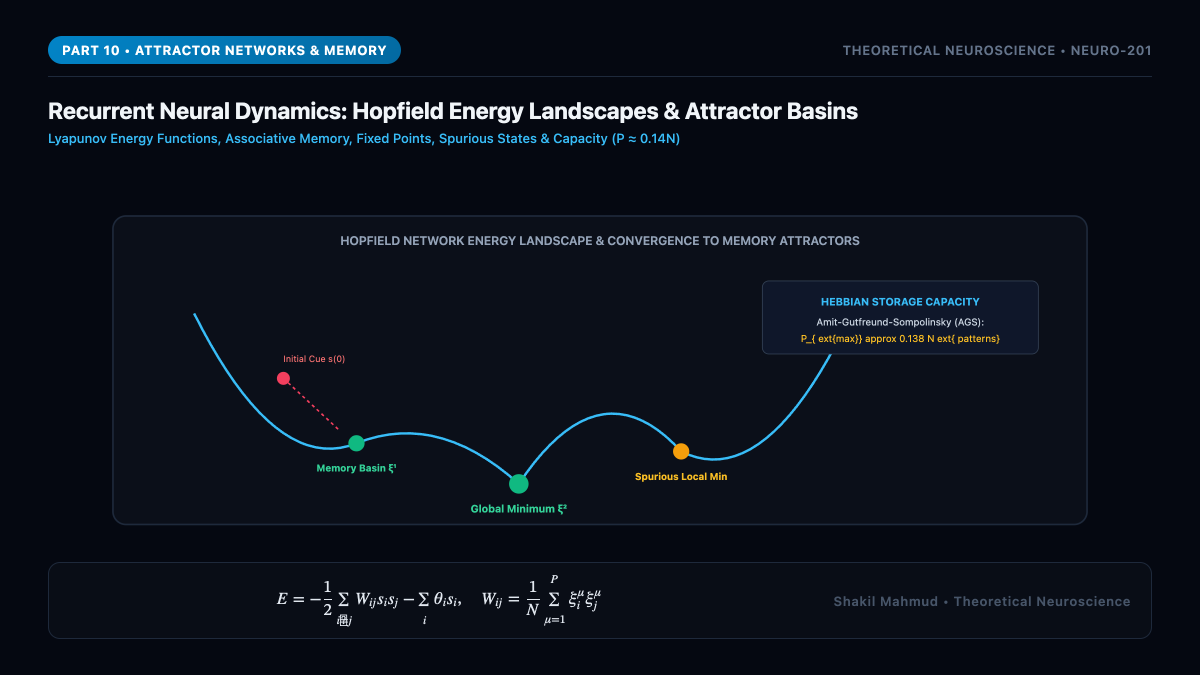
Feedforward neural architectures excel at instantaneous pattern recognition, yet cognitive life is defined by persistence: retaining a telephone number in mind, maintaining a behavioral goal across distractors, or retrieving an entire past memory from a fleeting scent. In 1982, physicist John Hopfield linked statistical mechanics with recurrent neurobiology, introducing Attractor Neural Networks. By establishing that symmetric recurrent connectivity creates a Lyapunov Energy Landscape with stable fixed-point basins, attractor theory unifies associative memory, persistent working memory, and decision-making.
1. The Hopfield Network & Spin-Glass Thermodynamics
Consider a network of $N$ recurrently connected binary neurons $s_i in {-1, +1}$. Each neuron updates its state asynchronously according to the sign of its local field $h_i = sum_{j neq i} W_{ij} s_j + theta_i$:
s_i(t+1) = text{sgn}left( sum_{j=1}^N W_{ij} s_j(t) – theta_i right)
Assuming symmetric synaptic weights ($W_{ij} = W_{ji}$) with zero self-coupling ($W_{ii} = 0$), Hopfield proved that the network minimizes a scalar Lyapunov Energy Function identical to the Ising spin-glass Hamiltonian:
E = -frac{1}{2} sum_{i=1}^N sum_{j=1}^N W_{ij} s_i s_j – sum_{i=1}^N theta_i s_i
With each state update $Delta s_i$, the energy change is $Delta E = -Delta s_i h_i le 0$. Because energy decreases monotonically and is bounded from below, the network is guaranteed to converge to a stable local energy minimum—an Attractor State.
2. Hebbian Imprinting & Memory Capacity
To store $P$ arbitrary binary memory patterns ${vec{xi}^1, dots, vec{xi}^P}$ with $xi_i^mu in {-1, +1}$, the synaptic matrix is constructed via the Hebbian learning prescription:
W_{ij} = frac{1}{N} sum_{mu=1}^P xi_i^mu xi_j^mu quad (i neq j)
When initialized with a noisy or partial cue $vec{s}(0)$, the network dynamics roll down the gradient of the energy landscape into the basin of attraction of the nearest stored pattern $vec{xi}^mu$, performing Associative Content-Addressable Memory Retrieval.
Using statistical replica theory from condensed matter physics, Daniel Amit, Hanoch Gutfreund, and Haim Sompolinsky (1985) rigorously derived the maximum storage capacity of the network before catastrophic crosstalk breakdown occurs:
P_{text{max}} approx 0.138 , N quad text{patterns}
Beyond this critical capacity ($P > 0.138N$), the energy landscape fractures into a disordered “spin-glass phase” riddled with spurious false minima, destroying memory retrieval.
3. Line Attractors & Continuous Working Memory
While classic Hopfield networks store discrete memories in isolated point attractors, working memory often requires holding continuous analog variables—such as the horizontal gaze angle of the eyes or continuous spatial direction. This is implemented via a Line Attractor.
In a continuous recurrent rate network $tau dot{vec{r}} = -vec{r} + f(W vec{r} + vec{I})$, if the weight matrix $W$ satisfies a fine-tuned balance condition such that the Jacobian has an eigenvalue of exactly zero ($lambda_{text{max}} = 0$), the network creates a continuous manifold of marginal equilibria. An input kick moves the state along the manifold; once the input ceases, the state remains indefinitely at its final position, preserving analog working memory in the prefrontal cortex.
4. Bistable Attractors & Decision-Making
In 2002, Xiao-Jing Wang extended attractor networks to perceptual decision-making. By coupling two excitatory populations with strong mutual inhibition, the energy landscape features two competing attractor basins separated by an unstable saddle point. Driven by sensory evidence, the network exhibits stochastic symmetry breaking, dropping into one attractor basin: modeling both the reaction time and confidence of choice.