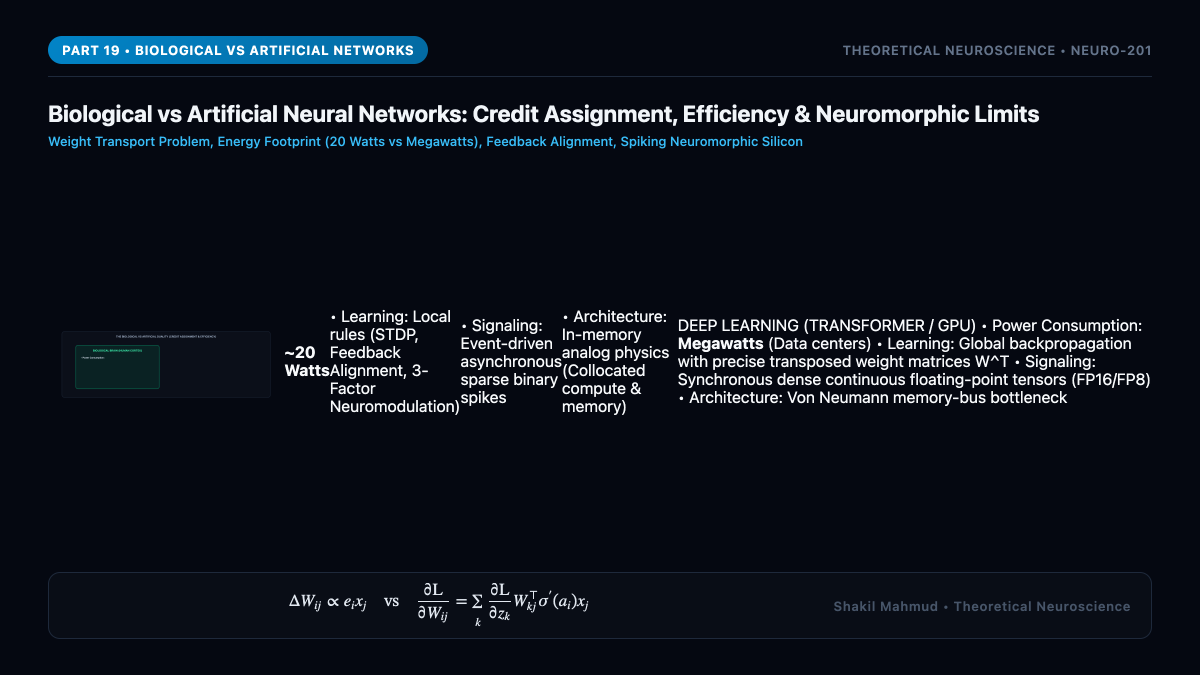
Contemporary Artificial Intelligence has achieved superhuman performance in chess, protein folding, and conversational language modeling through Deep Neural Networks (DNNs). Yet the foundational engine powering deep learning—Backpropagation of Error—is fundamentally biophysically impossible in the living brain. From the infamous “Weight Transport Problem” to the brain’s astonishing 20-Watt Power Budget, theoretical neuroscience explores the deep computational divergence between biological wetware and artificial silicon, laying the blueprints for next-generation Neuromorphic Computing.
1. Why Backpropagation is Biologically Impossible
In artificial deep networks, weight updates require computing the gradient of an objective loss $mathcal{L}$ with respect to weight matrix $W_l$ by chaining error derivatives backwards across layers:
delta_l = left( W_{l+1}^top delta_{l+1} right) odot sigma'(a_l), quad Delta W_l = -eta , delta_l (h_{l-1})^top
Biophysically, the mammalian brain cannot implement this algorithm due to several insurmountable physical constraints:
- The Weight Transport Problem: Backprop requires backward error propagation using the exact transpose of the forward synaptic weight matrix ($W^top$). Biological neurons have separate forward axons and distinct backward feedback circuits with completely independent synapses; there is no biological mechanism for a retrograde synapse to “know” the current weight of its forward counterpart.
- Non-Local Sign-Changing Derivations: Backprop requires downstream gradient signals that take negative values. Chemical synapses cannot switch instantaneously from excitatory (glutamate) to inhibitory (GABA) without violating Dale’s Principle.
- Clock Synchronization & Static Freezes: Backprop requires pausing forward inference while error signals travel backwards through identical frozen states, whereas the living brain operates continuously, asynchronously, and dynamically.
2. Biological Credit Assignment: Feedback Alignment & Target Propagation
How does the brain solve the Credit Assignment Problem across multi-synaptic deep hierarchies? In 2016, Timothy Lillicrap et al. made a shocking discovery: Random Feedback Alignment (FA).
If the exact transpose matrix $W^top$ in backpropagation is replaced by a fixed, completely random matrix $B$ that never updates during training:
delta_l approx left( B delta_{l+1} right) odot sigma'(a_l)
Surprisingly, deep networks still learn effectively! During early training, forward weights $W$ dynamically adapt to align themselves with the static random feedback matrix ($W B approx text{positive definite}$), demonstrating that biological feedback connections do not need to mirror forward synapses to guide deep representation learning.
3. The Thermodynamic Paradox: 20 Watts vs Megawatts
The human brain contains approximately 86 billion neurons, 150 trillion synapses, and processes multimodal vision, speech, motor control, and abstract thought while consuming an average power of only 20 Watts—barely enough to illuminate a dim incandescent lightbulb.
In contrast, training a modern frontier Large Language Model requires thousands of GPUs consuming Megawatts of power in massive cooling-dependent data centers. This staggering $10^5text{–}10^6$ factor in energy efficiency stems from fundamental differences in physics and architecture:
- Collocated Compute and Memory: Silicon follows the von Neumann architecture, where data must be shuttled constantly across power-hungry memory buses between CPU/GPU ALUs and DRAM (the “von Neumann memory wall”). In the brain, synapses are simultaneously the memory storage units and the physical computational processors.
- Event-Driven Asynchronous Spiking: DNNs perform dense matrix multiplications continuously over continuous 32-bit floating-point numbers. Biological neurons communicate via sparse binary events (action potentials), remaining electrically silent until relevant information arrives, minimizing metabolic expenditure.
4. Neuromorphic Engineering & Brain-Inspired Silicon
To break the von Neumann bottleneck, Neuromorphic Computing (spearheaded by Carver Mead, and realized in chips like Intel Loihi, IBM TrueNorth, and BrainScaleS) emulates biological physics directly in silicon:
- Spiking Neural Networks (SNNs): Hardware neurons implement integrate-and-fire equations using subthreshold analog CMOS circuitry, routing digital address-event representation (AER) spike packets asynchronously.
- Memristive In-Memory Crossbars: Non-volatile memristors leverage Ohm’s law ($I = V cdot G$) and Kirchhoff’s current law ($sum I$) to compute vector-matrix multiplications directly in the physical analog domain with zero memory bus transfer.
By blending biological local learning rules with analog physical dynamics, neuromorphic engineering bridges neuroscience and computing into an ultra-low-power cognitive frontier.




