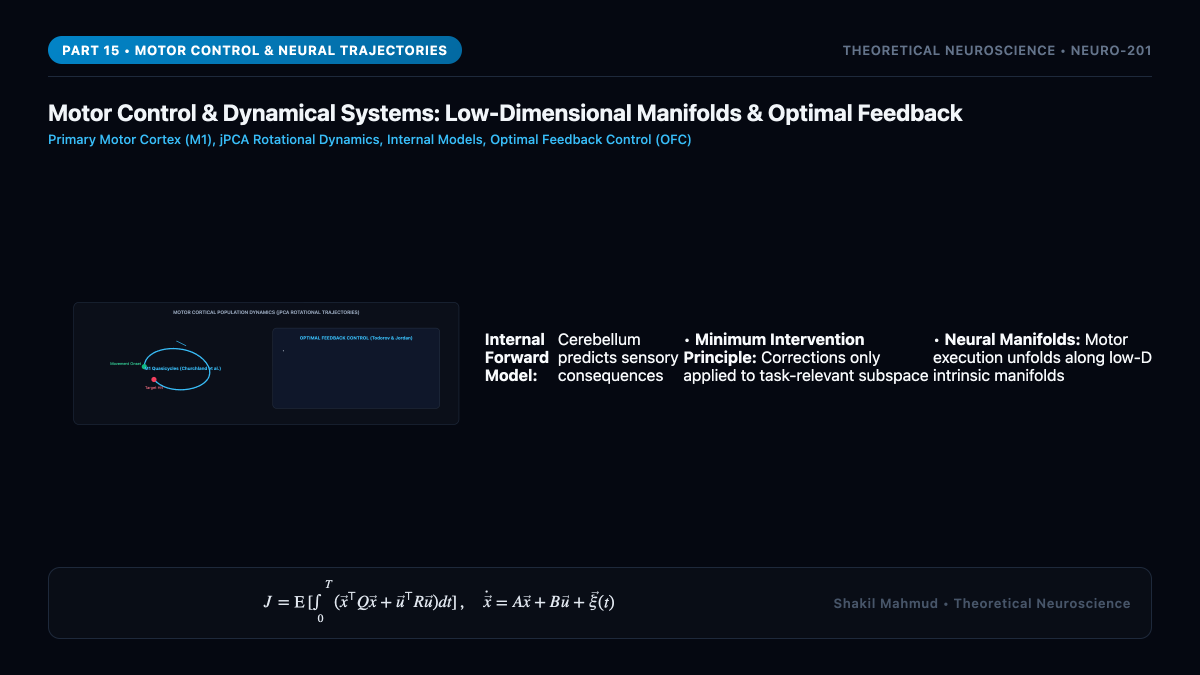
For decades, motor neurophysiologists viewed the primary motor cortex (M1) as an encoding device: attempting to correlate single-neuron firing rates with external movement parameters like velocity, muscle force, or hand position. Yet these tuning models constantly conflicted. In 2012, a conceptual revolution led by Mark Churchland, Krishna Shenoy, and John Cunningham re-conceptualized M1 not as an abstract representation map, but as an Autonomous Dynamical System. Neural population activity unfolds along smooth low-dimensional manifolds governed by Rotational jPCA Dynamics and orchestrated by Optimal Feedback Control (OFC).
1. The Dynamical Systems Paradigm in Motor Cortex
Instead of single neurons commanding individual muscles, motor execution is governed by collective population dynamics in an $N$-dimensional state space (where $N sim 100text{–}1000$ recorded neurons):
dot{vec{x}}(t) = F(vec{x}(t)) + vec{u}(t)
During the preparatory delay period preceding movement, external inputs $vec{u}(t)$ drive the neural state to a specific initial condition $vec{x}(0)$ on an intrinsic low-dimensional manifold. Upon the “Go” cue, input ceases, and the intrinsic recurrence of the network releases the trajectory, generating smooth, multiphasic muscle control signals without continuous conscious guiding.
2. Rotational Dynamics & The jPCA Formulation
To identify the fundamental dynamical rules governing motor generation, Churchland et al. formulated jPCA: a dimensionality reduction technique that specifically isolates skew-symmetric (purely rotational) linear dynamics:
dot{vec{x}} = M_{text{skew}} vec{x}, quad M_{text{skew}}^top = -M_{text{skew}}
Because skew-symmetric matrices have purely imaginary eigenvalues ($lambda = pm i omega$), the population state rotates smoothly in 2D planes at characteristic frequencies ($omega approx 2text{–}3text{ Hz}$):
begin{pmatrix} dot{x}_1 \ dot{x}_2 end{pmatrix} = begin{pmatrix} 0 & omega \ -omega & 0 end{pmatrix} begin{pmatrix} x_1 \ x_2 end{pmatrix}
These rotational “quasicycles” project rhythmic, quadrature basis patterns into downstream spinal motor pools. By decomposing complicated arm movements into a linear superposition of orthogonal rotational frequencies, M1 generates complex, fluid motor outputs with minimal metabolic interference.
3. Internal Models & The Cerebellar Forward Predictor
Biological motor control contends with massive physical delays: sensory conduction from the fingertips to cortex takes $50text{–}100text{ ms}$, while muscle activation introduces another $40text{ ms}$. If the brain relied solely on peripheral sensory feedback, rapid movements would suffer from catastrophic oscillatory instability.
The nervous system circumvents feedback delays via an Internal Forward Model residing primarily in the Cerebellum. When the motor cortex issues a motor command $vec{u}(t)$, an exact copy—the Efference Copy—is sent to the cerebellum:
hat{vec{x}}_{t+1} = f_{text{internal}}(hat{vec{x}}_t, vec{u}_t)
The cerebellum simulates the biomechanical physics of the limb in real-time, predicting the sensory consequences of movement tens of milliseconds before actual peripheral feedback arrives, allowing rapid online trajectory adjustments.
4. Optimal Feedback Control (OFC) & The Minimum Intervention Principle
In 2002, Emanuel Todorov and Michael Jordan established the standard theoretical framework for motor coordination: Optimal Feedback Control (OFC). Motor tasks are formulated as minimizing a quadratic cost function balancing goal accuracy against control effort:
J = mathbb{E}left[ int_0^T left( vec{x}(t)^top Q(t) vec{x}(t) + vec{u}(t)^top R(t) vec{u}(t) right) dt right]
Subject to non-linear musculoskeletal dynamics and signal-dependent motor noise ($sigma_{text{noise}} propto |vec{u}|$), OFC yields the celebrated Minimum Intervention Principle:
The motor system never corrects motor fluctuations that do not interfere with task success.
Uncontrolled manifold analysis confirms that trial-to-trial motor variability is high along task-irrelevant dimensions (allowing flexibility and motor synergies), but clamped with sub-millimeter precision along task-critical execution dimensions.




