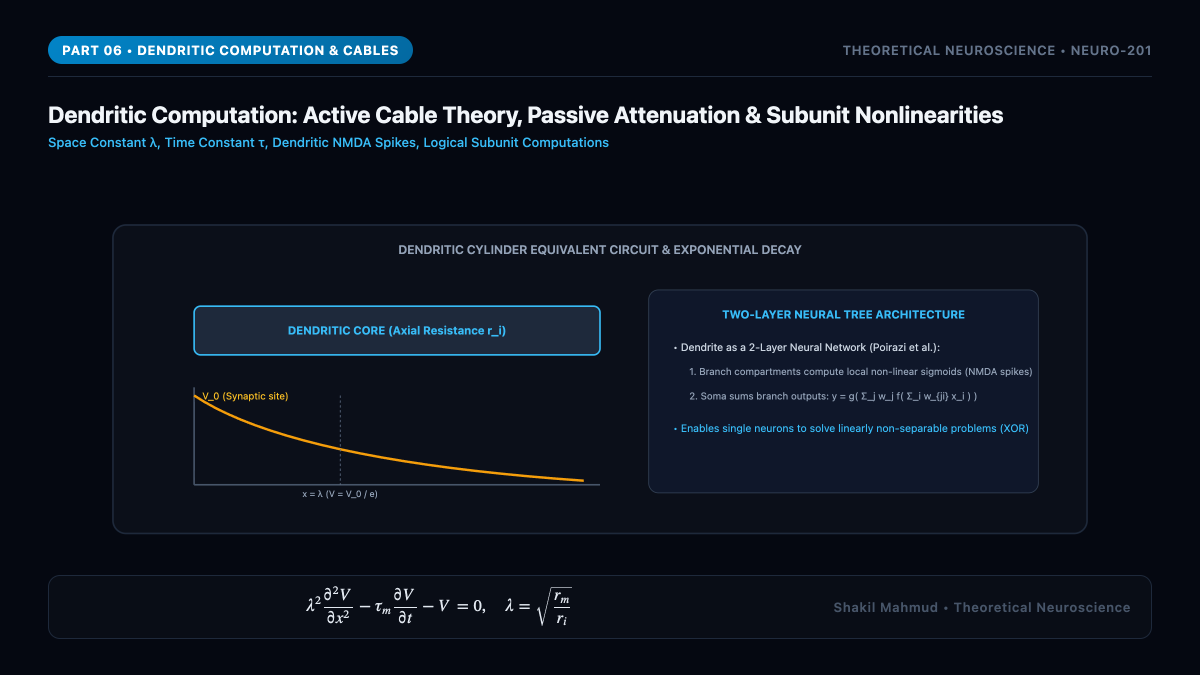
In classical artificial intelligence, the formal neuron is a dimensionless point: a simple spatial summation node followed by a static activation function ($y = sigma(sum w_i x_i)$). Real biological neurons, however, possess intricate geometric arborizations spanning hundreds of microns: Dendrites. Far from being passive copper wires, dendrites are highly non-linear computational engines. Through Wilfrid Rall’s cable theory and voltage-gated active conductances, modern neuroscience reveals that a single pyramidal neuron operates as a complete Two-Layer Non-Linear Neural Network.
1. Wilfrid Rall’s Passive Cable Theory
In 1959, Wilfrid Rall adapted Lord Kelvin’s submarine telegraph cable equations to model the continuous spread of electrical potential along branched cylindrical dendritic cables. Discretizing a cylinder into longitudinal axial resistance $r_i$ and membrane resistance $r_m$ shunted by capacitance $c_m$ yields the fundamental Linear Cable Equation:
lambda^2 frac{partial^2 V(x, t)}{partial x^2} – tau_m frac{partial V(x, t)}{partial t} – V(x, t) = 0
where the electrotonic space constant $lambda$ and membrane time constant $tau_m$ are defined by:
lambda equiv sqrt{frac{r_m}{r_i}} = sqrt{frac{a R_m}{2 R_i}}, quad tau_m equiv r_m c_m = R_m C_m
For a steady-state current injected at $x = 0$ into a semi-infinite cable, voltage decays exponentially with distance: $V(x) = V_0 e^{-x / lambda}$. Consequently, distant apical synapses suffer severe passive attenuation before reaching the soma.
2. The $3/2$ Branching Power Rule
At dendritic bifurcation nodes, electrical impedance matching is vital to prevent severe reflection of propagating signals. Rall proved that a parent branch of diameter $d_0$ splits seamlessly into daughter branches of diameters $d_1, d_2$ without impedance mismatch if their geometric diameters satisfy the $3/2$ Diameter Rule:
d_0^{3/2} = d_1^{3/2} + d_2^{3/2}
Under this condition, an entire branched dendritic tree can be mathematically collapsed into an equivalent single uniform cylinder, laying the analytical foundation for quantitative compartmental models.
3. Active Dendrites: Calcium, Sodium & NMDA Spikes
Modern intracellular two-photon uncaging experiments reveal that dendrites are densely packed with voltage-gated ion channels ($text{Na}_V, text{Ca}_V$) and NMDA receptor clusters. When a cluster of spatially proximate synapses on a thin basal or apical oblique branch is activated synchronously within a narrow temporal window ($approx 2text{–}4text{ ms}$), the local depolarization expels $text{Mg}^{2+}$, igniting a regenerative Dendritic NMDA Spike.
These local dendritic plateau potentials last for tens of milliseconds ($20text{–}50text{ ms}$), delivering a robust, non-linear all-or-none current pulse directly into the parent branch and soma, completely overcoming passive cable attenuation.
4. The Pyramidal Cell as a Two-Layer Deep Network
In a paradigm-shifting study, Panayiota Poirazi, Terrence Brannon, and Bartlett Mel (2003) demonstrated that a single neocortical pyramidal neuron does not compute a simple linear sum. Instead, it functions as a hierarchical two-layer network:
- Layer 1 (Dendritic Subunits): Individual dendritic branches act as independent computational subunits, each applying an internal non-linear activation function $f(sum_{i in text{branch } j} w_{ji} x_i)$ to its clustered synaptic inputs.
- Layer 2 (Somatic Integration): The soma linearly sums the non-linear outputs of all individual dendritic branches before applying the final axonal spiking threshold function $g(cdot)$:
y = gleft( sum_{j=1}^M W_j , fleft( sum_{i} w_{ji} x_i right) right)
Furthermore, in 2020, Gidon et al. discovered human cortical layer 2/3 dendritic action potentials (dCaAPs) whose amplitude decreases with increasing stimulus intensity, enabling a single human dendritic tree to compute the linearly non-separable XOR Logic Function. The biological neuron is not an artificial perceptron; it is an integrated deep learning unit in its own right.




