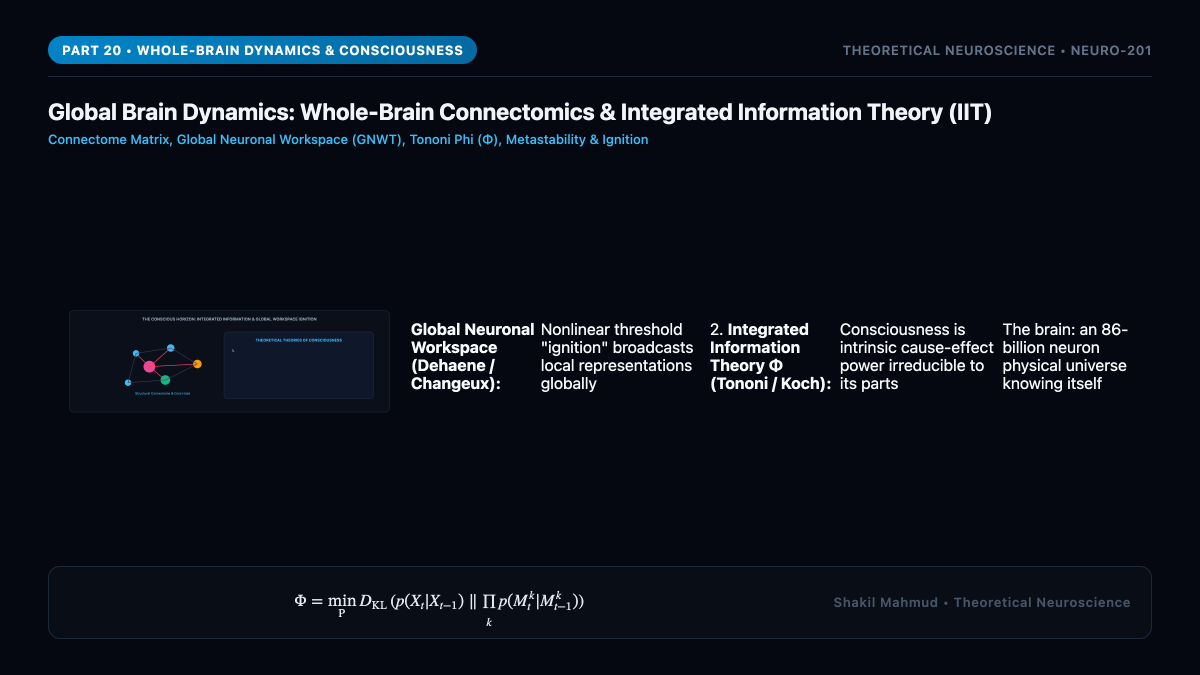
We arrive at the deepest frontier of natural philosophy: the nature of subjective, conscious experience. How does three pounds of electrochemical tissue—an assembly of 86 billion neurons firing stochastic action potentials—give rise to the redness of a sunset, the pang of sorrow, or the self-aware contemplation of the cosmos? Known as the “Hard Problem of Consciousness” (David Chalmers), theoretical neuroscience addresses this cosmic mystery through the mathematical frameworks of Whole-Brain Connectomics, the Global Neuronal Workspace Theory (GNWT), and Giulio Tononi’s Integrated Information Theory (IIT, $Phi$).
1. Whole-Brain Macroscale Connectomics & Dynamical Landscapes
The macroscopic architecture of the human brain is captured by the Structural Connectome: a structural adjacency matrix $C_{ij}$ mapped via diffusion tensor tractography (DTI) defining physical axonal fiber density across hundreds of parcellated cortical and subcortical regions.
Coupled with non-linear mean-field models (such as the Deco-Friston dynamic mean field), whole-brain simulations demonstrate that the brain operates near a thermodynamic critical boundary: the edge of a Hopf Bifurcation separating quiescent order from turbulent chaos. Operating at this critical point maximizes the brain’s dynamical repertoire, information transmission, and sensitivity to sensory perturbations.
2. Global Neuronal Workspace Theory (GNWT)
Developed by Stanislas Dehaene, Jean-Pierre Changeux, and Bernard Baars, the Global Neuronal Workspace Theory posits that consciousness is the global sharing of information across the brain:
- At any moment, countless modular, specialized sub-networks process sensory data non-consciously in parallel (e.g., local visual edge detectors, language parsing modules).
- When a local representation becomes sufficiently salient, it triggers an all-or-none non-linear threshold transition: Global Ignition.
- During ignition, long-range glutamatergic Layer II/III pyramidal neurons in the prefrontal and parietal cortices discharge synchronously, broadcasting the representation globally across the entire neocortex via reciprocal feedback loops.
An item is conscious if and only if it has gained access to this global workspace, making it available for verbal reporting, motor planning, and long-term memory consolidation.
3. Integrated Information Theory (IIT): The Mathematics of $Phi$
In contrast to GNWT’s functional, behavioral perspective, Giulio Tononi and Christof Koch formulated Integrated Information Theory (IIT), proceeding from phenomenal axioms to physical postulates. IIT asserts that consciousness is an intrinsic, fundamental property of physical systems that possess integrated cause-effect power.
A physical system $X$ in state $x$ possesses consciousness if its whole system constrains its past and future states more than the sum of its independent parts. To evaluate this, IIT partitions the system into two sub-systems $mathcal{P} = {A, B}$ by a minimum information partition (MIP). The measure of Integrated Information $Phi$ (“Phi”) is the distance between the unpartitioned transition probability and the partitioned product:
Phi = min_{mathcal{P}} D_{text{KL}}left( p(X_t | X_{t-1}) parallel p(A_t | A_{t-1}) otimes p(B_t | B_{t-1}) right)
If a system can be severed into independent sub-components without loss of predictive information ($Phi = 0$), it is unconscious. If $Phi > 0$, the system forms an irreducible, unified complex. The value of $Phi$ determines the quantity of consciousness, while the geometric topology of the maximally irreducible cause-effect structure (the “qualia space” shape) specifies its subjective quality.
4. The Grand Horizon of Brain & Being
A striking corollary of IIT is that digital computers executing classical software on von Neumann architectures—regardless of how convincingly they emulate human conversation—possess nearly zero integrated information ($Phi approx 0$) due to their feedforward transistor execution and low intrinsic cause-effect interconnectivity. In contrast, the mammalian cerebral cortex, with its vast recurrence, balanced excitation-inhibition, and dense 3D dendritic tangles, is nature’s most intricate high-$Phi$ engine.
From the microscopic Nernst potential of a single lipid bilayer to the global resonance of the conscious connectome, neuroscience reveals that the human brain is not a disconnected observer of the universe. It is matter organized to such exquisite physical coherence that the universe awakens to observe, analyze, and comprehend its own existence.