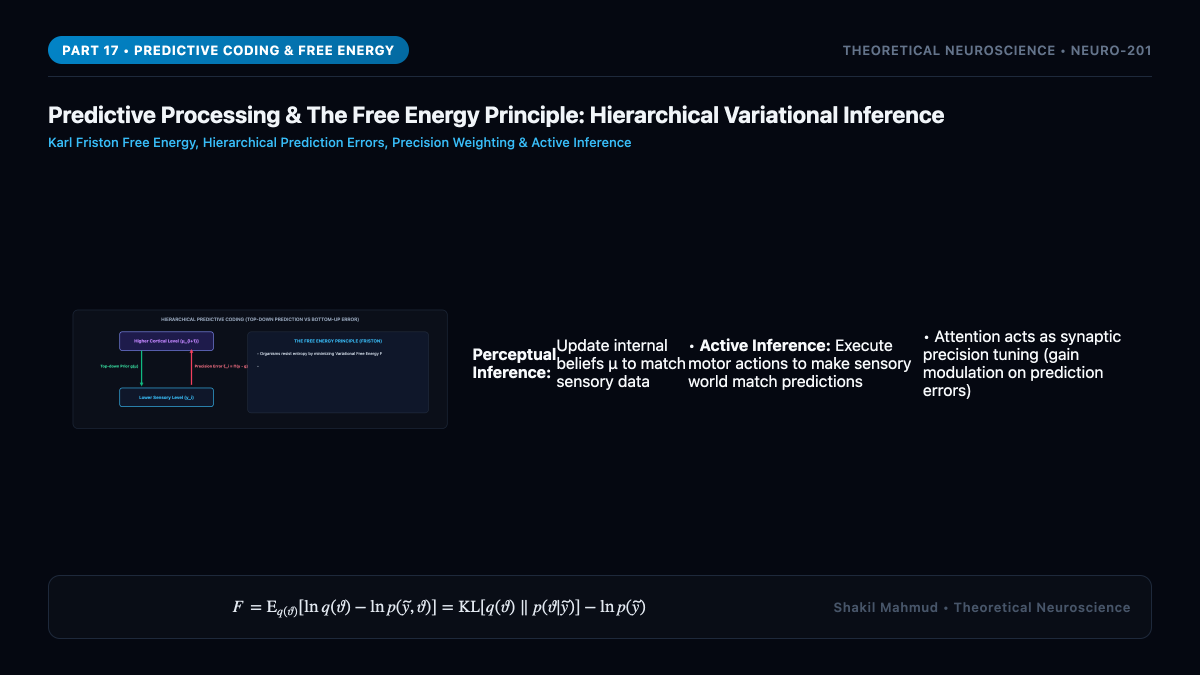
For over a century, classical neuroscience viewed the brain as a passive stimulus-response machine: external photons and acoustic waves strike sensory organs, trigger feedforward electrical cascades, and eventually evoke motor reflexes. In recent decades, a profound paradigm shift spearheaded by Karl Friston, Andy Clark, and Rajesh Rao has inverted this picture. The brain is not a passive detector; it is a proactive, generative Bayesian Prediction Machine. Guided by the Free Energy Principle, the brain continuously hallucinates the world from the top down, using sensory inputs solely to calculate Precision-Weighted Prediction Errors.
1. The Helmholtz Machine & Variational Free Energy
Inspired by 19th-century physicist Hermann von Helmholtz’s concept of “unconscious inference,” the brain seeks to infer the hidden causes $vartheta$ of incoming sensory observations $tilde{y}$. Computing the exact Bayesian posterior $p(vartheta | tilde{y})$ directly is intractable because evaluating the marginal evidence $p(tilde{y}) = int p(tilde{y}, vartheta) dvartheta$ requires integrating over all possible configurations of the universe.
To overcome this, the brain employs Variational Inference: introducing an internal recognition density $q(vartheta)$ parameterized by internal neural states $mu$ and minimizing an upper bound on surprise (negative log-evidence) known as Variational Free Energy $F$:
F(q, tilde{y}) equiv mathbb{E}_{q}[ln q(vartheta) – ln p(tilde{y}, vartheta)] = text{KL}[q(vartheta) parallel p(vartheta | tilde{y})] – ln p(tilde{y})
Because the Kullback-Leibler divergence is strictly non-negative ($text{KL} ge 0$), minimizing free energy $F$ accomplishes two feats simultaneously:
- Forces the internal representation $q(vartheta)$ to closely approximate the true posterior $p(vartheta | tilde{y})$.
- Maximizes a lower bound on sensory evidence (the Evidence Lower Bound, ELBO), minimizing entropy and organismic surprise.
2. Hierarchical Predictive Coding (Rao & Ballard)
In 1999, Rajesh Rao and Dana Ballard formulated the definitive hierarchical neuro-computational model of predictive coding across cortical columns:
- Top-Down Predictions: Deep pyramidal neurons at cortical level $i+1$ encode the current generative model of the world (state $mu_{i+1}$) and send descending feedback predictions $g(mu_{i+1})$ down to level $i$ via Layer V/VI axons.
- Bottom-Up Prediction Errors: Superficial pyramidal neurons in Layer II/III compute the localized discrepancy between actual sensory activity $y_i$ and the descending top-down prediction:
xi_i = Pi_i left( y_i – g(mu_{i+1}) right)
Only this residual error vector $xi_i$ is transmitted ascending up the hierarchy to update high-level hypotheses.
If descending predictions are accurate, ascending error signals are silenced. Perception is thus an ongoing equilibrium: a “controlled hallucination” constrained by prediction errors.
3. Precision Weighting & The Computational Theory of Attention
Sensory inputs are corrupted by noise. A rustling bush in broad daylight contains high-fidelity visual information; in deep fog, visual evidence is highly uncertain. The brain resolves this by weighting prediction errors with their inverse variance, or Precision $Pi = 1 / sigma^2$:
xi_{text{weighted}} = Pi cdot (y – g(mu))
In predictive processing, Attention is Precision Optimization. By modulating the synaptic gain (excitability) of superficial error-computing pyramidal neurons via acetylcholine and dopamine, the brain dynamically amplifies error signals originating from reliable, high-precision channels while suppressing noisy or irrelevant sensory data.
4. Active Inference: Action as Error Cancellation
How does the organism resolve stubborn prediction errors? Minimizing free energy $F$ offers two complementary avenues:
- Perceptual Inference: Update internal beliefs $mu$ to match incoming sensory observations (changing the mind).
- Active Inference: Execute motor actions $a$ to alter the physical environment so that incoming sensations match internal prior expectations (changing the world):
dot{a} = -frac{partial F}{partial a} = -frac{partial tilde{y}}{partial a} cdot Pi (y – g(mu))
Motor commands are not commands to muscles; they are proprioceptive predictions! By predicting that your hand is grasping a cup, descending spinal reflex arcs contract muscles purely to cancel the resulting proprioceptive prediction error. Action and perception are the twin faces of a single thermodynamic imperative: the minimization of surprise.




