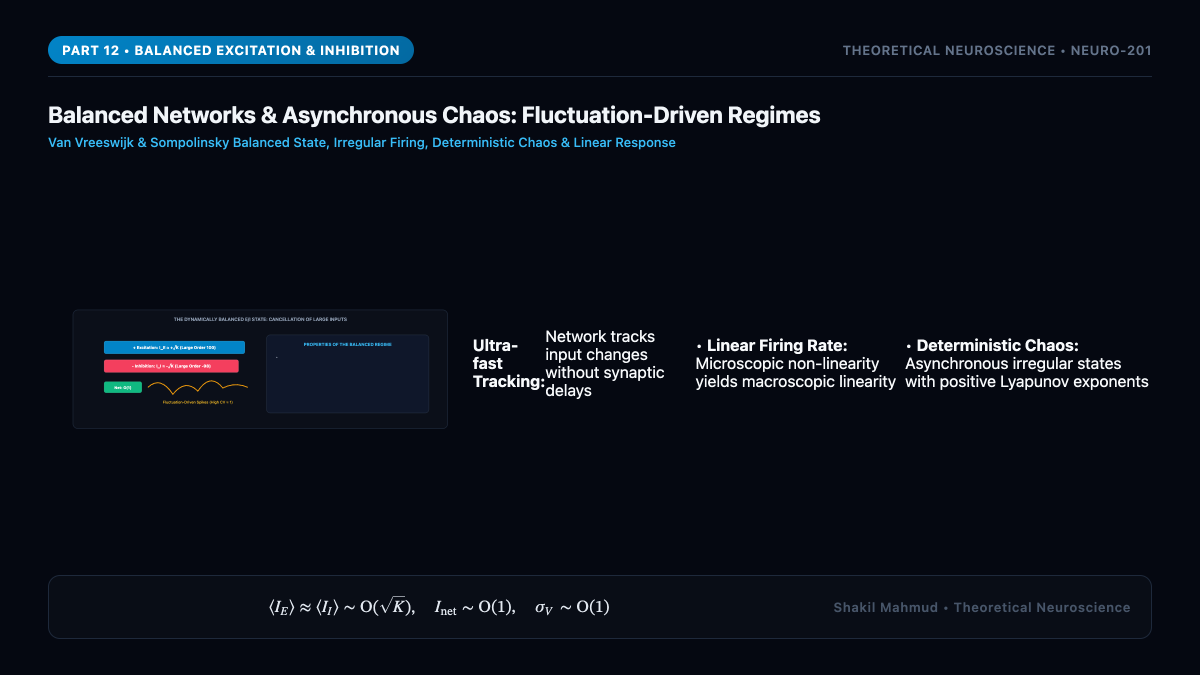
In the cerebral cortex, a single pyramidal neuron receives synaptic contacts from up to 10,000 presynaptic partners. If each excitatory synapse were to act additively, the total depolarization would drive the membrane potential to saturation within milliseconds. Conversely, experimental recordings in awake animals reveal an enigmatic paradox: cortical neurons fire with extreme, Poisson-like irregularity ($CV approx 1$), and average membrane voltages hover precariously just below threshold. In 1996, Carl van Vreeswijk and Haim Sompolinsky resolved this paradox with the theory of the Dynamically Balanced E/I Network.
1. The $sqrt{K}$ Scaling & The Balance Equation
Consider a network where each neuron receives $K$ excitatory and $K$ inhibitory inputs from a population of size $N$ (where $1 ll K ll N$). Let individual synaptic weights scale with network connectivity as $J / sqrt{K}$.
Under this scaling, the total mean excitatory and inhibitory currents entering a neuron are individually massive, scaling as the square root of in-degree:
langle I_E rangle sim K cdot frac{J_E}{sqrt{K}} cdot m_E = sqrt{K} , J_E m_E sim mathcal{O}(sqrt{K})
langle I_I rangle sim K cdot frac{J_I}{sqrt{K}} cdot m_I = sqrt{K} , J_I m_I sim mathcal{O}(sqrt{K})
For $K = 10,000$, $sqrt{K} = 100$. If unopposed, an input of $+100$ would destroy all computational sensitivity. However, van Vreeswijk and Sompolinsky demonstrated that recurrent feedback dynamically forces inhibition to track excitation with millisecond precision, causing catastrophic cancellation:
I_{text{total}} = sqrt{K} left( J_E m_E – J_I m_I + J_{text{ext}} m_{text{ext}} right) + delta I(t)
For the net mean current to remain finite ($mathcal{O}(1)$) as $K to infty$, the leading order term must cancel identically to zero: $J_E m_E – J_I m_I + J_{text{ext}} m_{text{ext}} = 0$.
2. Fluctuation-Driven Firing & Poisson Irregularity
Because the mean net current is balanced just below threshold, spikes are not driven by average drift. Instead, spikes occur exclusively when stochastic, microscopic imbalances produce rare, sharp upward voltage fluctuations that cross threshold: the Fluctuation-Driven Regime.
The variance of membrane potential fluctuations is order unity:
text{Var}(V_m) = sigma_V^2 sim K left( frac{J}{sqrt{K}} right)^2 = J^2 sim mathcal{O}(1)
This explains why cortical neurons in vivo exhibit high coefficients of variation ($CV approx 1$) and Fano factors: cortical irregularity is not noisy dysfunction, but an inevitable mathematical consequence of dynamically balanced recurrent networks.
3. Asynchronous Deterministic Chaos
Is this cortical stochasticity caused by thermal channel noise? In 1998, Sompolinsky and colleagues analyzed the balanced state using statistical mechanics and dynamical systems theory, demonstrating that even in completely deterministic networks without any external noise, the balanced state is an Asynchronous Chaotic Attractor.
The maximum Lyapunov exponent $lambda_{text{max}}$ is strictly positive ($lambda_{text{max}} > 0$). Microscopic perturbations in spike timings grow exponentially fast, yet macroscopic population firing rates remain stable and predictable. The network generates its own pseudorandom noise intrinsically through high-dimensional non-linear deterministic chaos.
4. Fast Linear Tracking & Computational Advantages
The dynamically balanced state confers profound functional benefits to the cerebral cortex:
- Instantaneous Tracking Without Synaptic Delays: Because a massive population of neurons is held continuously at threshold, external changes in input do not have to wait for membrane charging times ($tau_m approx 20text{ ms}$). The population response tracks input variations instantaneously ($tau_{text{pop}} ll tau_m$).
- Linearization of Macroscopic Responses: While individual neurons possess steep, highly non-linear threshold-activation curves, the population-averaged firing rate response $m = f(I_{text{ext}})$ is linearized by the recurrent negative feedback loop.
- Dynamic Range Expansion: The network avoids saturation across orders of magnitude of input intensity, preserving high sensitivity to both faint and overwhelming stimuli.




