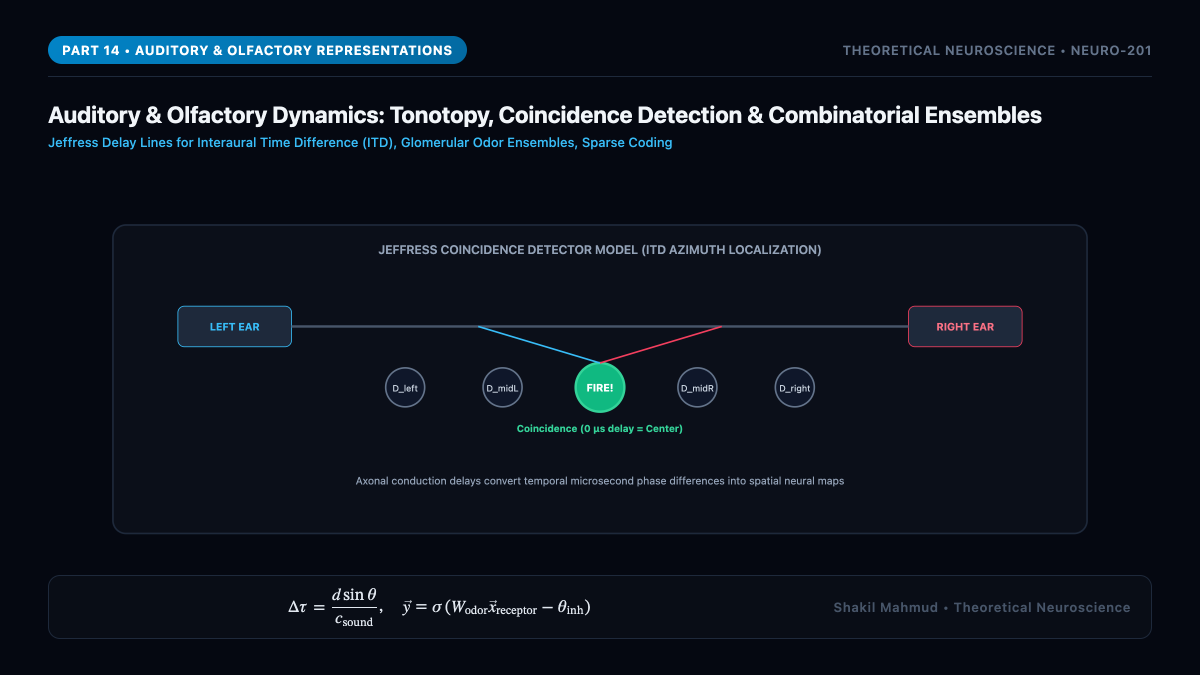
The physical stimuli of sensory experience span vastly different physical media: mechanical acoustic pressure waves traveling through air, and volatile organic chemical molecules drifting through turbulent plumes. Yet inside the nervous system, both audition and olfaction are mapped onto precise topological and combinatorial neural manifolds. From the cochlea’s Fourier-like Tonotopic Map and microsecond-precise Jeffress Coincidence Delay Lines to the high-dimensional sparse representations of the olfactory bulb, sensory neuroscience illuminates nature’s diverse encoding architectures.
1. The Cochlear Tonotopic Map & Spectral Fourier Decomposition
Acoustic sound enters the inner ear and sets the cochlear Basilar Membrane into fluid vibration. Because the mechanical stiffness of the basilar membrane varies continuously along its length (narrow and stiff at the base, wide and floppy at the apex), different acoustic frequencies produce peak resonant vibrations at distinct physical positions along the cochlea (von Békésy, Nobel Prize 1961).
High frequencies ($sim 20text{ kHz}$) resonate at the base, while low frequencies ($sim 20text{ Hz}$) travel to the apex. This spatial decomposition performs a continuous mechanical Fourier Transform, establishing a logarithmic Tonotopic Map that is faithfully projected through the auditory nerve, cochlear nucleus, inferior colliculus, and into primary auditory cortex (A1).
2. Microsecond Azimuth Localization: The Jeffress Delay-Line Model
To localize the horizontal azimuth $theta$ of a sound source, the brain exploits the fact that sound reaches the closer ear slightly before the distant ear, producing an Interaural Time Difference (ITD):
Delta tau = frac{d sintheta}{c_{text{sound}}}
For humans with interaural distance $d approx 20text{ cm}$, the maximum possible delay is only $approx 600,mutext{s}$, with angular discrimination requiring a timing precision of $10,mutext{s}$—vastly faster than the duration of an action potential ($1text{ ms}$).
In 1948, Lloyd Jeffress proposed an exquisite neural circuit model to resolve this dilemma: Coincidence Detection via Axonal Delay Lines. In the medial superior olive (MSO):
- Bipolar axonal branches from the left and right ears serve as physical transmission lines with graduated conduction delays.
- A linear array of coincidence detector neurons receives inputs from both sides.
- A detector fires if and only if action potentials from both ears arrive simultaneously.
The acoustic propagation delay in air is canceled by the internal neural axonal conduction delay, converting microsecond temporal phase discrepancies directly into a spatial topographically organized neural map of auditory space.
3. Olfactory Combinatorial Coding: The Axel-Buck Architecture
Unlike light and sound, odorants cannot be arranged along a continuous 1D frequency axis; chemical space is intrinsically high-dimensional. In 1991, Linda Buck and Richard Axel discovered the gene family of approximately 400 unique mammalian G-protein coupled Odorant Receptors (ORs) (Nobel Prize 2004).
Olfaction employs a Combinatorial Population Code:
- Each olfactory sensory neuron in the nasal epithelium expresses exactly one functional OR gene.
- Each chemical odorant molecule binds with varying affinity to multiple distinct OR types.
- All sensory neurons expressing the same receptor project their axons to two specific spherical neuropil targets called Glomeruli in the olfactory bulb.
Consequently, every odor produces a unique, high-dimensional combinatorial activation fingerprint across the glomerular array: an $M$-dimensional vector $vec{x}_{text{odor}} in mathbb{R}^M$.
4. Sparse Coding & Decorrelation in the Piriform Cortex
From the olfactory bulb, second-order mitral cells project to the Piriform Cortex. While the bulb is topographically organized into discrete glomeruli, connectivity to the piriform cortex is pseudo-random and divergent.
Coupled with strong global recurrent inhibition from local GABAergic interneurons, the piriform cortex transforms dense, overlapping bulb representations into extremely Sparse Distributed Codes: a given odor activates less than $5%$ of cortical pyramidal cells. This sparse decorrelation minimizes overlap between distinct scents, maximizing associative storage capacity and preventing catastrophic memory interference.




