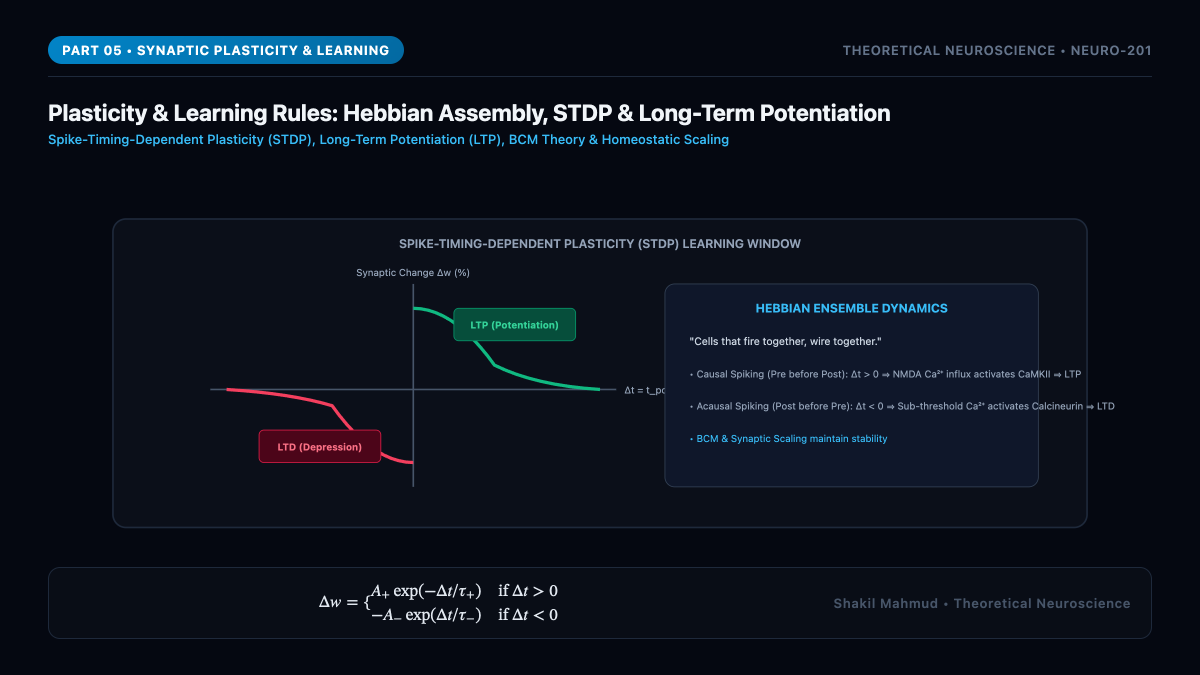
In 1949, Canadian psychologist Donald Hebb proposed a visionary postulate: when an axon of cell A repeatedly and persistently takes part in firing cell B, some metabolic change takes place such that A’s efficiency in firing B is increased—popularized as “cells that fire together, wire together.” In contemporary theoretical neuroscience, this principle has evolved into precise mathematical learning windows known as Spike-Timing-Dependent Plasticity (STDP). Mediated by postsynaptic calcium microdomains, STDP serves as the biological learning rule governing associative memory, developmental pruning, and temporal sequence learning.
1. The Hebbian Formulation & Instability Paradox
In rate-based neural modeling, classical Hebbian learning adjusts synaptic weight $w_{ij}$ between presynaptic rate $r_j$ and postsynaptic rate $r_i$ via a simple product rule:
frac{dw_{ij}}{dt} = eta , r_i r_j
However, this pure Hebbian rule suffers from an intrinsic instability: positive feedback. As weights grow, the postsynaptic firing rate increases, accelerating synaptic growth towards infinity ($w_{ij} to infty$).
To stabilize learning, theoretical neuroscientists introduced two critical constraints:
- Oja’s Rule (1982): Adds a normalized weight decay term $frac{dw_{ij}}{dt} = eta r_i (r_j – r_i w_{ij})$, which mathematically forces the weight vector to converge to the principal eigenvector of the input correlation matrix (performing biological Principal Component Analysis).
- The Bienenstock-Cooper-Munro (BCM) Theory (1982): Introduces a sliding modification threshold $theta_M$ governed by history:
frac{dw_{ij}}{dt} = eta phi(r_i, theta_M) r_j, quad theta_M = left( frac{langle r_i rangle}{r_0} right)^p langle r_i rangle
When postsynaptic activity exceeds $theta_M$, synapses potentiate; when below, they depress.
2. Spike-Timing-Dependent Plasticity (STDP)
In the late 1990s, Henry Markram, Guo-qiang Bi, and Mu-ming Poo discovered that synaptic modification depends acutely on the millisecond timing difference $Delta t = t_{text{post}} – t_{text{pre}}$ between presynaptic and postsynaptic spikes:
Delta w = begin{cases} A_+ expleft( -frac{Delta t}{tau_+} right) & text{if } Delta t > 0 quad (text{LTP}) \ -A_- expleft( frac{Delta t}{tau_-} right) & text{if } Delta t < 0 quad (text{LTD}) end{cases}
The asymmetric temporal kernel divides into two regimes:
- Causal Pre-before-Post Spiking ($Delta t > 0$): Presynaptic glutamate release coincides with backpropagating dendritic action potentials (bAP). The resulting maximal unblocking of NMDA receptors triggers a surge in intracellular calcium ($[text{Ca}^{2+}]_i > 5,mutext{M}$), activating CaMKII and producing Long-Term Potentiation (LTP) by inserting AMPA receptors into the postsynaptic density.
- Acausal Post-before-Pre Spiking ($Delta t < 0$): The postsynaptic spike precedes glutamate arrival. The delayed calcium influx is modest ($[text{Ca}^{2+}]_i approx 1,mutext{M}$), selectively activating high-affinity protein phosphatases (Calcineurin/PP1), leading to AMPA receptor endocytosis and Long-Term Depression (LTD).
3. Temporal Sequence Learning & Receptive Field Development
STDP transforms synapses into causality detectors. Because synapses that fire reliably before the postsynaptic spike are reinforced while lagging synapses are weakened, STDP naturally learns directed causal sequences in recurrent cortical networks.
In sensory processing, STDP accounts for the development of directional selectivity in the visual cortex, sound localization tuning in auditory circuits, and the formation of asymmetric place cell firing fields in the rodent hippocampus during linear track traversal.
4. Synaptic Scaling & Homeostatic Plasticity
While STDP operates on the millisecond scale, global stability across days requires Homeostatic Synaptic Scaling (Turrigiano et al.). If a neuron’s average firing rate drifts away from its target setpoint $nu_0$, all synaptic inputs are multiplicatively scaled:
w_{ij} leftarrow alpha w_{ij}, quad alpha = f(nu_0 – langle r_i rangle_{text{slow}})
This multiplicative preservation of relative synaptic weights maintains associative memories stored in synaptic ratios while preventing runaway excitation or quiescent silence.




