When Hans Berger first placed galvanometric electrodes on the human scalp in 1924, he recorded continuous, rhythmic electrical fluctuations that waxed and waned in synchronized harmony: Brain Waves. For decades, electroencephalographic (EEG) oscillations were dismissed by single-unit reductionists as mere “epiphenomena”—the idle hum of the brain’s idling engine. Contemporary theoretical neuroscience has proven the exact opposite: Neural Oscillations serve as the dynamic master clock and routing architecture of the brain, gating communication channels across distant anatomical areas through Phase Synchronization.
1. The Spectrum of Brain Rhythms & Local Field Potentials
A Local Field Potential (LFP) represents the aggregate low-frequency transmembrane current dipole created by synchronous postsynaptic potentials across thousands of aligned pyramidal apical dendrites. Brain rhythms span a conserved logarithmic frequency ladder across mammalian species (Buzsáki, 2006):
- Delta ($0.5text{–}4text{ Hz}$): Slow-wave deep sleep, thalamocortical bistability, and global homeostatic synaptic renormalization.
- Theta ($4text{–}8text{ Hz}$): Hippocampal spatial navigation, episodic memory encoding, and executive working memory in prefrontal cortex.
- Alpha ($8text{–}12text{ Hz}$): Originating in thalamic pacemakers; acts as an active inhibitory gating mechanism (Pfurtscheller’s “Inhibition-Timing Hypothesis”) that silences task-irrelevant sensory cortices.
- Beta ($13text{–}30text{ Hz}$): Motor cortex sensorimotor stabilization and maintaining the “cognitive status quo” in top-down frontal networks.
- Gamma ($30text{–}80text{ Hz}$): Arises from fast Pyramidal-Interneuron Network Gamma (PING) loops mediated by parvalbumin (PV) basket cells, binding distributed sensory features into unified conscious percepts.
2. The PING Mechanism: Pyramidal-Interneuron Network Gamma
Gamma oscillations are generated locally within cortical microcircuits through the PING (Pyramidal-Interneuron Network Gamma) feedback mechanism:
- A burst of pyramidal excitation ($E$) discharges a synchronized volley into local fast-spiking parvalbumin interneurons ($I$).
- The interneurons fire immediately, feeding back a massive wave of $text{GABA}_A$-mediated somatic inhibition across all local pyramidal cells ($I to E$).
- This inhibition completely clamps pyramidal firing for the duration of the inhibitory postsynaptic conductance ($tau_{text{GABA}_A} approx 15text{–}25text{ ms}$).
- As the $text{GABA}_A$ conductance decays exponentially, the pyramidal cells escape from inhibition and fire their next synchronized volley.
The oscillation period $T_{text{gamma}} approx tau_{text{decay}}$ is determined strictly by the decay kinetics of the chloride channel, setting the natural frequency of gamma at $40text{–}50text{ Hz}$.
3. Cross-Frequency Coupling: The Theta-Gamma Neural Buffer
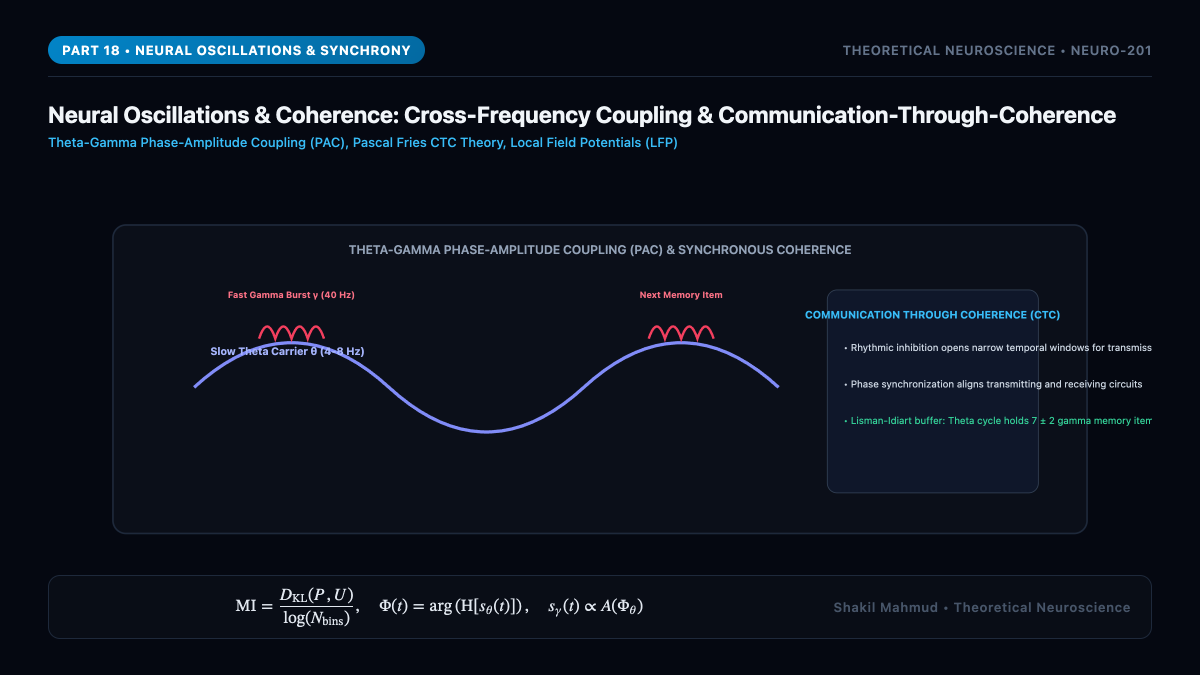
Complex cognition requires coordinating operations occurring across different spatial and temporal scales. The nervous system achieves this via Cross-Frequency Coupling (CFC), predominantly Theta-Gamma Phase-Amplitude Coupling (PAC).
The high-frequency gamma amplitude envelope $A_gamma(t)$ is modulated by the specific phase $Phi_theta(t)$ of the slow theta carrier rhythm:
A_gamma(t) = f(Phi_theta(t))
Quantified by Canolty and Tort’s Modulation Index (MI) based on the Kullback-Leibler distance from a uniform phase distribution, PAC implements the celebrated Lisman-Idiart Working Memory Buffer: each individual gamma burst nested within a specific phase cycle of a $5text{ Hz}$ theta wave ($T_theta approx 200text{ ms}$) encodes a distinct sequential memory item. Because approximately $7$ gamma cycles fit within a single theta cycle ($200text{ ms} / 25text{ ms} approx 7$), PAC provides the biophysical explanation for George Miller’s famous psychological limit of working memory: $7 pm 2$ items!
4. Communication-Through-Coherence (CTC)
How does the brain dynamically route information between anatomical areas without changing physical wiring? In 2005, Pascal Fries formulated the Communication-Through-Coherence (CTC) hypothesis:
Effective communication between two neuronal populations requires that their rhythmic excitability peaks are phase-synchronized with a phase lag matching the axonal conduction delay.
Rhythmic GABAergic inhibition acts as a rotating door, opening narrow temporal windows where inputs can trigger postsynaptic spikes. If the sending area’s spike bursts arrive precisely during the receiving area’s excitability peak (trough of inhibition), information flows with maximum gain. If the phase lag shifts by half a cycle ($180^circ$), spikes arrive during peak inhibition and are annihilated, dynamically switching cognitive communication channels in fractions of a second.




