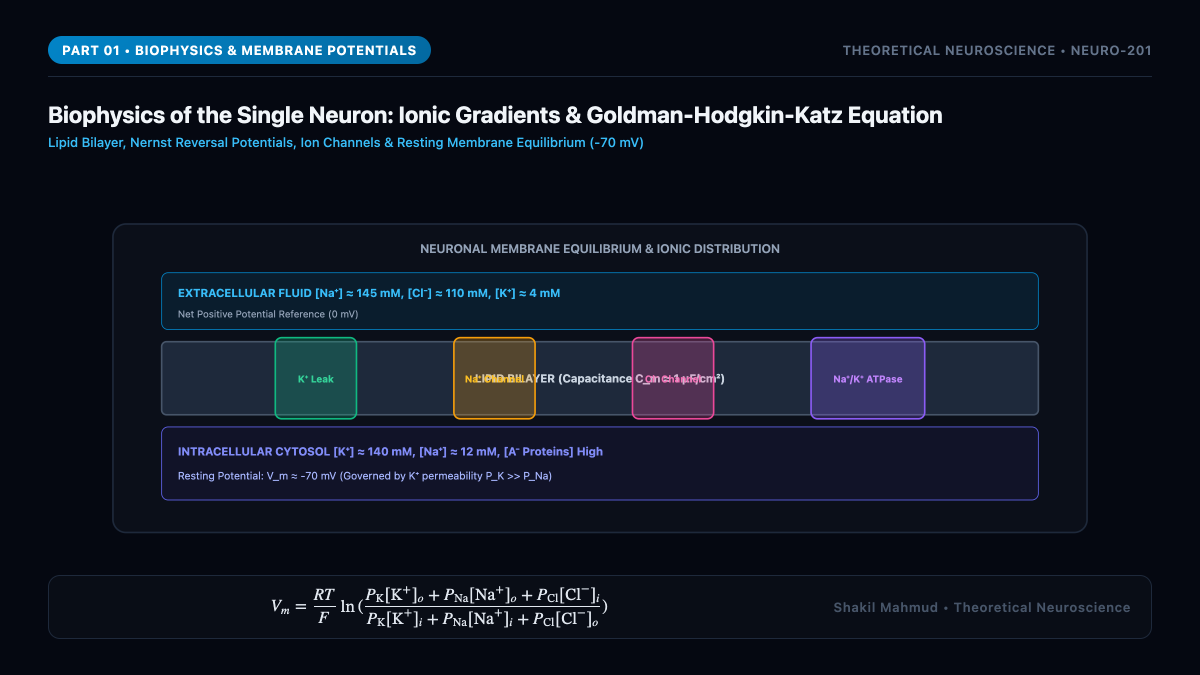
At its physical core, every thought, perception, and voluntary movement in the animal kingdom originates as a microscopic flow of ions across a nanoscale lipid membrane. A single biological neuron is fundamentally an electrochemical battery and capacitive circuit. By exploiting active ATP-driven ionic pumps and selective ion channels, the neuronal membrane maintains a delicate thermodynamic non-equilibrium that stores electrical energy, establishing the Resting Membrane Potential ($V_m approx -70text{ mV}$) upon which all neural computation relies.
1. Thermodynamic Equilibrium & The Nernst Potential
The neuronal membrane separates two aqueous electrolytic solutions: the extracellular fluid (dominated by sodium $text{Na}^+$ and chloride $text{Cl}^-$) and the intracellular cytosol (dominated by potassium $text{K}^+$ and large impermeable organic anions $text{A}^-$). For a single permeable ionic species with valence $z$, diffusion down its chemical concentration gradient is counterbalanced by the opposing electrical potential gradient.
At electrochemical equilibrium, the electrochemical potential $mu_i = mu_i^0 + RT ln[C]_i + z F V$ is equal on both sides of the membrane. Equating these chemical and electrical potentials yields the fundamental Nernst Equation:
E_{text{ion}} = frac{RT}{zF} ln left( frac{[text{ion}]_o}{[text{ion}]_i} right)
where $R$ is the universal gas constant, $T$ is temperature in Kelvin, $F$ is Faraday’s constant, and $[text{ion}]_o, [text{ion}]_i$ are the extracellular and intracellular concentrations. At mammalian physiological temperature ($37^circtext{C}$ or $310text{ K}$), the constant factor $frac{RT}{F} ln(10) approx 61.5text{ mV}$, yielding the standard mammalian reversal potentials:
- Potassium ($text{K}^+$): $[text{K}^+]_i approx 140text{ mM}, [text{K}^+]_o approx 4text{ mM} implies E_{text{K}} approx -90text{ mV}$
- Sodium ($text{Na}^+$): $[text{Na}^+]_i approx 12text{ mM}, [text{Na}^+]_o approx 145text{ mM} implies E_{text{Na}} approx +60text{ mV}$
- Chloride ($text{Cl}^-$): $[text{Cl}^-]_i approx 10text{ mM}, [text{Cl}^-]_o approx 110text{ mM} implies E_{text{Cl}} approx -70text{ mV}$
2. Multi-Ion Permeability & The Goldman-Hodgkin-Katz (GHK) Equation
In reality, the biological membrane is simultaneously permeable to multiple ionic species. The net steady-state voltage is not governed by any single Nernst potential, but by the weighted sum of permeabilities $P_{text{ion}}$. Integrating the Nernst-Planck electrodiffusion flux across a thin membrane of width $L$ under the assumption of a constant electrical field ($dV/dx = text{const}$) yields the celebrated Goldman-Hodgkin-Katz (GHK) Voltage Equation:
V_m = frac{RT}{F} ln left( frac{P_{text{K}}[text{K}^+]_o + P_{text{Na}}[text{Na}^+]_o + P_{text{Cl}}[text{Cl}^-]_i}{P_{text{K}}[text{K}^+]_i + P_{text{Na}}[text{Na}^+]_i + P_{text{Cl}}[text{Cl}^-]_o} right)
Because chloride is negatively charged ($z = -1$), its concentration ratio is inverted inside the logarithm. In the resting neuronal state, constitutive potassium leak channels (such as $K_{2P}$ channels) dominate membrane permeability, with relative ratios $P_{text{K}} : P_{text{Na}} : P_{text{Cl}} approx 1.0 : 0.04 : 0.45$. Consequently, the resting potential rests very close to the potassium reversal potential at approximately $-70text{ mV}$.
3. Equivalent Electrical Circuit of the Membrane
Biophysically, the phospholipid bilayer is an insulator separating two conductive salt solutions, acting as a parallel-plate capacitor with specific capacitance $C_m approx 1,mutext{F/cm}^2$. Each ionic pathway behaves as a variable resistor (conductance $g_k$) in series with a battery of electromotive force $E_k$.
Applying Kirchhoff’s Current Law, the total current density $I_m$ across the membrane is the sum of capacitive displacement current and ionic ohmic currents:
I_m = C_m frac{dV_m}{dt} + sum_k g_k (V_m – E_k) + I_{text{inj}}
When external injection current $I_{text{inj}} = 0$ and $dV_m/dt = 0$, the membrane stabilizes at its resting potential:
V_{text{rest}} = frac{g_{text{K}} E_{text{K}} + g_{text{Na}} E_{text{Na}} + g_{text{Cl}} E_{text{Cl}}}{g_{text{K}} + g_{text{Na}} + g_{text{Cl}}}
4. The Metabolic Foundation: The $text{Na}^+/text{K}^+$ ATPase Pump
Passive leak currents would eventually dissipate ionic concentration gradients, causing the cell to depolarize and die. To maintain steady-state gradients, the neuron expends roughly $50%$ to $70%$ of its total cellular ATP to power the $text{Na}^+/text{K}^+$ ATPase pump.
For every molecule of ATP hydrolyzed, this electrogenic pump transports $3,text{Na}^+$ ions out of the cytoplasm and $2,text{K}^+$ ions inward against their respective electrochemical gradients, generating a net outward hyperpolarizing current that preserves the thermodynamic fuel of the brain.




