For centuries, optical events were measured on timescales accessible to human reflexes and electronic circuitry. The advent of ultrafast optics smashed these speed barriers, compressing coherent electromagnetic energy first into femtoseconds ((10^{-15} ext{ s})) via passive mode-locking and Chirped Pulse Amplification (CPA), and ultimately into attoseconds ((10^{-18} ext{ s})) via High-Harmonic Generation. This ultra-high temporal resolution permits real-time stroboscopic tracking of electronic wave functions orbiting atomic nuclei.
1. The Mathematics of Mode-Locking
A multi-mode laser cavity with (2N + 1) longitudinal modes oscillating with arbitrary, uncorrelated phases (phi_q) emits a continuous, fluctuating chaotic background intensity. However, if an intracavity mechanism locks all mode phases into an invariant phase relation ((phi_q = phi_0 = ext{const})), the total electric field becomes:
[
E(t) = sum_{q=-N}^N E_0 e^{i[(omega_0 + q Delta omega) t + phi_0]} = E_0 e^{i(omega_0 t + phi_0)} rac{sinleft(rac{2N+1}{2}Delta omega t
ight)}{sinleft(rac{1}{2}Delta omega t
ight)}
]
The time-averaged optical intensity forms a periodic train of ultra-intense pulses separated by the cavity round-trip time (T_{ ext{rep}} = 2L/c = 1/Delta
u_{ ext{FSR}}). The physical consequences are profound:
- Peak Intensity Enhancement: Peak power scales quadratically with the number of locked modes:
[
I_{ ext{peak}} = (2N + 1)^2 I_0
] - Transform-Limited Pulse Duration: By the Fourier time-frequency uncertainty relation, pulse duration (Delta t) is inversely proportional to total gain bandwidth (Delta omega = (2N+1)Delta
u_{ ext{FSR}}):
[
Delta t cdot Delta
u ge K_{ ext{shape}} implies Delta t approx rac{K}{Delta
u_{ ext{gain}}}
]
where (K = 0.441) for Gaussian pulses and (0.315) for (operatorname{sech}^2) pulses. Broadband laser media such as Titanium-doped Sapphire (( ext{Ti:Sapphire}), (Delta lambda approx 650 ext{–}1100 ext{ nm})) support sub-10-femtosecond optical pulses.
2. Kerr-Lens Mode-Locking (KLM)
While active mode-locking uses external acousto-optic modulators, the shortest femtosecond pulses are synthesized through passive Kerr-Lens Mode-Locking. In a non-linear crystal, the intensity-dependent refractive index (n(I) = n_0 + n_2 I) acts as a spatial gradient index lens. Because an intense ultrashort spike exhibits higher peak intensity than continuous wave (CW) background, it experiences stronger self-focusing.
Placing an aperture (hard aperture) or maximizing overlap with the pump beam (soft aperture) inside the cavity suppresses low-intensity CW light while providing preferential saturable gain to the ultrashort pulse, locking millions of modes passively.
3. Chirped Pulse Amplification (CPA)
Amplifying a 10-femtosecond pulse directly in solid-state amplifier crystals triggers severe catastrophic non-linear self-focusing (filamentation) and optical dielectric breakdown when peak power exceeds the critical B-integral threshold ((B = rac{2pi}{lambda}int n_2 I(z) , dz < 3 ext{–}5)).
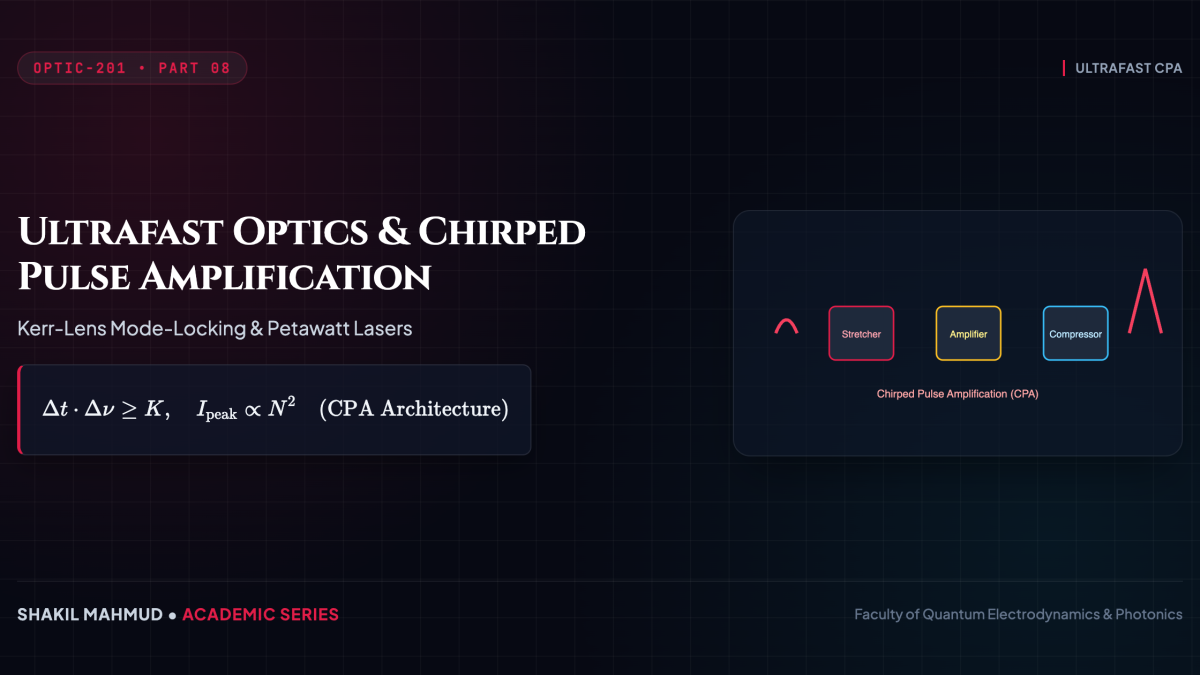
Donna Strickland and Gérard Mourou (1985 Nobel Prize) solved this paradox via Chirped Pulse Amplification (CPA) in three elegant steps:
- Stretching: A low-energy femtosecond seed pulse passes through a diffraction grating pair. Positive group delay dispersion stretches the pulse temporally by a factor of (10^4) (from (50 ext{ fs}) to (1 ext{ ns})), introducing a linear frequency sweep (chirp) and dropping peak power by four orders of magnitude.
- Amplification: The stretched, low-intensity pulse is safely amplified in large Nd:glass or Ti:Sapphire amplifiers by a factor of (10^6 ext{–}10^9), remaining well below the crystal damage threshold.
- Compression: The high-energy chirped pulse traverses a matched grating pair introducing negative dispersion, compressing the pulse back to its original femtosecond duration and unleashing Petawatt ((10^{15} ext{ W})) and Exawatt ((10^{18} ext{ W})) peak powers.
4. High-Harmonic Generation (HHG) and Attosecond Pulses
When Petawatt-scale laser fields ((I > 10^{14} ext{ W/cm}^2)) interact with noble gas atoms, the laser electric field suppresses the atomic Coulomb barrier, initiating High-Harmonic Generation (HHG), described by Corkum’s Three-Step Model (2023 Nobel Prize: Agostini, Krausz, L’Huillier):
- Tunnel Ionization: The electron quantum-mechanically tunnels through the suppressed atomic barrier into the continuum.
- Laser Acceleration: The free electron oscillates in the intense laser field, acquiring kinetic energy (E_k = 3.17 U_p), where (U_p = e^2 E_0^2 / (4 m_e omega_0^2)) is the ponderomotive potential.
- Recombination & Coherent Emission: As the laser field reverses polarity, the electron is driven back and recombines with its parent ion, releasing its accumulated kinetic and ionization energy as an extreme ultraviolet (XUV) photon:
[
hbar omega_{ ext{cutoff}} = I_p + 3.17 U_p
]
Fourier synthesis of these synchronized odd high harmonics generates isolated attosecond pulses (( au sim 50 ext{–}200 ext{ as})), opening the frontier of attosecond pump-probe spectroscopy to observe electron motion inside valence atomic shells in real time.