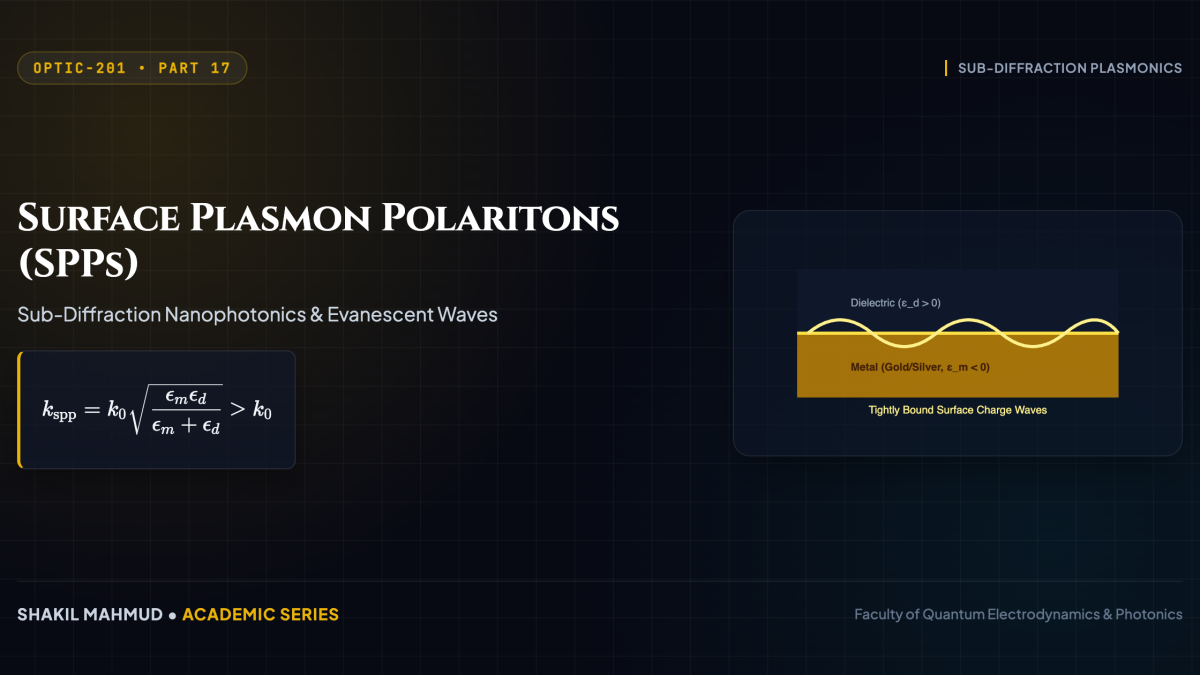
Under conventional wave optics, the wave nature of light imposes the Abbe diffraction barrier ((Delta x sim lambda / 2n)): light cannot be focused into a spatial spot smaller than approximately half its free-space wavelength. Plasmonics circumvents this boundary by marrying photons with the collective electronic plasma oscillations of noble metals (such as gold and silver). The resulting hybrid quasi-particles—Surface Plasmon Polaritons (SPPs)—compress electromagnetic fields into nanometer-scale volumes, enabling single-molecule spectroscopy and extreme nanophotonic circuitry.
1. The Drude Free-Electron Gas Model
The optical response of noble metals is governed by the conduction electron plasma. Solving the equation of motion for free electrons under an alternating electric field (mathbf{E}(t) = mathbf{E}_0 e^{-iomega t}) yields the Drude dielectric function:
[
psilon_m(omega) = 1 – rac{omega_p^2}{omega^2 + i gamma omega} = 1 – rac{omega_p^2}{omega^2 + gamma^2} + i rac{gamma omega_p^2}{omega(omega^2 + gamma^2)}
]
where (gamma = 1/ au) is the electron collision damping rate, and (omega_p) is the collective plasma frequency:
[
omega_p = sqrt{rac{n_e e^2}{psilon_0 m_e}}
]
For frequencies below the plasma frequency ((omega < omega_p)), the real part of the permittivity is negative ((operatorname{Re}[psilon_m] < 0)), rendering the metal highly reflective and capable of supporting bound surface charge waves.
2. Surface Plasmon Polariton Dispersion Relation
Consider a planar interface between a semi-infinite metal ((z < 0), (psilon_m(omega) 0), (psilon_d > 0)). Enforcing Maxwell boundary conditions (continuity of tangential (mathbf{E}) and normal (mathbf{D})) reveals that only Transverse Magnetic (TM or p-polarized) modes can couple to surface charge oscillations.
The resulting bound SPP dispersion relation along the propagation direction (x) is:
[
k_{ ext{spp}}(omega) = rac{omega}{c} sqrt{rac{psilon_m(omega) psilon_d}{psilon_m(omega) + psilon_d}}
]
Because (psilon_m psilon_d), the term inside the square root is strictly greater than (psilon_d). Consequently, the SPP wavevector is always greater than the light wavevector in the adjacent dielectric:
[
k_{ ext{spp}}(omega) > k_{ ext{light}} = rac{omega}{c} sqrt{psilon_d}
]
This momentum mismatch creates two monumental physical consequences:
- Exponential Evanescent Confinement: In the perpendicular (z)-direction, the electric field decays exponentially into both media ((E propto e^{-|k_z| |z|})), localizing electromagnetic energy within nanometers of the metal surface.
- Optical Coupling Barrier: A propagating light beam incident from free space cannot directly excite SPPs because its in-plane momentum is insufficient ((k_x le rac{omega}{c}sqrt{psilon_d} < k_{ ext{spp}})).
3. Prism Coupling: Kretschmann and Otto Geometries
To supply the missing momentum, experimentalists utilize high-index prism couplers ((n_p > sqrt{psilon_d})):
- Kretschmann Configuration: A thin metallic film ((sim 50 ext{ nm})) is evaporated directly onto the base of a glass prism. Light undergoes total internal reflection inside the prism, generating an evanescent tail with enhanced in-plane momentum (k_x = rac{omega}{c} n_p sin heta). At the resonance angle ( heta_{ ext{spp}}), momentum matching occurs:
[
rac{omega}{c} n_p sin heta_{ ext{spp}} = operatorname{Re}[k_{ ext{spp}}]
]
Light energy tunnels resonant into SPPs, causing an abrupt, sharp dip in optical reflectivity to near zero. - Otto Configuration: The prism is separated from a bulk metal surface by a sub-micrometer air gap, permitting evanescent coupling without depositing metal on the prism.
4. Localized Surface Plasmon Resonance (LSPR) and SERS
When metallic nanoparticles (gold or silver nanospheres, nanorods) of radius (a ll lambda) are illuminated, electrons undergo non-propagating collective dipole oscillations. By quasi-static Mie theory, the polarizability (alpha) is:
[
alpha = 4pi psilon_0 a^3 rac{psilon_m(omega) – psilon_d}{psilon_m(omega) + 2psilon_d}
]
Resonance occurs at the Fröhlich condition: (operatorname{Re}[psilon_m(omega_0)] = -2psilon_d). At this frequency, optical absorption and scattering cross-sections surge by orders of magnitude, and colossal local electric field enhancements ((|E_{ ext{loc}}| sim 100 ext{–}1000 |E_0|)) develop in the near-field “hotspots” between nanoparticle dimers.
This electric field concentration underpins Surface-Enhanced Raman Spectroscopy (SERS): because Raman scattering intensity scales as (I_{ ext{SERS}} propto |E_{ ext{loc}}|^4), electromagnetic enhancement factors exceed (10^8 ext{–}10^{12}), enabling single-molecule chemical identification.