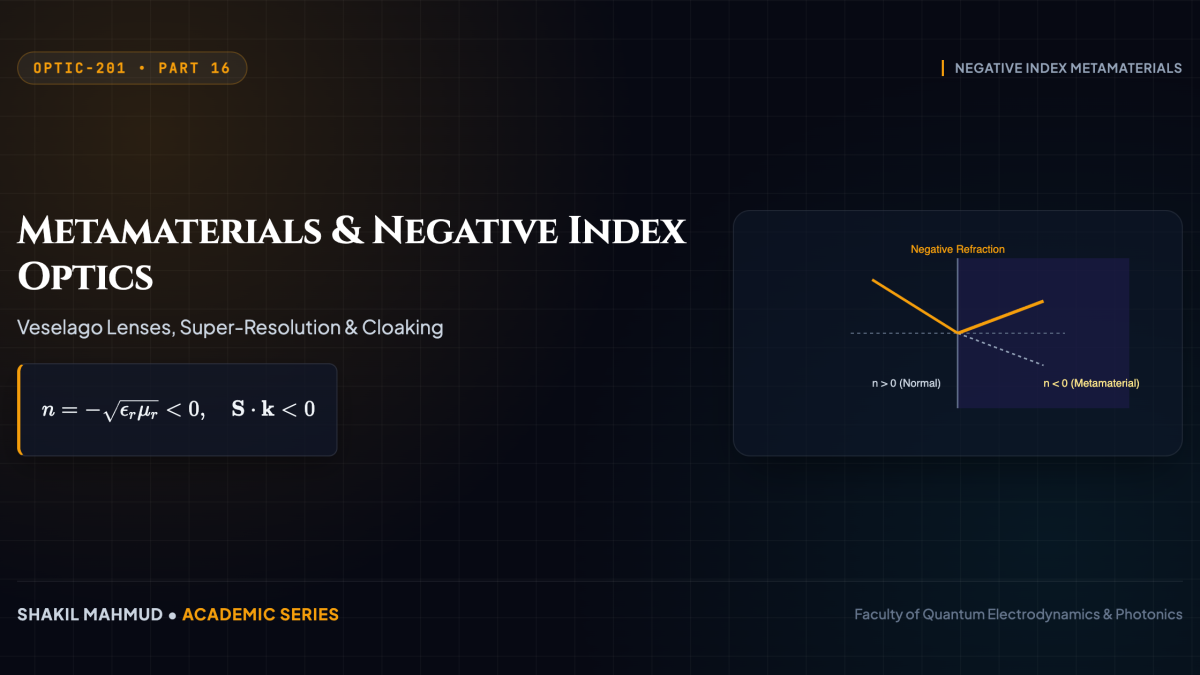
Every natural material found on Earth possesses positive electric permittivity ((psilon > 0)) and positive magnetic permeability ((mu > 0)), dictating a strictly positive refractive index ((n = +sqrt{psilon mu})). In 1968, Soviet theoretical physicist Victor Veselago posed a daring hypothesis: what if both (psilon) and (mu) were simultaneously negative? Thirty years later, John Pendry showed how artificially engineered sub-wavelength artificial structures—optical metamaterials—realize Veselago’s vision, shattering the Abbe diffraction barrier and transforming science-fiction invisibility cloaks into rigorous transformation electromagnetism.
1. Veselago Electrodynamics and Left-Handed Media
In Maxwell’s curl equations for monochromatic plane waves ((mathbf{E}, mathbf{H} propto e^{i(mathbf{k} cdot mathbf{r} – omega t)})):
[
mathbf{k} imes mathbf{E} = omega mu mathbf{H} quad ext{and} quad mathbf{k} imes mathbf{H} = -omega psilon mathbf{E}
]
When (psilon > 0) and (mu > 0), the vectors ({mathbf{E}, mathbf{H}, mathbf{k}}) form a conventional right-handed orthogonal triad. However, when (psilon < 0) and (mu < 0) simultaneously, the cross products force the wavevector (mathbf{k}) to point in the opposite direction: ({mathbf{E}, mathbf{H}, mathbf{k}}) forms a left-handed triad.
The physical implications are staggering:
- Negative Refractive Index: The refractive index must be chosen with the negative square root branch:
[
n = -sqrt{psilon_r mu_r}
] - Reversed Snell’s Law: An incoming light ray refracts to the same side of the normal surface interface:
[
rac{sin heta_1}{sin heta_2} = rac{n_2}{n_1} < 0
] - Reversed Doppler & Cherenkov Effects: A moving source shifts toward lower frequencies, and charged particles emit Cherenkov radiation backward rather than forward.
- Opposite Poynting Vector: The Poynting vector (mathbf{S} = mathbf{E} imes mathbf{H}) (energy flow) points strictly antiparallel to the wavevector (mathbf{k}) (phase velocity). Energy flows away from the source while phase fronts travel backward toward the source!
2. Artificial Realization: Split-Ring Resonators (SRR)
While metals provide negative permittivity ((psilon < 0)) below their plasma frequency via Drude free-electron gas dynamics, natural magnetic permeability is stubbornly unity ((mu approx 1)) at optical frequencies because magnetic spin resonances cannot follow Petahertz oscillations.
John Pendry solved this conundrum by inventing the Split-Ring Resonator (SRR): a sub-wavelength metallic loop interrupted by a capacitive gap. An alternating magnetic field threading the loop induces a circular eddy current, while the gap acts as a capacitor, creating a microscopic LC resonance circuit. Near resonance, the magnetic response lags the driving field by (pi), yielding an effective negative permeability (mu_{ ext{eff}} < 0). Interleaving SRRs with metallic wire arrays produces simultaneous negative index ((n < 0)).
3. The Pendry Superlens: Shattering the Diffraction Limit
Under conventional optics, the Ernst Abbe diffraction barrier restricts imaging resolution to (Delta x approx lambda / (2 ext{NA})). This limit occurs because fine sub-wavelength features are encoded in evanescent waves possessing imaginary longitudinal wavevectors ((k_z = i sqrt{k_x^2 – (omega/c)^2})), which decay exponentially with distance ((e^{-|k_z| d})) before reaching the lens.
Pendry proved that a flat slab of negative-index material ((psilon = -1, mu = -1)) acts as a Superlens: not only does it refocus propagating rays, but the resonant excitation of surface plasmons on both interfaces amplifies evanescent waves exponentially ((e^{+|k_z| d})), perfectly reconstructing both near-field and far-field components at the image plane with arbitrary, sub-diffraction spatial resolution.
4. Transformation Optics and Invisibility Cloaking
Form-invariance of Maxwell’s equations under general coordinate transformations permits Transformation Optics: any geometric coordinate distortion is mathematically equivalent to filling flat space with a tailored anisotropic, inhomogeneous metamaterial tensor (bar{bar{psilon}}(mathbf{r})) and (bar{bar{mu}}(mathbf{r})):
[
psilon^{i’j’} = mu^{i’j’} = rac{1}{det(mathbf{J})} J^i_{i’} J^j_{j’}
]
where (mathbf{J}) is the coordinate transformation Jacobian. By defining a spatial coordinate mapping that smoothly compresses a central cylindrical region into an outer concentric annular shell, electromagnetic rays curve smoothly around the hidden interior cavity and resume their original trajectories on the other side without phase distortion or scattering. An external observer sees unobstructed background light, rendering the central object completely invisible.

