The invention of the laser (Light Amplification by Stimulated Emission of Radiation) fundamentally transformed modern science and technology, providing coherent, monochromatic, directional optical beams spanning from telecommunications to nuclear fusion. Operating far from thermodynamic equilibrium, a laser harnesses quantum stimulated emission inside an optical feedback cavity, mediated by the non-equilibrium condition of population inversion.
1. The Einstein Radiation Coefficients and Thermodynamic Balance
In 1917, Albert Einstein deduced that the interaction of atoms with blackbody radiation requires three distinct optical processes:
- Spontaneous Emission: An excited atom in level 2 decays spontaneously to ground level 1 with transition probability (A_{21}) (rate (dot{N}_{2, ext{sp}} = -A_{21} N_2)).
- Stimulated Absorption: Radiation of spectral energy density (
ho(
u)) excites level 1 to level 2 with rate (B_{12} N_1
ho(
u)). - Stimulated Emission: An incident resonant photon induces an excited atom to emit a twin photon possessing identical frequency, phase, polarization, and propagation direction: rate (B_{21} N_2
ho(
u)).
Equating upward and downward transition rates in thermodynamic equilibrium governed by the Boltzmann distribution (N_2 / N_1 = e^{-h
u / k_B T}) and Planck’s radiation law yields the fundamental Einstein relations:
[
g_1 B_{12} = g_2 B_{21}, qquad rac{A_{21}}{B_{21}} = rac{8pi h
u^3}{c^3}
]
where (g_1, g_2) are state degeneracies. Spontaneous emission scales as (
u^3), explaining why X-ray and gamma-ray lasers require astronomical pumping powers compared to infrared and optical devices.
2. The Impossibility of Steady-State Lasing in Two-Level Systems
The net macroscopic amplification rate (dI/dz) of light traversing an atomic medium is proportional to the difference between stimulated emission and stimulated absorption:
[
rac{dI}{dz} = gamma(
u) I(z) = sigma(
u) (N_2 – N_1) I(z)
]
where (sigma(
u)) is the stimulated emission cross-section. For optical gain ((gamma > 0)), one must achieve population inversion: (N_2 > N_1).
In a simple two-level system under intense optical pumping, the steady-state population balance under pumping rate (W_p) is:
[
rac{dN_2}{dt} = W_p (N_1 – N_2) – A_{21} N_2 = 0 implies rac{N_2}{N_{ ext{total}}} = rac{W_p}{2 W_p + A_{21}} < rac{1}{2}
]
Even under infinite optical pumping ((W_p o infty)), the populations saturate at equality ((N_1 = N_2)), rendering the medium transparent ((gamma = 0)). Consequently, steady-state lasing is strictly impossible in a two-level medium.
3. Three-Level vs. Four-Level Lasing Schemes
To overcome this limitation, gain media rely on multi-level cascaded transitions:
A. Three-Level Lasers (e.g., Ruby Laser, ( ext{Cr}^{3+}: ext{Al}_2 ext{O}_3))
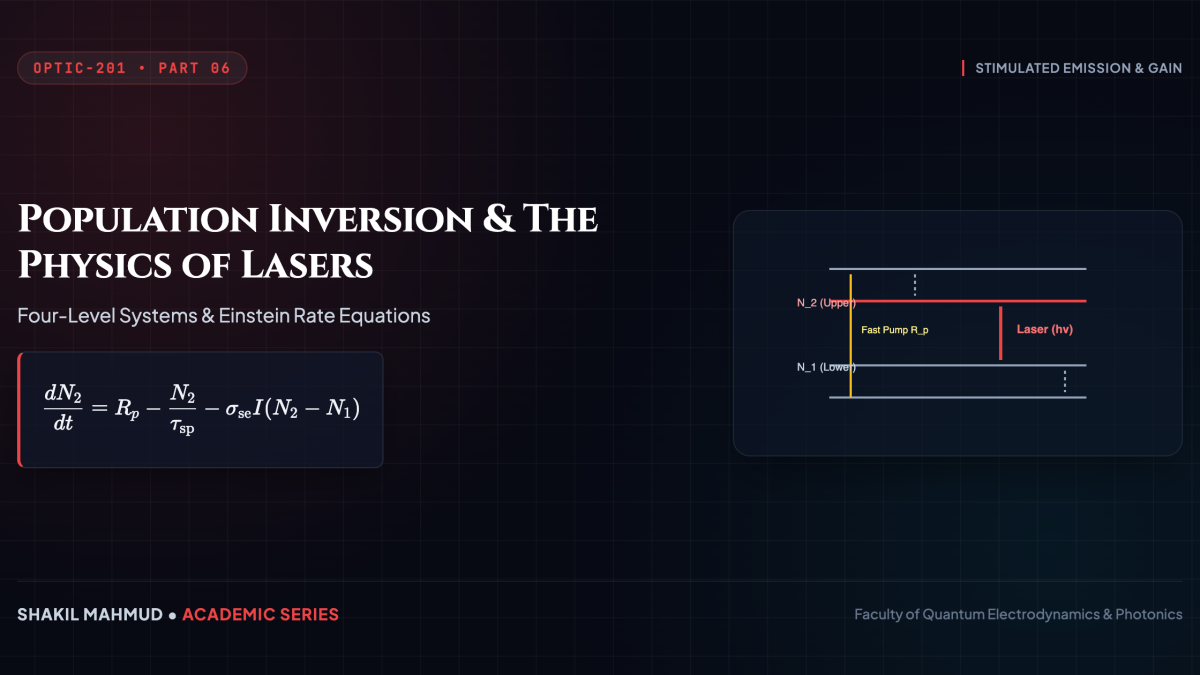
Pumping excites ground state atoms ((N_1)) to an upper broad pump band ((E_3)), which undergoes rapid non-radiative decay to a long-lived metastable lasing state ((E_2)). Because the terminal laser level is the ground state ((N_1)), inversion requires pumping more than (50%) of the entire atomic population out of the ground state ((N_2 > N_{ ext{total}}/2)), demanding very high pump thresholds.
B. Four-Level Lasers (e.g., ( ext{Nd}^{3+}: ext{YAG}), Helium-Neon)
The lower laser level ((E_1)) sits far above the ground state ((E_0)) such that (E_1 – E_0 gg k_B T). Under thermal equilibrium, the lower laser level is practically unpopulated ((N_1 approx 0)). Any atom transferred to (E_2) immediately produces inversion ((N_2 – N_1 approx N_2 > 0)), and rapid sub-picosecond non-radiative relaxation from (E_1) to (E_0) prevents bottlenecking, yielding low pump thresholds and high wall-plug efficiency.
4. Cavity Threshold Conditions and The Schawlow-Townes Linewidth
Placing the gain medium within a Fabry-Pérot cavity of mirror reflectivities (R_1, R_2) and length (L), the threshold gain (gamma_{ ext{th}}) balancing round-trip mirror transmission loss and internal scattering loss (alpha_s) is:
[
e^{2(gamma_{ ext{th}} – alpha_s)L} R_1 R_2 = 1 implies gamma_{ ext{th}} = alpha_s + rac{1}{2L}lnleft(rac{1}{R_1 R_2}
ight)
]
Above threshold, gain clamps strictly at (gamma_{ ext{th}}), and all additional pump power converts into coherent laser output. The ultimate fundamental quantum limit on laser linewidth is dictated by spontaneous emission into the lasing mode, formulated by Arthur Schawlow and Charles Townes (1958):
[
Delta
u_{ ext{laser}} = rac{2pi h
u (Delta
u_{ ext{cav}})^2}{P_{ ext{out}}}
]
where (Delta
u_{ ext{cav}}) is the passive cavity bandwidth and (P_{ ext{out}}) is output power, enabling modern ultra-stable optical clock lasers to achieve sub-Hertz linewidths.