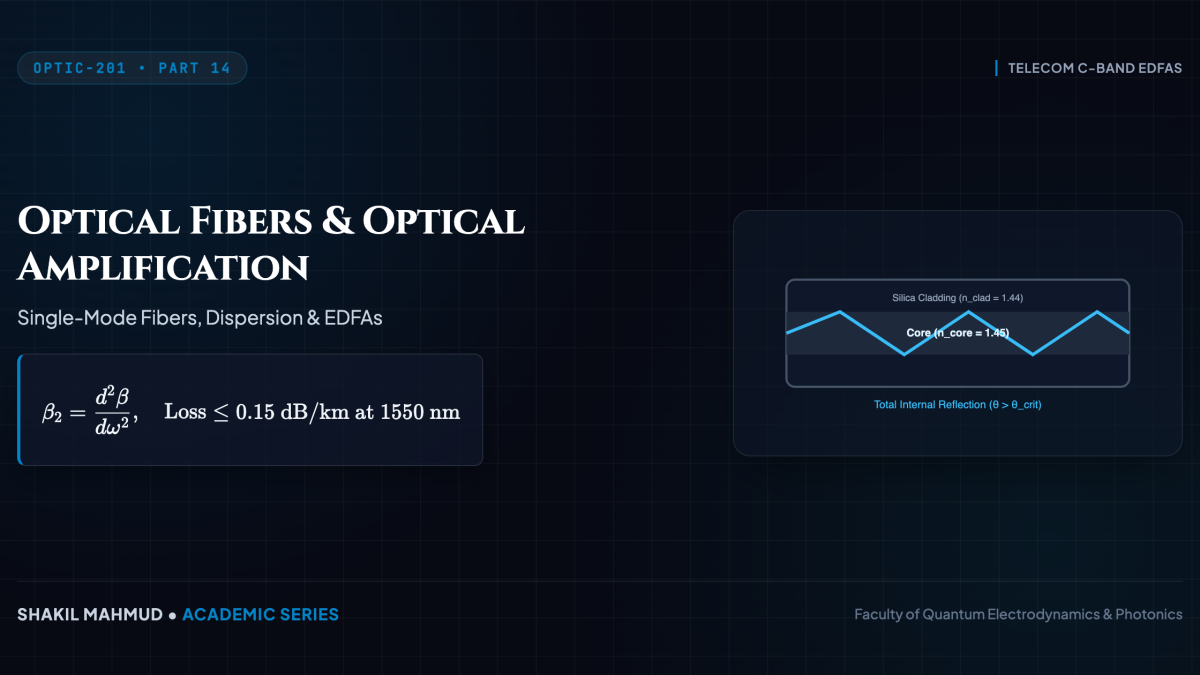
The worldwide digital infrastructure that powers modern civilization rests on a transparent thread of ultra-pure silica glass no thicker than a human hair. Developed through the pioneering insights of Charles Kao (2009 Nobel Prize), optical fiber technology transits petabits of information per second across transcontinental oceans. This triumph requires overcoming two fundamental physical adversaries: signal attenuation, conquered by Erbium-Doped Fiber Amplifiers (EDFA), and temporal pulse broadening, tamed by chromatic dispersion management.
1. Waveguiding and Modal Propagation
Light guidance in standard step-index fibers relies on total internal reflection at the boundary between a high-index silica core ((n_1)) and a low-index cladding ((n_2 < n_1)). The maximum launch angle defining the light-gathering capacity is the Numerical Aperture (NA):
[
ext{NA} = sin heta_{ ext{acc}} = sqrt{n_1^2 – n_2^2} approx n_1 sqrt{2Delta}
]
where (Delta = (n_1 – n_2)/n_1 ll 1). Solving Maxwell’s equations under weakly guiding cylindrical dielectric boundary conditions yields the dimensionless Normalized Frequency (V-number):
[
V = rac{2pi a}{lambda} ext{NA} = rac{2pi a}{lambda} sqrt{n_1^2 – n_2^2}
]
To eliminate modal dispersion—where different geometric paths arrive at different times—modern communications mandate Single-Mode Fibers (SMF) operating below the single-mode cutoff limit ((V < 2.405)), forcing light to propagate exclusively in the fundamental ( ext{LP}_{01}) (or ( ext{HE}_{11})) spatial mode.
2. Chromatic Dispersion Management
Even in a single-mode fiber, an optical pulse broadens temporally because different spectral components travel at different group velocities (v_g = (partial beta / partial omega)^{-1}). The total chromatic dispersion parameter (D) (( ext{ps}/( ext{nm} cdot ext{km}))) is the sum of material and waveguide dispersion:
[
D = -rac{2pi c}{lambda^2} beta_2 = D_{ ext{mat}} + D_{ ext{wg}}
]
For fused silica, material dispersion passes through zero at (lambda approx 1270 ext{ nm}). However, optical attenuation reaches its global minimum ((alpha approx 0.16 ext{ dB/km})) in the telecommunications C-band ((lambda approx 1550 ext{ nm})), where standard single-mode fibers (Corning SMF-28) exhibit anomalous dispersion of (D approx +17 ext{ ps}/( ext{nm} cdot ext{km})).
To prevent pulses from overlapping and corrupting gigabit-per-second bit streams over thousands of kilometers, networks deploy Dispersion-Compensating Fibers (DCF) with narrow, highly depressed cladding profiles engineered to provide massive negative waveguide dispersion ((D approx -100 ext{ ps}/( ext{nm} cdot ext{km}))), restoring pulse integrity periodically along the transmission link.
3. Erbium-Doped Fiber Amplifiers (EDFA)
Prior to 1987, long-distance optical signals required electronic repeaters: converting photons to electrons, electronic amplification, and re-emission via laser diodes—creating an insurmountable bandwidth bottleneck. David Payne and Emmanuel Desurvire shattered this barrier by inventing the Erbium-Doped Fiber Amplifier (EDFA).
By doping a short length ((10 ext{–}20 ext{ m})) of silica fiber with trivalent Erbium ions (( ext{Er}^{3+})), an external laser diode at (980 ext{ nm}) pumps ions from the ({}^4I_{15/2}) ground state into the ({}^4I_{11/2}) band, followed by rapid non-radiative relaxation ((sim 1 mu ext{s})) into the long-lived metastable state ({}^4I_{13/2}) (( au_{ ext{sp}} approx 10 ext{ ms})).
This creates a massive population inversion. Photons in the telecommunications window ((1530 ext{–}1565 ext{ nm})) stimulate transitions back to ground, emitting identical coherent photons with high gain ((G > 30 ext{–}40 ext{ dB})) and near-quantum-limited noise figures (( ext{NF} approx 3 ext{–}4 ext{ dB})). Crucially, because EDFAs operate purely in the optical domain without electronic conversion, a single amplifier simultaneously amplifies dozens of independent wavelength channels, enabling modern Dense Wavelength-Division Multiplexing (DWDM).

