While second-order optical non-linearities require non-centrosymmetric crystals, third-order susceptibility (chi^{(3)}) is universal, operating across all states of matter including silica glass, liquids, and atmospheric gases. The central consequence of (chi^{(3)}) is the Optical Kerr Effect: the modulation of a medium’s refractive index in direct proportion to optical intensity. In optical waveguiding, the exquisite balance between Kerr non-linearity and dispersion creates optical solitons—wavepackets that propagate indefinitely without spatial diffraction or temporal broadening.
1. The Optical Kerr Effect and Self-Phase Modulation (SPM)
The electronic Kerr effect arises from the anharmonic distortion of the electronic cloud by intense optical fields, modifying the refractive index according to:
[
n(I) = n_0 + n_2 I = n_0 + rac{3 chi^{(3)}}{4 psilon_0 c n_0^2} |E|^2
]
where (n_2) is the non-linear refractive index coefficient ((approx 3 imes 10^{-20} ext{ m}^2/ ext{W}) in fused silica). When an ultrashort optical pulse of temporal intensity envelope (I(t)) propagates through a Kerr medium over distance (L), it acquires a non-linear phase shift proportional to its own local instantaneous intensity, a phenomenon known as Self-Phase Modulation (SPM):
[
phi_{ ext{NL}}(t) = -rac{omega_0}{c} n_2 I(t) L
]
The time-dependent phase shift introduces an instantaneous frequency chirp across the pulse profile:
[
delta omega(t) = -rac{partial phi_{ ext{NL}}}{partial t} = rac{omega_0 n_2 L}{c} rac{partial I(t)}{partial t}
]
The leading edge of the pulse ((partial I / partial t > 0)) experiences a red-shift, while the trailing edge ((partial I / partial t < 0)) experiences a blue-shift, significantly broadening the optical spectrum while preserving the temporal envelope.
2. Spatial Self-Focusing and Critical Collapse
In the spatial transverse domain, a laser beam possessing a transverse Gaussian profile (I(r) = I_0 e^{-2r^2/w_0^2}) induces an intensity-dependent index distribution that peaks on the optical axis ((r = 0)). The Kerr medium behaves as a converging graded-index lens:
[
n(r) approx n_0 + n_2 I_0 left(1 – rac{2r^2}{w_0^2}
ight)
]
If self-focusing exactly counterbalances linear diffraction spreading (( heta_{ ext{diff}} sim lambda / (pi w_0 n_0))), a self-trapped spatial beam forms. Setting the diffraction angle equal to the total internal reflection critical angle yields the catastrophic Critical Power for Self-Focusing:
[
P_{ ext{cr}} = rac{alpha lambda^2}{4pi n_0 n_2} approx rac{0.148 lambda^2}{n_0 n_2}
]
When beam power exceeds (P_{ ext{cr}}) in bulk media, catastrophic runaway self-focusing occurs until higher-order plasma defocusing or multi-photon absorption arrests the collapse, creating stable extended laser filaments.
3. Temporal Solitons and The Non-Linear Schrödinger Equation (NLSE)
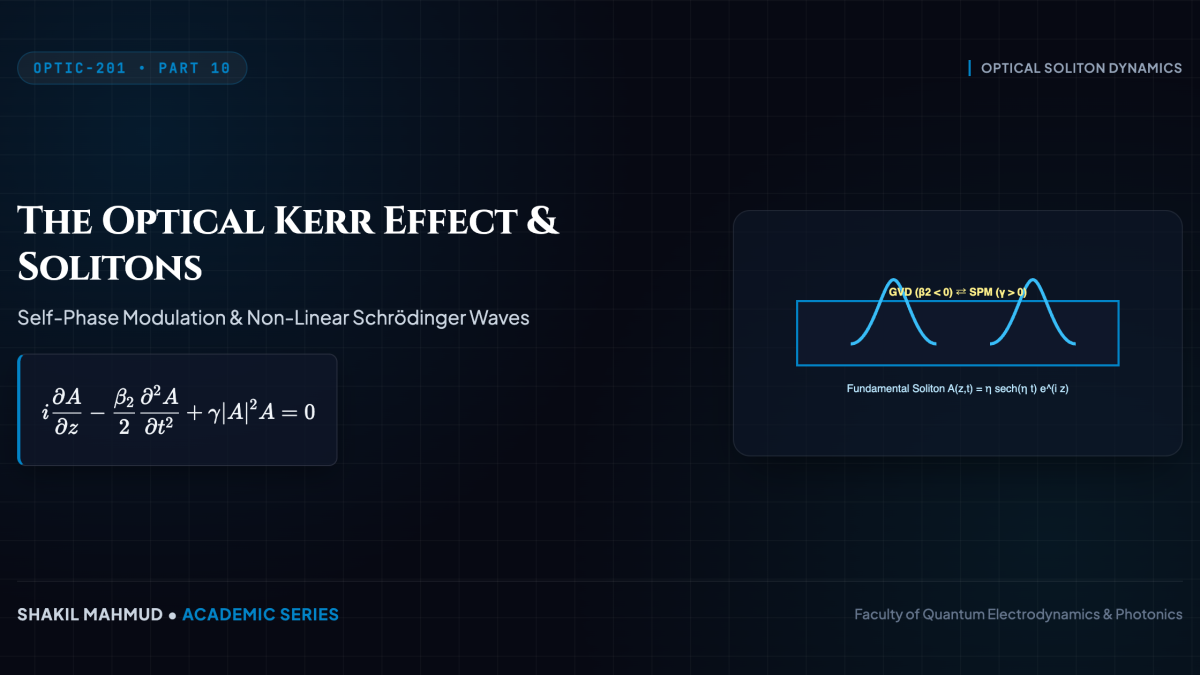
In single-mode optical fibers, spatial diffraction is eliminated by geometric boundary confinement. The pulse envelope (A(z, t)) evolves under the combined influence of second-order group velocity dispersion (GVD, parameter (beta_2 = partial^2 k / partial omega^2)) and Kerr non-linearity (parameter (gamma = n_2 omega_0 / (c A_{ ext{eff}}))), governed by the celebrated Non-Linear Schrödinger Equation (NLSE):
[
i rac{partial A}{partial z} – rac{beta_2}{2} rac{partial^2 A}{partial T^2} + gamma |A|^2 A = 0
]
where (T = t – z/v_g) is the retarded time frame moving at group velocity (v_g). In the anomalous dispersion regime ((beta_2 < 0)), GVD causes high frequencies (blue) to travel faster than low frequencies (red). Because SPM red-shifts the leading edge and blue-shifts the trailing edge, the non-linear chirp exactly cancels the chromatic dispersion chirp!
Under this exact balance, the fundamental ((N=1)) bright soliton solution emerges:
[
A(z, T) = sqrt{P_0} operatorname{sech}left(rac{T}{T_0}
ight) e^{i rac{gamma P_0}{2} z}
]
provided the peak power (P_0) satisfies the soliton condition (P_0 = rac{|beta_2|}{gamma T_0^2}). Optical solitons form the bedrock of transoceanic optical fiber communications and supercontinuum frequency combs.