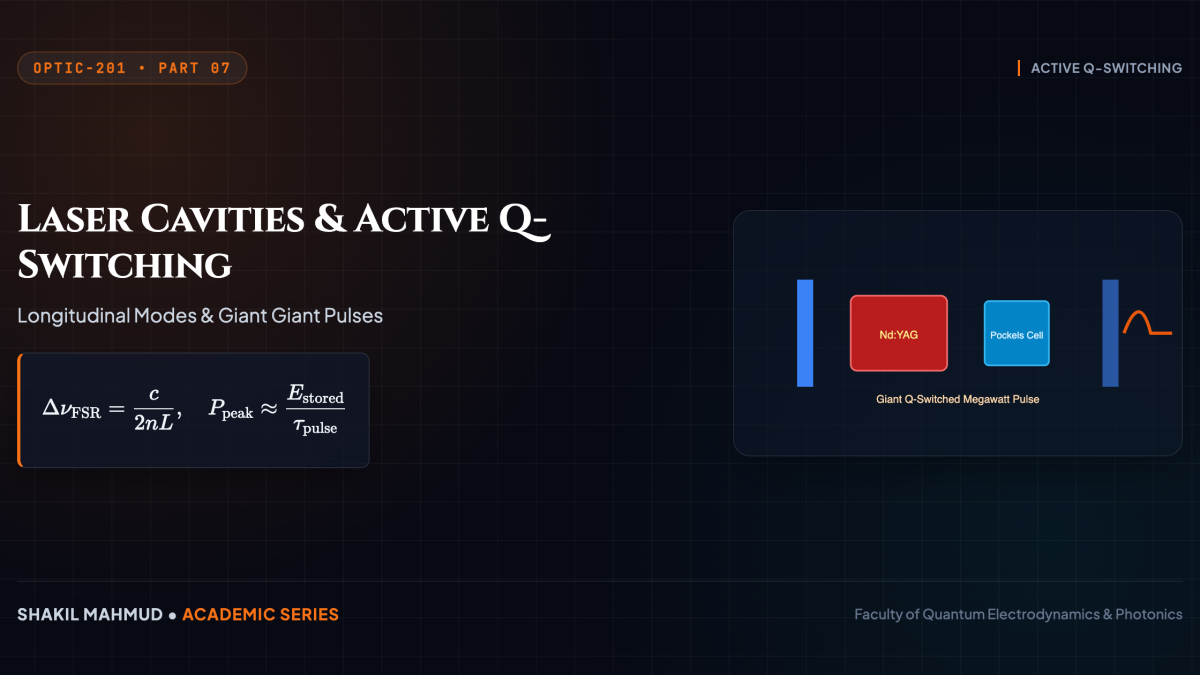
An optical amplifier alone does not make a laser; it requires an optical feedback resonator to establish spatial and temporal boundary conditions. By recirculating spontaneous photons through an active gain medium, a laser cavity resonator selects discrete electromagnetic longitudinal and transverse spatial modes. Furthermore, by dynamically modulating the quality factor of the cavity via Q-switching, lasers can compress continuous energy storage into giant, gigawatt-scale pulses lasting mere nanoseconds.
1. Optical Resonator Modes and The Free Spectral Range (FSR)
Consider a linear standing-wave Fabry-Pérot cavity of optical path length (n L) bounded by two parallel mirrors. Constructive round-trip phase interference requires an integer number (q) of half-wavelengths to span the cavity:
[
2 n L = q lambda_q = q rac{c}{
u_q} implies
u_q = q rac{c}{2 n L}
]
The frequency separation between adjacent longitudinal modes is the Free Spectral Range (FSR):
[
Delta
u_{ ext{FSR}} =
u_{q+1} –
u_q = rac{c}{2 n L}
]
For a 30-cm-long gas or solid-state cavity ((L = 0.3 ext{ m})), (Delta
u_{ ext{FSR}} approx 500 ext{ MHz}). If the atomic gain bandwidth (Delta
u_{ ext{gain}}) (e.g., (1 ext{ GHz}) in He-Ne, or (120 ext{ GHz}) in Nd:YAG) spans multiple FSR intervals, the laser oscillates simultaneously in hundreds of competing longitudinal modes.
2. Transverse Electromagnetic Modes: ( ext{TEM}_{mn}) Gaussian Beams
Diffraction and mirror curvature confine radiation laterally into transverse spatial eigensolutions characterized by Hermite-Gaussian modes ( ext{TEM}_{mn}(x, y, z)). The fundamental ( ext{TEM}_{00}) Gaussian mode features a circular, uniphase intensity cross-section:
[
I(r, z) = I_0 left( rac{w_0}{w(z)}
ight)^2 xpleft( -rac{2r^2}{w(z)^2}
ight)
]
where (w(z) = w_0 sqrt{1 + (z/z_R)^2}) describes the beam radius expanding hyperbolically away from the beam waist (w_0), and (z_R = pi w_0^2 n / lambda) is the Rayleigh range. The ( ext{TEM}_{00}) mode has the lowest diffraction loss and attains the absolute theoretical minimum divergence angle ( heta = lambda / (pi w_0)), saturating the optical phase space diffraction limit.
3. Dynamics of Active Q-Switching: Giant Pulse Formation
The cavity quality factor (Q) measures the ratio of stored electromagnetic energy to energy dissipated per cycle: (Q = 2pi
u_0 E_{ ext{stored}} / P_{ ext{loss}}). In Q-switching, one artificially spoils the cavity (Q) to a very low value (high cavity loss) during optical pumping.
A. Population Storage Phase
Because cavity losses exceed available gain ((gamma < gamma_{ ext{th,spoiled}})), lasing cannot ignite. Pumping pumps inversion to colossal non-equilibrium values (N_i gg N_{ ext{th}}), storing massive energy in the metastable atomic state without stimulated emission depletion.
B. Fast Switching Phase
Within nanoseconds, an electro-optic Pockels Cell (applying a half-wave voltage (V_{pi} = lambda / (2 n_0^3 r_{63})) to rotate polarization by (90^circ) between crossed polarizers) or acousto-optic modulator suddenly restores the cavity to high (Q).
C. The Giant Pulse Avalanche
The gain (gamma propto N_i) now vastly exceeds the operating threshold ((gamma gg gamma_{ ext{th}})). A catastrophic stimulated avalanche rapidly sweeps through the cavity, emptying the accumulated population in a giant pulse described by the Wagner-Frost coupled rate equations:
[
rac{dphi}{dt} = left( rac{2sigma N l}{t_r} – rac{1}{ au_c}
ight) phi, qquad rac{dN}{dt} = -2sigma c phi N
]
where (phi) is photon density, (l) is gain medium length, and ( au_c = t_r / (2alpha L)) is cavity photon lifetime. The peak power of the resulting giant pulse reaches gigawatt scales over durations of (sim 5 ext{–}20 ext{ ns}):
[
P_{ ext{peak}} approx rac{E_{ ext{stored}}}{ au_{ ext{pulse}}} = rac{N_i h
u V}{2 au_{ ext{pulse}}}
]
4. Cavity Stability: ABCD Ray Matrices
Whether light rays remain confined inside a two-mirror curved resonator over infinite bounces is governed by the g-parameters:
[
g_1 = 1 – rac{L}{R_1}, qquad g_2 = 1 – rac{L}{R_2}
]
Tracing ray propagation using paraxial ABCD ray-transfer matrices yields the fundamental stability criterion:
[
0 le g_1 g_2 le 1
]
Symmetric confocal resonators ((g_1 = g_2 = 0)) and hemispherical cavities operate comfortably inside the stable zone, while planar cavities ((g_1 = g_2 = 1)) sit dangerously at the marginal stability edge, vulnerable to diffraction and misalignment.