In standard quantum mechanics textbooks, spontaneous emission is often introduced as an immutable, intrinsic property of an isolated excited atom. In 1946, Edward Mills Purcell overturned this dogma with a profound insight: an atom cannot emit a photon if there is no electromagnetic vacuum mode available to accept it. By structuring the surrounding dielectric environment inside a high-finesse optical cavity or photonic crystal, the Purcell Effect permits either dramatic acceleration or near-total suppression of spontaneous decay.
1. Fermi’s Golden Rule and The Local Density of States (LDOS)
By time-dependent perturbation theory, the transition rate (Gamma_{ ext{sp}}) of a two-level emitter from excited state (|e
angle) to ground state (|g
angle) with dipole moment (mathbf{d}) is governed by Fermi’s Golden Rule:
[
Gamma_{ ext{sp}} = rac{2pi}{hbar^2} sum_f |langle f | hat{H}_{ ext{int}} | i
angle|^2 delta(omega_i – omega_f)
]
Decomposing the field into electromagnetic eigenstates reveals that the transition rate is directly proportional to the projected Local Density of Optical States (LDOS) (
ho(mathbf{r}, omega)):
[
Gamma_{ ext{sp}}(mathbf{r}, omega_0) = rac{pi omega_0}{hbar psilon_0} |mathbf{d}|^2
ho_{mathbf{n}}(mathbf{r}, omega_0)
]
where (
ho_{mathbf{n}}(mathbf{r}, omega_0) = sum_m |mathbf{n} cdot mathbf{f}_m(mathbf{r})|^2 delta(omega_0 – omega_m)) measures the density of photon modes with polarization (mathbf{n}) at position (mathbf{r}). In free space, integrating over isotropic spherical k-space yields the standard Weisskopf-Wigner spontaneous emission rate:
[
ho_{ ext{free}}(omega_0) = rac{omega_0^2}{pi^2 c^3} implies Gamma_0 = rac{omega_0^3 |mathbf{d}|^2}{3pi psilon_0 hbar c^3}
]
2. Derivation of the Purcell Factor
Now consider an emitter placed at the electric field antinode of an optical microcavity supporting a resonant mode of frequency (omega_c approx omega_0), characterized by quality factor (Q = omega_c / Delta omega_c) and effective mode volume (V_{ ext{mode}}):
[
V_{ ext{mode}} = rac{int psilon(mathbf{r}) |mathbf{E}(mathbf{r})|^2 , dV}{max[psilon(mathbf{r}) |mathbf{E}(mathbf{r})|^2]}
]
The cavity mode broadens the singular delta function (delta(omega – omega_c)) into a normalized Lorentzian lineshape of spectral width (Delta omega_c). At the resonance peak, the cavity LDOS is:
[
ho_{ ext{cav}}(omega_0) = rac{2}{pi Delta omega_c V_{ ext{mode}}} = rac{2 Q}{pi omega_c V_{ ext{mode}}}
]
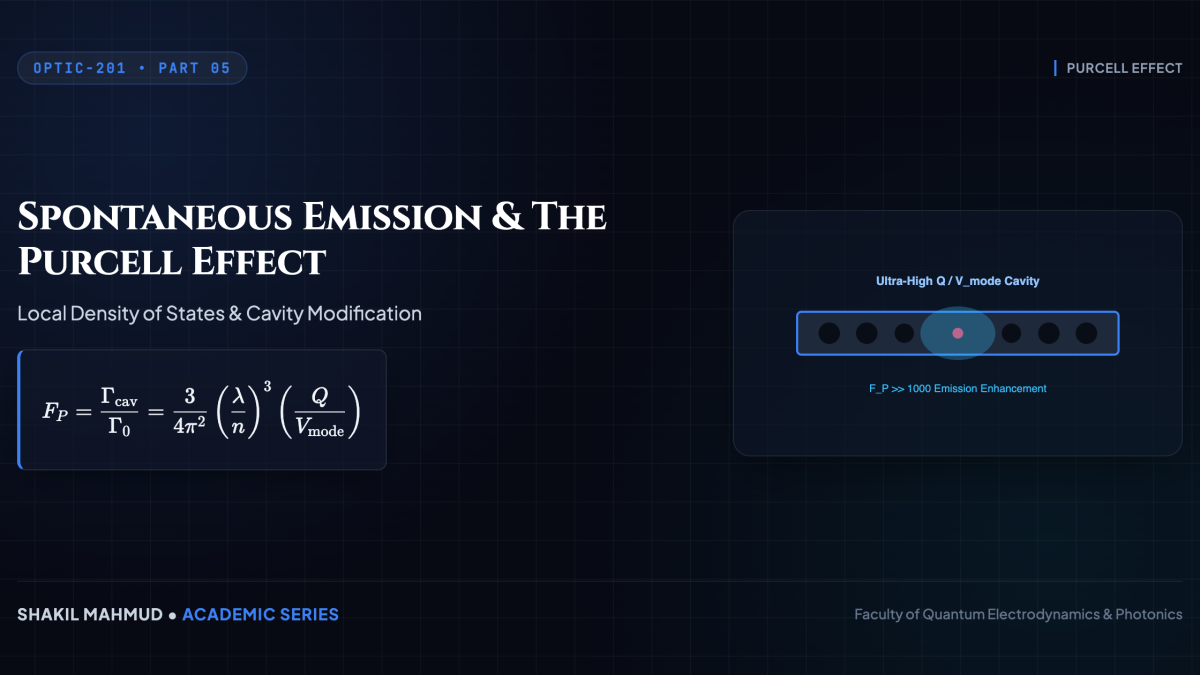
Dividing the on-resonance cavity emission rate (Gamma_{ ext{cav}}) by the free-space decay rate (Gamma_0) yields the celebrated dimensionless Purcell Factor ((F_P)):
[
F_P = rac{Gamma_{ ext{cav}}}{Gamma_0} = rac{3}{4pi^2} left( rac{lambda_c}{n}
ight)^3 left( rac{Q}{V_{ ext{mode}}}
ight)
]
To maximize spontaneous emission acceleration, one requires simultaneously ultra-high quality factors (Q) (long photon storage times) and deep sub-wavelength mode volumes (V_{ ext{mode}} ll (lambda/2n)^3).
3. Purcell Enhancement vs. Spontaneous Emission Inhibition
Depending on the spectral and spatial tuning of the cavity, two distinct physical regimes manifest:
A. Purcell Enhancement ((F_P gg 1))
In nanobeam photonic crystal cavities and micropillar resonators, (Q / V) ratios can exceed (10^6 (lambda/n)^{-3}), yielding Purcell factors (F_P > 100 ext{–}1000). Spontaneous decay becomes ultra-fast (sub-picosecond), funneling up to (beta > 99%) of all emitted photons into the designated single output waveguide mode, which is the foundational design criterion for high-brightness, deterministic single-photon sources.
B. Spontaneous Emission Inhibition ((F_P o 0))
If an emitter’s transition frequency falls inside a complete Photonic Bandgap (PBG) where no electromagnetic modes exist ((
ho(mathbf{r}, omega) quiv 0)), spontaneous emission is strictly suppressed. The excited state lifetime ( au = 1/Gamma) can be extended by orders of magnitude, effectively stabilizing fragile quantum superpositions.
4. The Weak vs. Strong Coupling Boundary
The Purcell effect operates in the weak coupling regime of cavity QED, where cavity dissipation ((kappa = omega_c / 2Q)) and atomic dephasing ((gamma)) are faster than the vacuum Rabi coupling rate ((g ll kappa + gamma)). In this irreversible regime, the emitted photon leaks from the cavity before it can be reabsorbed.
When the cooperativity parameter (C = g^2 / (kappa gamma) = F_P / 2 > 1), the system crosses the threshold into the coherent strong-coupling regime, where energy undergoes reversible Rabi exchange rather than monotonic exponential decay.