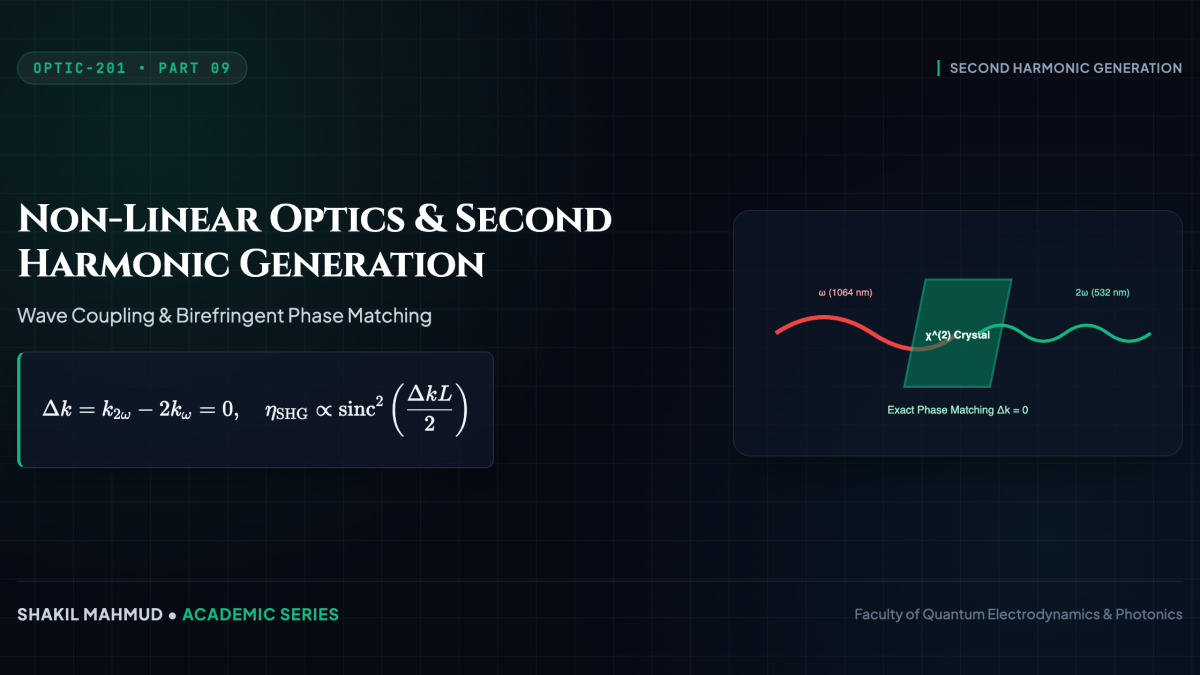
Under conventional optical intensities, dielectric media respond linearly: the induced macroscopic polarization (mathbf{P}) tracks the incident electric field (mathbf{E}) strictly as (mathbf{P} = psilon_0 chi^{(1)} mathbf{E}). However, under the colossal electric field gradients generated by coherent lasers ((|mathbf{E}| sim 10^7 ext{–}10^{10} ext{ V/m}), approaching intra-atomic Coulomb field strengths), the electron cloud is driven into non-parabolic, anharmonic potential wells. This gives rise to non-linear optical polarization, enabling frequency doubling, sum-frequency mixing, and coherent parametric light manipulation.
1. The Non-Linear Polarization Expansion
The total macroscopic polarization of an anisotropic dielectric medium under intense monochromatic irradiation is expressed as a power series in the electric field:
[
mathbf{P}(t) = psilon_0 left[ chi^{(1)} mathbf{E}(t) + chi^{(2)} mathbf{E}^2(t) + chi^{(3)} mathbf{E}^3(t) + dots
ight]
]
where (chi^{(n)}) is the (n)-th order non-linear optical susceptibility tensor of rank (n+1). In centrosymmetric media (materials invariant under spatial inversion (mathbf{r} o -mathbf{r}), such as isotropic glasses, gases, and silicon), inversion symmetry requires:
[
mathbf{P}(-mathbf{E}) = -mathbf{P}(mathbf{E}) implies chi^{(2)} quiv 0
]
Consequently, Second-Harmonic Generation (SHG) and all three-wave mixing phenomena occur exclusively in non-centrosymmetric crystalline lattices (e.g., Potassium Titanyl Phosphate ( ext{KTiOPO}_4) [KTP], Lithium Niobate ( ext{LiNbO}_3), and Beta-Barium Borate (beta ext{-BaB}_2 ext{O}_4) [BBO]).
2. Second-Harmonic Generation and Coupled-Wave Equations
Consider a fundamental wave of angular frequency (omega_1 = omega) propagating along the (z)-axis, generating a frequency-doubled second-harmonic wave (omega_2 = 2omega). Substituting the total field into the Maxwell wave equation under the Slowly Varying Envelope Approximation (SVEA, (|rac{partial^2 A}{partial z^2}| ll |k rac{partial A}{partial z}|)) yields the spatial coupled-amplitude equations:
[
rac{dA_1}{dz} = i rac{omega d_{ ext{eff}}}{n_1 c} A_2 A_1^* e^{-i Delta k z}
]
[
rac{dA_2}{dz} = i rac{omega d_{ ext{eff}}}{n_2 c} A_1^2 e^{i Delta k z}
]
where (d_{ ext{eff}} = rac{1}{2}chi^{(2)}_{ ext{eff}}) is the effective non-linear coefficient, and (Delta k) represents the crucial wavevector phase mismatch:
[
Delta k = k_2 – 2k_1 = rac{2omega}{c} [n(2omega) – n(omega)]
]
3. Phase-Matching and Coherence Length
In the non-depleted pump regime ((A_1(z) approx A_1(0) = ext{const})), integrating the second-harmonic amplitude gives the generated intensity profile:
[
I_{2omega}(L) = rac{2omega^2 d_{ ext{eff}}^2}{psilon_0 c^3 n_1^2 n_2} I_omega^2 L^2 operatorname{sinc}^2left(rac{Delta k L}{2}
ight)
]
Because natural materials exhibit normal chromatic dispersion ((n(2omega) > n(omega))), the phase mismatch is strictly non-zero ((Delta k
e 0)). The second-harmonic power oscillates sinusoidally with crystal length, transferring energy constructively only over the coherence length:
[
L_{ ext{coh}} = rac{pi}{|Delta k|} = rac{lambda}{4|n(2omega) – n(omega)|}
]
Beyond (L_{ ext{coh}}), the harmonic wave falls (pi) out of phase with the non-linear driving polarization, transferring power destructively back into the fundamental pump beam.
4. Birefringent and Quasi-Phase Matching (QPM)
To overcome destructive interference and achieve macroscopically scalable energy conversion ((operatorname{sinc}^2 o 1)), two primary physical methodologies are implemented:
- Birefringent Phase-Matching: By exploiting optical anisotropy in uniaxial crystals, an ordinary fundamental polarization wave ((n_o(omega))) matches the extraordinary index ((n_e(2omega, heta_m))) at a designated crystal propagation angle ( heta_m):
[
rac{1}{n_e^2(2omega, heta_m)} = rac{cos^2 heta_m}{n_o^2(2omega)} + rac{sin^2 heta_m}{n_e^2(2omega)} = rac{1}{n_o^2(omega)}
] - Quasi-Phase Matching (QPM): In ferroelectric materials such as Periodically Poled Lithium Niobate (PPLN), periodic microscopic electric field poling flips the spontaneous ferroelectric domain orientation every coherence length ((Lambda = 2L_{ ext{coh}})). This periodically inverts the sign of (chi^{(2)}), resetting the accumulating (pi) phase slip and permitting monotonic quadratic growth of the frequency-doubled field along the entire interaction length.