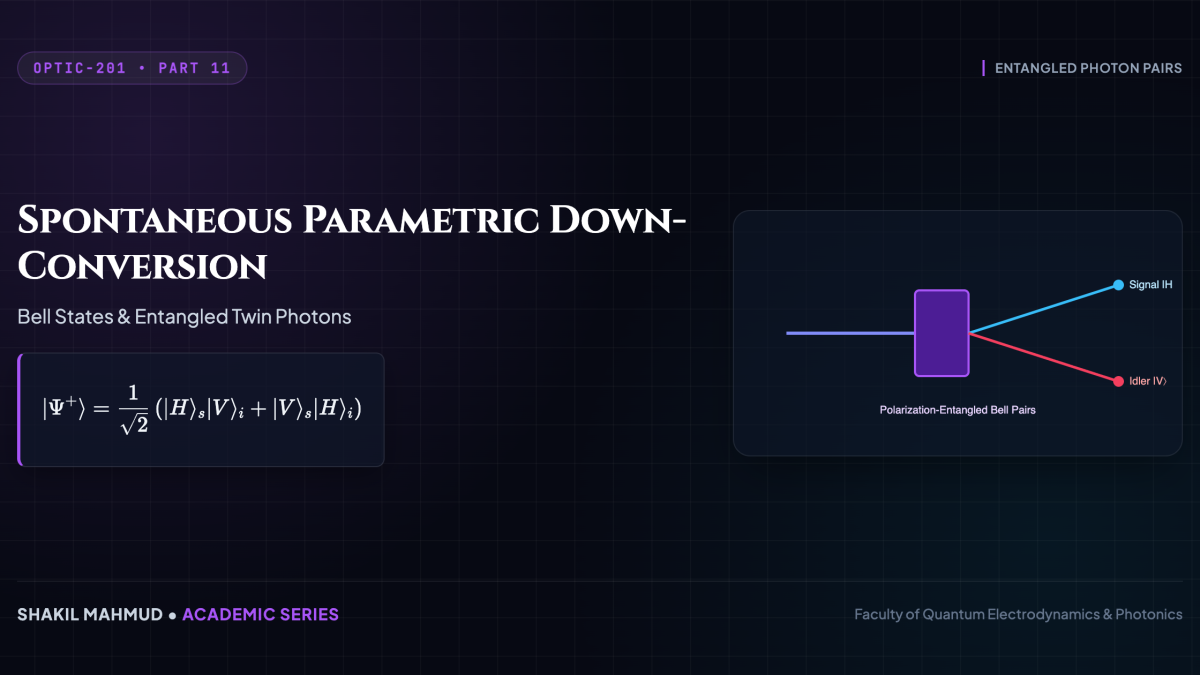
Non-linear wave interactions represent the premier experimental engine of modern quantum information science. By converting high-energy pump photons into correlated low-energy photon pairs through Spontaneous Parametric Down-Conversion (SPDC) and Four-Wave Mixing (FWM), quantum optics physicists synthesize deterministic single photons, heralded Fock states, and EPR-entangled Bell states with near-perfect fidelity.
1. Spontaneous Parametric Down-Conversion (SPDC)
In a non-centrosymmetric (chi^{(2)}) non-linear crystal, an incoming pump photon of frequency (omega_p) occasionally annihilates to spontaneously create two lower-energy photons: a signal ((omega_s)) and an idler ((omega_i)). This process is governed strictly by the conservation of energy and momentum (phase-matching):
[
hbar omega_p = hbar omega_s + hbar omega_i
]
[
hbar mathbf{k}_p = hbar mathbf{k}_s + hbar mathbf{k}_i
]
Depending on the polarization alignment between pump and down-converted photons, SPDC is classified into two primary geometries:
- Type-I Phase-Matching: Signal and idler photons possess identical linear polarizations, orthogonal to that of the pump photon ((e o o + o)).
- Type-II Phase-Matching: Signal and idler photons possess mutually orthogonal polarizations ((e o o + e)). The spatial output forms two intersecting emission cones. At the two intersection points where the trajectories are kinematically indistinguishable, the photon pair collapses into a maximally entangled Bell state:
[
|Psi^+
angle = rac{1}{sqrt{2}} left(|H
angle_s |V
angle_i + |V
angle_s |H
angle_i
ight)
]
2. Optical Parametric Amplification (OPA) and Oscillators (OPO)
When an intense coherent pump beam at (omega_p) interacts inside a crystal in the presence of an injected signal seed at (omega_s), stimulated parametric down-conversion occurs. The signal wave is coherently amplified, while an idler wave is generated simultaneously. The spatial spatial gain of the signal field obeys:
[
A_s(z) = A_s(0) cosh(g z) + i rac{kappa_s}{g} A_i^*(0) sinh(g z)
]
where the parametric gain coefficient (g) is defined by (g = sqrt{kappa_s kappa_i^* – (Delta k / 2)^2}), with coupling strength (kappa_s propto chi^{(2)} A_p). When placed inside an optical cavity resonant with the signal (or idler) frequency, the system forms an Optical Parametric Oscillator (OPO).
Unlike conventional lasers, an OPO does not require atomic population inversion or excited electronic states; light amplification is instantaneous and purely parametric, enabling continuously tunable coherent emission from the ultraviolet to the far-infrared.
3. Four-Wave Mixing (FWM) in Silicon and Fiber Waveguides
In third-order (chi^{(3)}) media such as silica optical fibers and nanophotonic silicon waveguides, two pump photons annihilate to generate signal and idler photons:
[
2omega_p = omega_s + omega_i quad ext{and} quad 2mathbf{k}_p = mathbf{k}_s + mathbf{k}_i + 2gamma P_0
]
where (2gamma P_0) represents the non-linear phase contribution induced by self- and cross-phase modulation. Degenerate Four-Wave Mixing in micro-ring resonators enables on-chip CMOS-compatible generation of entangled photon pairs, providing the foundational hardware for quantum photonic photonic circuits.