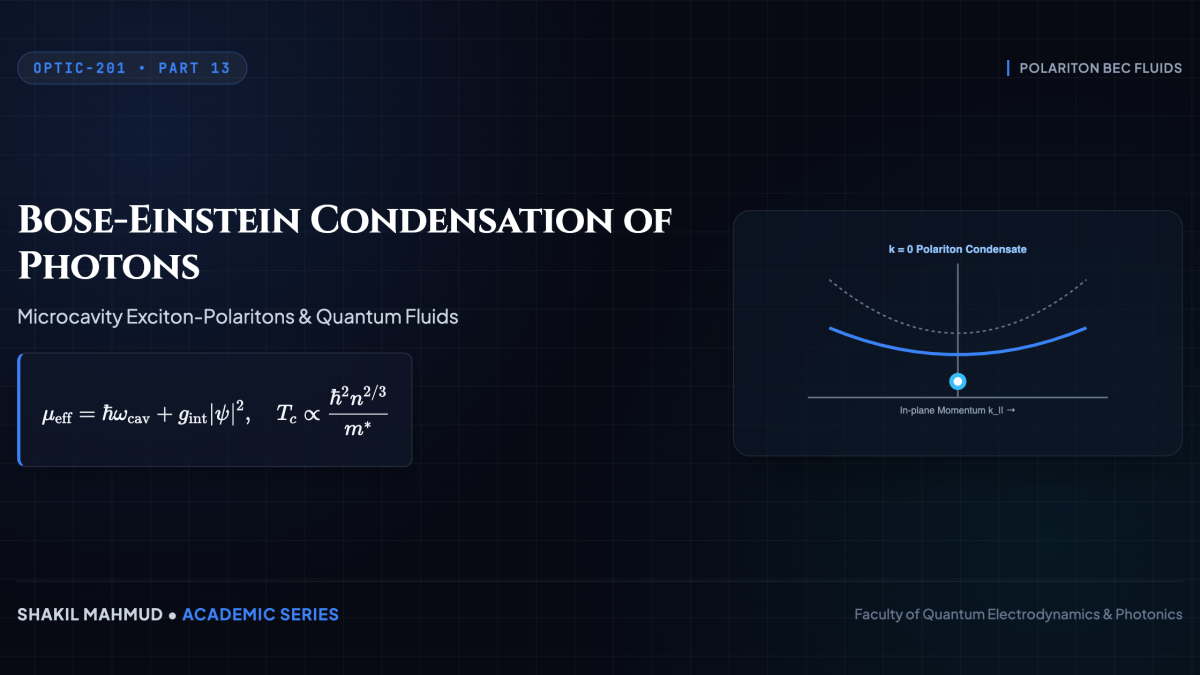
Under textbook statistical mechanics, photons are massless, non-conserved gauge bosons described by a chemical potential identically equal to zero ((mu = 0)). As a blackbody system cools toward absolute zero, photons simply disappear into the vacuum walls rather than condensing. However, by introducing geometric dimensional confinement and thermalizing fluorescent dye molecules inside high-finesse microcavities, physicists achieved the impossible: forcing photons to acquire an effective non-zero rest mass and a non-zero chemical potential ((mu
e 0)), demonstrating Bose-Einstein Condensation (BEC) of Light at room temperature.
1. Effective Photon Mass in Microcavities
Consider an optical Fabry-Pérot microcavity consisting of two high-reflectivity dielectric mirrors spaced by distance (D_0 approx q rac{lambda}{2}) along the (z)-axis. Confinement quantizes the longitudinal wavevector to (k_z = q pi / D_0). For photons possessing small transverse momentum (|mathbf{k}_perp| ll k_z), the relativistic energy dispersion relation expands as:
[
E = hbar c sqrt{k_z^2 + mathbf{k}_perp^2} = hbar c k_z sqrt{1 + rac{mathbf{k}_perp^2}{k_z^2}} approx hbar c k_z + rac{hbar^2 mathbf{k}_perp^2}{2 m_{ ext{eff}}}
]
The first term represents an effective rest energy (m_{ ext{eff}} c^2 = hbar omega_{ ext{cutoff}}), while the second term matches the non-relativistic kinetic energy of a massive two-dimensional particle possessing an effective inertial photon mass:
[
m_{ ext{eff}} = rac{hbar k_z}{c} = rac{hbar omega_{ ext{cutoff}}}{c^2} sim 10^{-35} ext{ kg} approx 10^{-5} m_e
]
Because mirrors are curved with radius (R), the varying cavity length creates an effective two-dimensional harmonic trapping potential (V(r) = rac{1}{2} m_{ ext{eff}} Omega^2 r^2), perfectly analogous to atomic magnetic traps.
2. Thermalization and Chemical Potential ((mu
e 0))
To establish a true thermodynamic equilibrium without losing photons to wall absorption, the cavity is filled with concentrated fluorescent dye molecules (e.g., Rhodamine 6G). Dye molecules undergo rapid absorption and emission cycles (( au_{ ext{therm}} sim 10^{-12} ext{ s})). By the Kennard-Stepanov relation, emission and absorption cross-sections satisfy a Boltzmann relation:
[
rac{sigma_{ ext{em}}(omega)}{sigma_{ ext{abs}}(omega)} propto xpleft(-rac{hbar(omega – omega_{ ext{zpl}})}{k_B T}
ight)
]
Because the dye thermalizes photons much faster than cavity decay (( au_{ ext{cav}} sim 10^{-9} ext{ s})), photons reach thermal equilibrium with the solvent molecules at room temperature ((T = 300 ext{ K})). If optical pump power injects photons faster than they escape, total photon number (N) is conserved dynamically, lifting the zero chemical potential restriction:
[
N = int rac{g(psilon) , dpsilon}{e^{(psilon – mu)/k_B T} – 1}
]
As pump power increases, (mu) approaches the ground state energy (psilon_0 = hbar omega_{ ext{cutoff}}). Beyond critical photon density (N_c), the excited states saturate, and macroscopic occupation collapses into the spatial ground state: a Bose-Einstein Condensate of Photons.
3. Exciton-Polaritons and Superfluidity of Light
In semiconductor microcavities featuring quantum wells (e.g., GaAs/AlGaAs), the strong coupling regime hybridizes cavity photons with semiconductor electron-hole pairs (excitons), creating bosonic quasi-particles called exciton-polaritons:
[
|Psi_{ ext{pol}}
angle = X |exciton
angle + C |photon
angle
]
Exciton-polaritons combine the best of both worlds: ultra-light effective mass ((sim 10^{-4} m_e)) inherited from their photonic component, and strong non-linear inter-particle scattering inherited from the Coulomb interactions of their exciton component. Polariton condensates exhibit true quantum fluid phenomena: frictionless flow around obstacles (superfluidity satisfying the Landau criterion), quantized vortex lattices, and macroscopic phase coherence at cryogenic to ambient temperatures.