For centuries, thermal kinetic motion was an inescapable obstacle to high-precision measurement: at room temperature, gaseous atoms fly chaotically at hundreds of meters per second, causing severe Doppler broadening. In the late 20th century, Arthur Ashkin, Steven Chu, Claude Cohen-Tannoudji, and William Phillips (1997 Nobel Prize) demonstrated a miracle of quantum mechanics: using the radiation pressure of laser light to decelerate, cool, and trap neutral atoms down to microkelvin and nanokelvin temperatures.
1. Radiation Pressure and Optical Force
A photon carrying wavevector (mathbf{k}) possesses linear momentum (mathbf{p} = hbar mathbf{k}). When a two-level atom of mass (M) absorbs a photon resonant with transition frequency (omega_0), it receives a momentum kick (Delta mathbf{p} = hbar mathbf{k}), accelerating by recoil velocity (v_r = hbar k / M). The atom subsequently undergoes spontaneous emission in a random isotropic direction, averaging the net spontaneous recoil force to zero over many cycles.
The time-averaged optical scattering force is the photon momentum multiplied by the photon scattering rate (R_{ ext{scatt}}):
[
mathbf{F}_{ ext{scatt}} = hbar mathbf{k} R_{ ext{scatt}} = hbar mathbf{k} rac{Gamma}{2} rac{s_0}{1 + s_0 + (2delta / Gamma)^2}
]
where (Gamma = 1/ au) is the natural linewidth of the excited atomic state, (s_0 = I / I_{ ext{sat}}) is the saturation parameter, and (delta = omega_L – omega_0) is the laser detuning from atomic resonance.
2. Doppler Cooling and Optical Molasses
If an atom moves with velocity (mathbf{v}) toward a counter-propagating laser beam detuned to the red side of atomic resonance ((delta = omega_L – omega_0 < 0)), the moving atom experiences a Doppler-shifted laser frequency (omega' = omega_L – mathbf{k} cdot mathbf{v}). Because (mathbf{k}) points against (mathbf{v}), (omega') is shifted closer to atomic resonance (omega_0), dramatically increasing photon absorption from the opposing beam.
In three dimensions, pairing six red-detuned laser beams along (pm x, pm y, pm z) subjects the atom to a velocity-dependent friction force:
[
mathbf{F}_{ ext{net}} approx -alpha mathbf{v} quad ext{where} quad alpha = -4 hbar k^2 rac{s_0 (2delta / Gamma)}{[1 + s_0 + (2delta / Gamma)^2]^2}
]
This viscous drag acts as optical molasses, reducing atomic kinetic velocity from (500 ext{ m/s}) to a few centimeters per second. Balancing Doppler cooling friction against heating from random spontaneous recoil diffusion yields the theoretical Doppler Cooling Limit:
[
k_B T_D = rac{hbar Gamma}{2} approx 140 ext{–}240 , mu ext{K} quad ( ext{for alkali atoms like Rb, Cs, Na})
]
3. Sisyphus Cooling and Sub-Doppler Temperatures
In 1988, Phillips and Chu observed atomic temperatures well below (T_D), dropping to the microkelvin range. This sub-Doppler breakthrough was explained by Cohen-Tannoudji through Sisyphus Cooling: interfering counter-propagating orthogonal linearly polarized beams ((operatorname{lin} perp operatorname{lin})) form a spatial standing wave of spatially alternating polarization ((sigma^+ o pi o sigma^-)).
Through the optical Stark effect, ground-state magnetic sublevels (m_J) undergo spatially oscillating light shifts. An atom moving through the light always climbs up the potential hill of its current internal state, converting kinetic energy into potential energy. Near the peak of the hill, optical pumping drives a transition to the lower potential valley, forcing the atom into an eternal uphill climb like the mythical Sisyphus, dissipating kinetic energy down to the Recoil Limit:
[
k_B T_{ ext{recoil}} = rac{hbar^2 k^2}{2 M} sim 100 ext{–}300 ext{ nK}
]
4. The Magneto-Optical Trap (MOT)
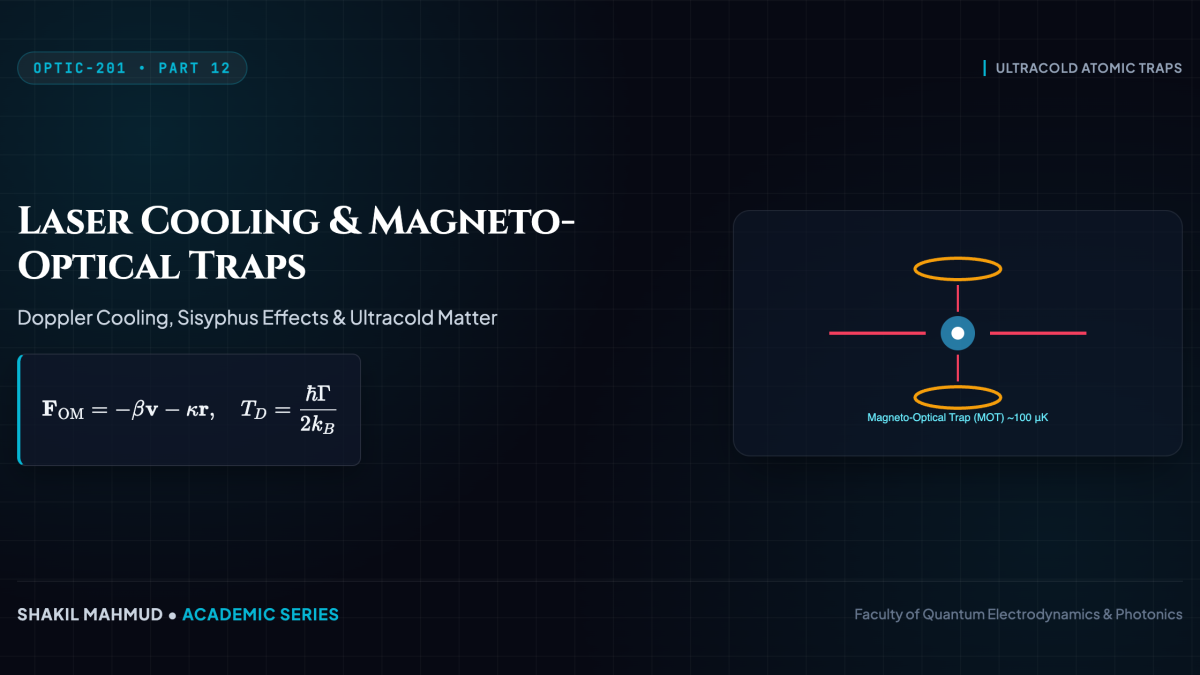
Optical molasses cools atoms but does not trap them spatially (they slowly diffuse outward). To create true spatial confinement, a Magneto-Optical Trap (MOT) introduces a quadrupole magnetic field generated by anti-Helmholtz coils, providing a linear magnetic field gradient (mathbf{B}(z) = b z hat{z}).
By the Zeeman effect, the magnetic sublevels (m_F) shift in energy linearly with distance from the trap center ((Delta E = g_F mu_B m_F B)). The six cooling beams are circularly polarized ((sigma^+, sigma^-)). An atom displaced from the center is Zeeman-shifted into resonance with the laser beam pushing it back toward the zero-field center, creating an effective damped harmonic oscillator potential:
[
F_z = -alpha v_z – kappa z
]
The MOT traps dense atomic clouds of (10^8 ext{–}10^{10}) ultracold atoms at sub-millikelvin temperatures, serving as the universal launching platform for Bose-Einstein condensates, optical atomic clocks, and quantum simulation.