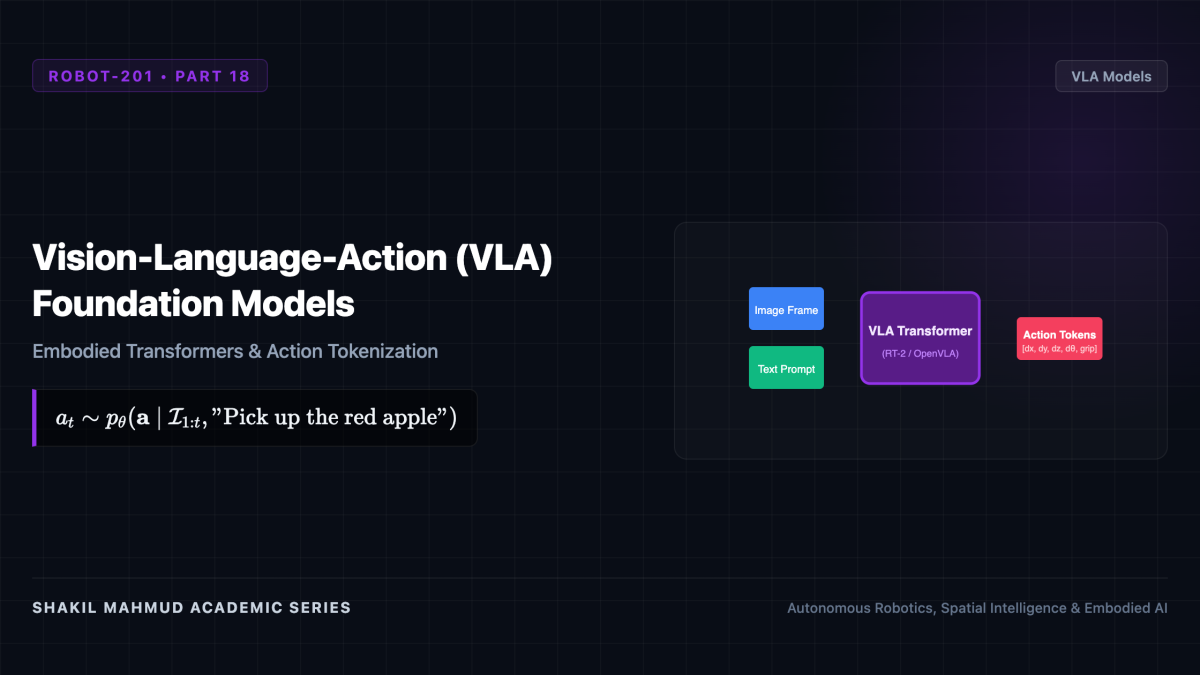
For six decades, robotic intelligence was fractured: computer vision recognized objects, symbolic planners reasoned about goals, and trajectory optimizers generated motor commands in isolated software silos. Vision-Language-Action (VLA) foundation models shatter these boundaries by unifying internet-scale semantic knowledge with low-level physical control inside a single end-to-end multimodal transformer. Treating physical robot actions as tokens within the model’s vocabulary empowers robots to follow open-world natural language instructions and manipulate novel objects zero-shot.
1. The Tokenization of Physical Action
Modern Vision-Language Models (VLMs, such as PaLM-E, Gemini, LLaVA) represent images as visual patches and text as sub-word tokens. The revolutionary insight behind models like Google’s RT-2 (Robotic Transformer 2) and Stanford’s OpenVLA is representing continuous robot action vectors directly as discrete linguistic tokens:
[
a_t = [Delta x, Delta y, Delta z, Delta ext{roll}, Delta ext{pitch}, Delta ext{yaw}, ext{gripper}] in mathbb{R}^7
]
Each continuous action component is uniformly discretized into (256) discrete bins corresponding to reserved token IDs within the language vocabulary:
[
ext{token}_k = ext{clamp}left( leftlfloor rac{a_k – a_{k,min}}{a_{k,max} – a_{k,min}} imes 256
ight
floor, 0, 255
ight)
]
Physical action prediction is thereby reformulated as standard autoregressive next-token language generation:
[
p(a_t mid mathcal{I}_{1:t}, mathcal{T}) = prod_{k=1}^7 p( ext{token}_k mid ext{token}_{<k}, mathcal{I}_{1:t}, mathcal{T})
]
Where (mathcal{I}) is the streaming camera observation and (mathcal{T}) is the natural language command (e.g., “Move the ripe banana away from the plastic bowl”).
2. Transfer of Internet-Scale Semantic Knowledge to Physical Actuation
By co-fine-tuning a 7-to-55 billion parameter vision-language model simultaneously on billions of internet text-image pairs and hundreds of thousands of teleoperated robot demonstration trajectories:
- Semantic Generalization: If instructed to “Pick up the extinct animal”, the model identifies a toy dinosaur—even though no such robot demonstration existed—drawing upon internet pretraining.
- Symbolic Reasoning to Physical Affordances: If commanded “I spilled my coffee, help me”, the model reasons that coffee requires absorption, identifies a sponge or paper towel on the table, and generates the grasping trajectory to wipe the spill.
3. 3D Spatial Scene Graphs and Metric Grounding
2D visual tokens lack explicit 3D spatial depth, occasionally causing spatial hallucination. State-of-the-art spatial intelligence frameworks ground VLA tokens into 3D Spatial Scene Graphs (SSGs):
[
mathcal{G}_{ ext{spatial}} = (mathcal{V}_{ ext{nodes}}, mathcal{E}_{ ext{edges}})
]
Where nodes represent physical objects annotated with 3D oriented bounding boxes, visual feature embeddings, and geometric point clouds; edges represent spatial relations (“inside”, “on top of”, “supported by”). Metric grounding ensures that language commands translate into millimeter-accurate spatial trajectory targets.
4. Diffusion Policies and Flow Matching for High-Frequency Actions
While autoregressive VLA transformers excel at high-level semantic reasoning at (3 ext{–}10 ext{ Hz}), dexterous tool manipulation and contact stabilization require (50 ext{–}100 ext{ Hz}) multi-modal trajectory generation. Modern embodied architectures couple VLA models with Diffusion Policies or Flow Matching:
[
rac{d a}{dt} = v_ heta(a, t mid c_{ ext{VLA}}, o_t)
]
The high-level VLA outputs a conditioning embedding (c_{ ext{VLA}}), and a conditional diffusion network generates continuous, smooth chunks of multi-step action trajectories, capturing expressive multimodal action distributions (e.g., smoothly dodging an obstacle from either the left or the right).